
FourJaw Manufacturing Analytics
Highlights
One signal, not a thousand.
FourJaw abandoned complex, machine-by-machine control-system integrations for a simple current-clamp sensor measuring power draw - a proxy for productivity that installs in minutes on any machine, regardless of age, brand, or type.
Reliability without the network fight.
To simplify installation and avoid reliance on customers’ Wi-Fi infrastructure, FourJaw adopted independent cellular connectivity through Soracom. This removed the need to connect to customer networks and reduced a common source of delays during setup.
From insight to action.
FourJaw pairs sensor data with operator-entered context on shop-floor tablets and a consultative "Productivity Accelerator" review process, turning raw uptime data into a continuous-improvement loop for manufacturers on four continents.
FourJaw Manufacturing Analytics was founded in 2020, spinning out of the Advanced Manufacturing Research Center (AMRC) in the UK. The company builds plug-and-play IoT hardware and a cloud analytics platform that gives manufacturers real-time visibility into machine uptime, downtime causes, and energy use without requiring a capital project to get there.
Its name is a nod to its roots: a four-jaw chuck is the lathe fixture used to hold square or irregular stock, as opposed to the three-jaw chuck used for round material – manufacturing shorthand that grounds the company without boxing it into one narrow use case. Today FourJaw’s customers span aerospace, automotive and biotech companies; building products, food and beverage, textiles, and brewing, with installations across the UK, US, Australia, New Zealand, and Singapore.

The Challenge: Machines Nobody Could See Clearly
Ten million factories are fighting the same daily battle: how to get more output from the constraints they already have: the same team, the same machines, the same floor space. FourJaw CEO Chris Iveson’s experience, echoed by nearly every new customer, is that manufacturers consistently overestimate how productive their machines actually are. It’s common for a factory to assume its equipment is running at roughly 50% of available time, only to discover, once real data arrives, that the true number is closer to 20%.
In the company’s earliest days, FourJaw connected directly into the control systems of CNC lathes and milling machines to extract rich, granular data – reverse-engineering part geometry and building detailed dashboards. While that approach produced some technically impressive results, it created a bit of a commercial bottleneck: every machine’s age, brand, and origin created new installation exceptions. Teams would arrive at a factory and rule out entire lines because a machine was too old, or unique. A long, expensive, specialist install process delivered a mountain of data, yet when FourJaw finally asked customers what they actually wanted from all of it, the answer was simple: “I just want to know when it’s making me money.”
A second, unrelated problem surfaced as FourJaw moved from small manufacturers toward larger customers: connectivity. FourJaw’s hardware initially reached the cloud exclusively over the customer’s own Wi-Fi. As soon as an installation touched a company with more complex (often third-party-managed) IT infrastructure, network reliability became a recurring issue – with no clean way to tell whether a dropped connection was an equipment issue or the customer’s network.
The Solution: One Sensor, Independent Connectivity, a Continuous Improvement Loop
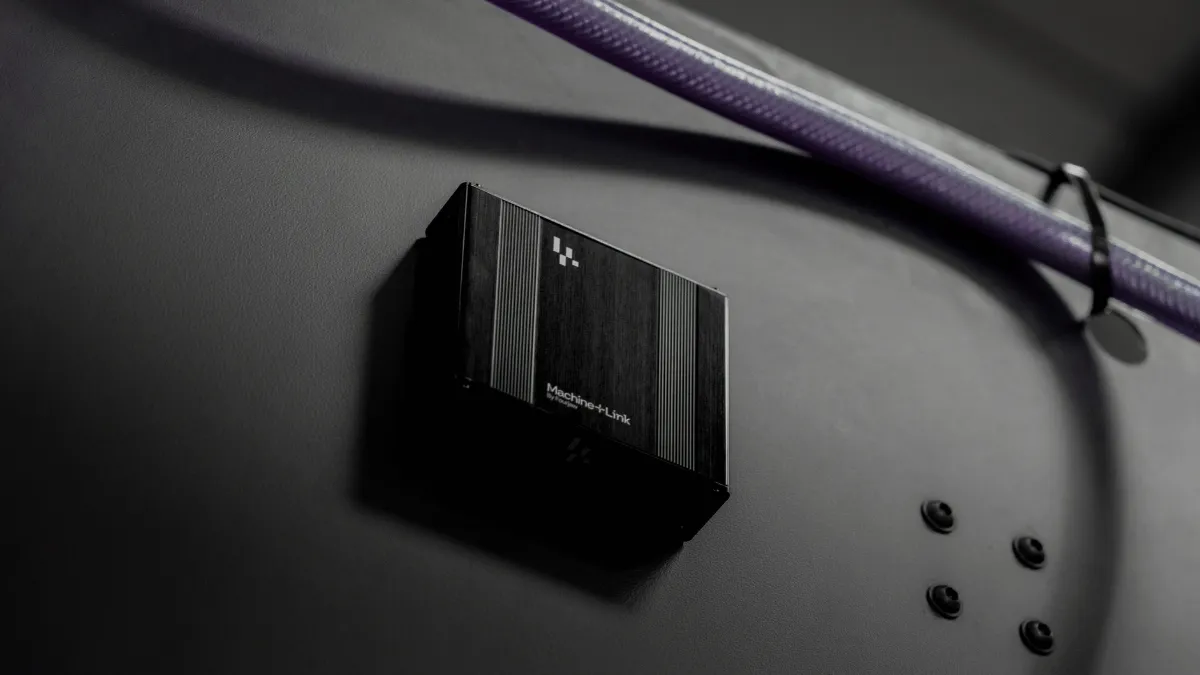
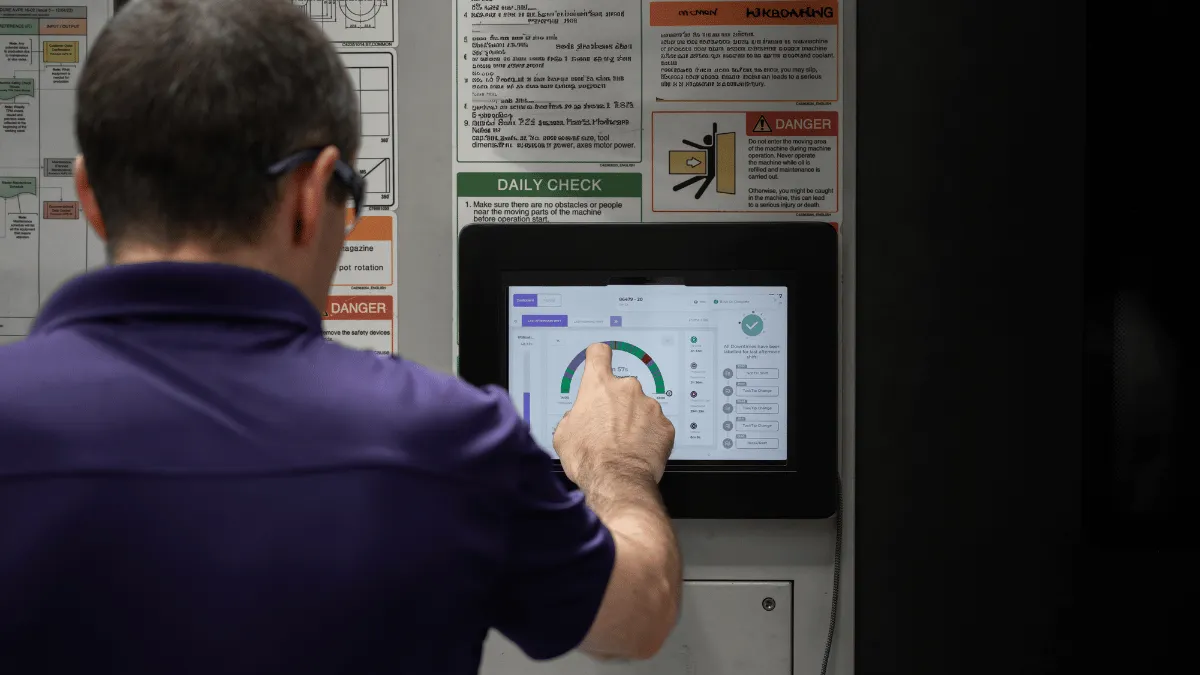
FourJaw’s answer to the first problem came from a deliberate step back. Rather than extracting everything a machine’s control system could offer, FourJaw built its platform around a single measurable signal: power draw. The logic holds for almost any production machine, as it undoubtedly draws more current when it’s actively working than when it’s idle. A current clamp, connected in minutes by the customer’s own maintenance staff, streams that signal continuously to FourJaw’s AWS-hosted platform, where algorithms translate it into uptime and downtime data. A tablet mounted at the machine, used by the operator, supplies the context the sensor alone can’t: the machine doesn’t know why it isn’t running, but an operator can pinpoint whether it’s a missing tool, a late material delivery, or a changeover. FourJaw combines those inputs to turn a raw data signal into actionable data insight. The same architecture scales in both directions: FourJaw prototyped it on an office kettle and now runs it on multimillion-pound CNC machines side by side on the same dashboards.
FourJaw’s answer to the second problem came from a trade show in London, where the team first encountered Soracom. FourJaw began deploying Soracom SIM cards as an independent cellular connectivity layer – bypassing the customer’s network entirely rather than negotiating around it. That single change removed FourJaw from the “whose fault is it” conversation altogether: as soon as a customer reports any connectivity trouble, FourJaw’s response today is simply to ship out a router with a Soracom SIM inside, at no hardware cost to the customer, and the problem resolves. FourJaw also uses remote-reboot capability over the cellular connection to recover a stalled device without a truck roll or site visit. The result is a self-install model that works the same way whether the customer is in Sheffield, Singapore, or Australia; installed by the customer’s own maintenance team, with only remote support needed from FourJaw.
Getting the hardware live is only the first half of the value, in Iveson’s view. FourJaw’s customer success team runs what it calls the Productivity Accelerator: a consultative review, typically after the first 30 days of data, that identifies the single biggest opportunity for improvement, puts a number on what solving it would be worth, and agrees a plan with the customer before checking back in a month later. It’s this loop (sense, understand, act, re-measure) that FourJaw credits with turning first-month sticker shock (i.e. “we’re only running at 20%?”) into sustained productivity gains.
That loop shows up directly in the outcomes FourJaw points to. Iveson cites Lister Windows, a UK manufacturer FourJaw works with, as an example: after acting on the productivity gaps its FourJaw data surfaced, Lister Windows is now producing 250 additional PVC windows every single week. “The outcomes that can be achieved off the back of this are really, really valuable,” Iveson says, noting it’s one of many similar results found by FourJaw customers. “All manufacturers are fighting this productivity battle, and it’s very difficult to actually win that battle if you’ve not got the data to start off with.”
Why Soracom
For FourJaw, Soracom’s value isn’t a feature on a spec sheet – it’s the thing that makes the rest of the product possible at all. “Soracom is a huge pain reliever to us,” Iveson says, “because without Soracom we can’t reliably connect our devices to the cloud. We’ve got thousands of devices out there. All of them need to connect reliably to the cloud, and if they don’t, then we are not providing the value that we need to our customers.” That reliability is what let FourJaw step out of network challenges it was never equipped to referee: independent, carrier-grade cellular connectivity means FourJaw’s hardware no longer depends on (or gets blamed for) a customer’s own Wi-Fi and IT environment. “As soon as you drop a router in with a Soracom SIM in it, it just works,” Iveson says of the fix FourJaw now reaches for by default.
That reliability has scaled globally without FourJaw having to solve local connectivity market-by-market, supporting installations across the UK, US, Australia, New Zealand, and Singapore. And because FourJaw’s own platform is built on AWS, Soracom’s AWS-native architecture – including the option of routing cellular traffic privately to AWS without touching the public internet – lines up with infrastructure FourJaw already runs.
It’s that combination – reliability that scales globally without local integration work, on infrastructure that already matches FourJaw’s own – that took connectivity off FourJaw’s list of problems to solve. As FourJaw’s footprint extends into more industries and more demanding operating environments, that’s a foundation built to grow alongside FourJaw’s own roadmap, not one fixed at “a SIM in a router.”
What’s Next
FourJaw’s next major platform shift moves it from analysis into orchestration: integrating with customers’ ERP systems to pull work orders and push them directly to the same shop-floor tablets that already capture downtime reasons, closing the loop from analyze to plan to act. A new hardware sensor, automating part-count alongside the existing power and uptime monitoring, is also in development.
None of that changes what FourJaw says hasn’t changed since 2020: the value is in the simplicity, and simplicity, done well, is what customers actually adopt. As that roadmap grows the amount and variety of data flowing off the shop floor, the connectivity layer underneath it – the part FourJaw has said it doesn’t have to think about – becomes more important, not less.
FourJaw Manufacturing Analytics – Company Overview

FourJaw turns a single power-draw sensor into real-time productivity data for any factory machine - and uses Soracom's cellular connectivity to keep thousands of those sensors reliably online, everywhere they're installed.




Cloud Native
IoT Connectivity Platform
Soracom built the worlds first cloud-native connectivity management platform, built on AWS. Learn more about going beyond connectivity.