
Home Webinars Let’s Talk IoT Devices: From Prototype to Produc...
Let’s Talk IoT Devices: From Prototype to Production with the Blues Notecard for Soracom
Develop in days, pilot in weeks, scale in months with the Blues Notecard for Soracom.
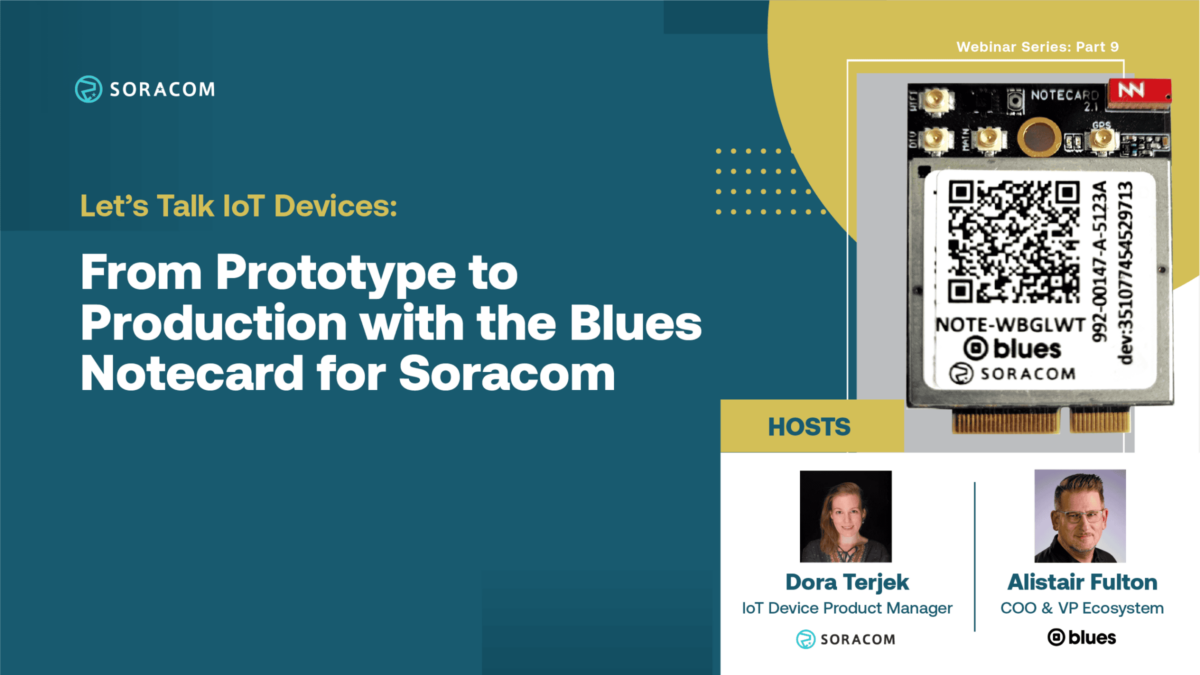
Speakers


Cut your IoT development time in half while slashing costs: Discover how industry leaders are redefining smart device connectivity. Join us for an insightful discussion featuring Alistair Fulton, COO & VP Ecosystem at Blues, and Dora Terjek, IoT Device Product Manager at Soracom.
Learn how these two innovative companies are reshaping the IoT landscape by solving critical device connectivity and cloud integration challenges.
Here’s what we cover in this webinar:
✅ Simplify IoT Hardware Design: Discover how to drastically reduce development time and costs.
✅ Avoid Costly Mistakes: Learn how to make the right connectivity choices and sidestep the hidden expenses of in-house IoT development.
✅ Low-Power, Data-Efficient Solutions: Explore technologies that simplify product development and extend battery life.
✅ Scale Globally with Ease: Leverage Soracom’s multi-carrier connectivity and Blues’ wireless cloud data pump to seamlessly deploy your IoT solution worldwide.
✅ Real-World Use Cases: Get inspired by successful IoT implementations across a range of industries, including environmental monitoring, energy management, AgTech, EV charging, healthcare, micromobility, and refrigeration.
This webinar is a must-watch for anyone looking to streamline the development and deployment of IoT products.
Watch It Now!
This is the ninth episode of our Let’s Talk IoT Devices series, and it’s super nice to have you today. We are going to focus on some super exciting topics today around hardware design and how we can actually reduce development time and costs. We are going to be talking about a new product that we have recently launched together, which is, the Blues Notecard for Soracom. And I really hope we can have some valuable insights to our audience. Alistair, before I ask you to say a few words about yourself, I would like to quickly introduce myself and say a few words about what’s gonna happen in this session. My name is Dora. I’m working as the device product manager within, Soracom. I’m based out of Stockholm, Sweden. It’s afternoon over here, and, I’ve been working within the IoT sphere for over fifteen years now, mainly with connectivity, but also quite a lot with hardware. Maybe a few sentences about Soracom, who is joining us for the first time. We are a full scale MVNO originating from Japan. We are headquartered in Tokyo, but we also have, regional teams within Europe and also within North America. We have our core network, which is rather unusual for for, for an MVNO, and, we based it on AWS. We have over seven million SIM cards all over the world now, and, we are working with a lot of different type of IoT customers starting from startups through SMEs to enterprise customers. And we are, having this session live today. We are going to record it. And if you are watching, you are going to receive the recorded version, after this session, one or two days after. So keep an eye on your mailbox. We are not going to use slides today, or, Alistair, you might be wanting to drop in a few things here and there. But this is going to be more like a friendly chat between the two of us, but we are very excited to receive any type of questions from you. So if you look at the right hand side of your screen, you are going to be able to see the chat function. So feel free to raise anything, and we are either going to pick it up during our discussion, or we are going to have a dedicated section after, the dialogue. I think these are the most important points. Alistair, can you say a few sentences about yourself, please? Sure. I I I also have been in the messy space of of connecting things, probably for the last, well, thirty years or so, if I’m honest, in a variety of different spaces. I’ve I’ve kind of focused throughout really on trying to, really enable developers and customers with the tools that we’ve invented over the course of this time to analyze and understand what’s happening in the physical world and and essentially make better decisions. The I think the core goal of that really is, you know, the true purpose of the IoT, which is aligning economic goals of producing more from less and more efficient production with environmental goals of of actually reducing harm. I currently am COO of Blues, and we’re really focused on the nitty gritty of of connectivity, and and we’ll talk about that. But I my background is is varied. I used to run, Semtech’s IoT division, so semiconductor space. We brought, LoRa to market, to fill, what I saw as a gap in in low power wireless connectivity, for customers, particularly in the industrial space. Power and connectivity are often two things that run, you know, counter counter to each other. I spent a couple of years before that building Hitachi’s Lumada industrial IoT platform. So on the platform side, how do we actually start using in what was the early days of AI and machine learning, how do we start using some of these tools to really drive intelligence into the machines that Hitachi, delivers to customers? And before that, I spent eight years at Microsoft. I I started what became Azure IoT as an incubation project back in two thousand and nine and kinda grew that through the business. And and before that, I spent a bunch of years actually building solutions with customers, so industrial, enterprise level, use some utility stuff, monitoring train tracks, you know, that sort of nasty, gritty, you know, difficult problems. Which honestly is what led me into the platform space to begin with because it was horrible to figure out what to do with the data and then ultimately into the connectivity space because even though there are lots of tools available to use the data, actually just getting the data still to this day remains a real challenge that a lot of customers struggle with. Indeed. And, as I understand, the vision of Blues is basically to transform every physical product into an intelligent service. Right? To send data from point a to point b. Yeah. We focus on one very simple problem, which is exactly that, Dora. You know, we when I look at the IoT, we have not made it easy as an industry for customers to adopt these technologies despite, you know, I think what has been good intent, because of variety and because of differentiation, which which, you know, is often cast as a good word. But when it comes to things that you as a customer are trying to put together and make work together, differentiation has been one of the things that has really hindered adoption of the IoT. And I think for a lot of customers these days, they kind of look at the the mess of of options that are available, you know, ten, fifteen different types of connectivity that they could use. Yeah. Five hundred plus different IoT platforms that are out there. It’s a very, very confusing space. And so what Blues is focused on is one problem that is universal, and that is how do I make this machine or this sensor or this device intelligent? How do I give it connectivity? And we’ve really focused on getting data from A to B. We get the data from the device, we deliver it to the cloud of your choice, and and so in that context, partnership, and this, you know, is why we’re working with Soracom, partnership to me is is as intrinsic to the IoT as the very concept of connecting devices. Because if we’re going to do our jobs, but, you know, for customers well, it’s going to be through working together and making sure that everything that we do is interoperable and can be integrated without customers facing this massive integration tax or worse, being locked into a single supplier. And so partnership within the context of what Blues is doing is really a critical part of our business, and and it’s an area that that I joined the company really to kinda drive. We have, you know, a product that is incredibly easy to use, which I which I think is the start point for everything. Mhmm. We have a we have an enterprise sales team that that works directly with large scale customers. Yeah. But our main go to market is through partners. Brilliant. Do you want to tell us a little bit about what type of partners you are working with? Yeah. We work across the range. I mean, really, when it comes down to it, I see what Blues does as an enabler for companies, you know, offering services in this space. Now sometimes that’s systems integrator type services. I’ll come and build it for you, mister customer. I’ll put it together. I’ll integrate the best in class tools that I select. Sometimes they’re solution providers, and and you could argue there’s not a lot of difference sometimes. A solution provider is is doing what a systems integrator does, but doing it on a replicable basis. They do it for a number of different customers, and they package the product. We also work with hardware design companies. We work with hardware manufacturing companies. We, of course, work with with cloud platform companies and platform companies like Soracom. You know, there are there are a lot of companies, you know, offering parts of the jigsaw, and pretty much Blues is an enabler for for every single one. So while our customers range from, you know, global scale enterprises down to, you know, midsize companies, our partners similarly scale from from global scale, operators down to more specialized companies. In the IoT, you get a lot of and when I say IoT, I’m pretty much exclusively referring to industrial IoT. You get a lot of companies that have really deep specialized knowledge and understanding of the sector, say, oil extraction. And they work with the base of customers in that market. They know what to do with the data. They have a a broad experience in delivering value to customers, but what they’re struggling with is connecting the next device. And that’s that’s really where Blues comes in. And it’s I mean, you’re probably surprised to hear me say hardware companies because, you know, if you go to most hardware companies and say, hey. You know, I need to design device X. They may start you with the chip down design. They may say, oh, great. You know, I I can build a custom solution just for you. And the problem that that that has created over the years is custom equals cost, custom equals risk, and custom equals challenges in optimizing for low power. So a lot of the hardware companies that we work with, they use the Blues module, and it’s a we sell a hardware module and a cloud client in the back end where the data lands and routes to your cloud. They take the Blues module, and they use it to accelerate their own development processes. Even though they can do chip down design, they use Blues because it means that they can deliver POCs. We’ve had customers deliver POCs in two or three days. They can deliver a POC pretty much immediately, and they can move very quickly into production. And that means they can deliver more value ultimately to their customer. Exactly. Yeah. Because if you care about time to market and and time to revenue, and, of course, you wanna focus on your core business instead of trying to build your own little device. So note card definitely has a lot of value on this market. Can you tell us a little bit about, the typical customer journey that what’s looking that like at this? We, I mean, we tend to see customers fall into and I’ll talk about end customers. Our partners, you know, our job our job is to enable our partners to be successful, period. That that’s what we do. But our our partners service a very broad range of customers. There are companies that are, you know, what I’d call transformers. You know, they’re they’re taking an existing, business model, an existing product, and they’re trying to transform what they’re offering by connecting that device, by making it intelligent. And those sorts of companies, you know, they tend to they can range from being manufacturing company. They they generally make something. They make a device, a machine, refrigeration unit, battery, you know. And and so they’re taking Blues. They’re adding connectivity to their device, and then they’re able to go into market and offer their customers incremental value. And those that that that can be very, I’ll say, very disruptive in some instances. But a lot of the time, it’s really more about more customer value, being able to compete. And and as you said, time to market in those sorts of situations is absolutely critical, particularly if you have competition that is coming in from the left field and and offering a connected product as is often the case in most, most manufacturing market. Yeah. And then we have more kind of innovative companies that have come up with a novel and new idea who who, you know the thing that they they know is is what to do with the data. I mean, we work with a number of companies in the environmental space, and they’re building solutions that do everything from monitoring ocean currents and temperature to predict more accurately, more efficient shipping routes, which has a significant reduction on, on the fuel consumption. And then things like water quality and so forth. And those guys, they know what to do with the data. They very often are not experienced in the in the embedded space. They may be experienced in the sensor space, but that connectivity part, that’s the thing that really trips them up. And and, you know, going back to the day when I used to actually build, you know, end to end solutions, the assumption that those folks will often make is that, well, connected is easy. I mean, it must be. If you if you take a quick look out there, there’s networks everywhere. You know, there’s lots of providers. Everyone’s telling me it’s simple. It must be simple. I’ll just focus on building the application and maybe some of the hardware, and then they run into this brick wall of connectivity. For transformers, it’s often to transform a type customers, it’s it’s often the same. They’re really, really good at making industrial refrigeration. You know, they’re that’s that’s their core, And they tend to think that connectivity is simple, and then they run into that brick wall. And you see both types of customers spending at what is on average an eighteen to twenty four month cycle going through initial iterations of hardware design, figuring out that it doesn’t work, and then going back to the drawing board and starting again and testing and then having to take those designs through testing, through FCC, and through and then having to figure out, well, jeez, you know, which which MV and L am I getting? I’ll I’ll get it. I’ll I’ll use your card. I’ll take the SIM. I’ll put that in. I’ll test that for it. Then I have to figure out how to manufacture the device. Then I have to figure and often, those customers just give up. It it it becomes such an expense and such a distraction that they think, well, I’m I’m gonna I’m just gonna spend my time doing something else. Yeah. With Blues, what those customers tend to do is shorten that timeline from a couple of years, ideally, down to, like, three to six months. And the main the main driver of that timeline is more the internal transformation they’re doing within their business or other kind of deployment issues. We’ve managed to take the connectivity, you know, conundrum, if you like, off the table. It it’s no longer a blocker for them. And that’s incredible to see. To see when customers say, really? You you this I I built this POC that actually worked first time, and and that’s that’s kind of the intended goal. We get that quite a lot from customers, actually. It’s really good that you also mentioned a few use cases where Notecard and its deployment has been successful. When it comes to greenfield versus brownfield applications, Would you say that one of them is more suitable than the other for the Blue Note card? It it depends. I mean, I think Blues Notecard really fits into the proper kind of problem set I described, which is I want to connect this device. It hasn’t been connected before. I need to figure out how to do that. Now innovator transformer to a degree, greenfield, brownfield, it doesn’t doesn’t map exactly and they differ, which is why we kinda tend to look at them as separate groups. Greenfield I paused because of this. Brownfield, the business case is proven. And when I say Brownfield, I don’t mean a device that’s already connected. I mean an environment where some devices are connected, an existing factory, you know, existing production units, etcetera. Those those use cases are often driven either by regulation. I have to do this, otherwise, I’m gonna get fined business, or they’re driven by competition. And so the impetus to get the thing figured out and get it done quickly is very strong, and they tend to move really quite quickly. Innovators at greenfield sites often have a lot more things to figure out. But from a Blue’s perspective, our ideal point is before you finalize your first hardware design. Now we work with customers who are already in the second and third iteration of their hardware, and they’re desperate to throw it away and start again. But our ideal point is, I’ve got this great idea. I’ve got a business that that needs this. I’ve got a customer that’s ready for it. I know how to make everything else. The connectivity part is what I don’t want to spend time on. And, you know, I don’t want to build a customer solution because that means I have to manage it. I don’t want to have to figure out how to optimize for low power and design my own card because that’s actually surprisingly hard. I don’t want to have to worry about, did I get the security model right? You know, am I am I creating a backdoor into my network that’s that’s gonna create some huge problem? And then, of course, the business side of it, which is the simplicity of working with a partner like Soracom that can provide access to the world. And that part, again, is is a hurdle that once people have been through their hardware design, they said, well, obviously, there’s networks everywhere. Then figuring out which network. And very importantly for industrial customers, where you’re talking about fifteen, twenty year life expectancies, cellular networks in particular don’t run for twenty years in in most instances. And so these customers need to have a hardware solution that enables them to change the radio without having incurring any cost. And with Blue, you know, one of our initial design principles was you need to be able to take one Blue’s note card out of your product, that maybe runs CAT one, and you need to be able to put in another card that runs NB-IoT, say, with no code change, with no need to retest Mhmm. And no need to do anything to to the security model. It’s plug and play and it just works. And that kind of insurance model is really important, really for both types of customers. But, yeah, we that’s where we tend to come in. Where customers have, like I said, got their hardware solution established, you’d be surprised at the number of customers who say, I’ve worked out it’s costing me a million dollars a year to have this custom hardware solution because I have to employ a team of five people to maintain it, and I had to, you know, please spare me this. So we do get quite a bit of that as well, but greenfield is often, cleaner a cleaner path. Yeah. And what we also see from Soracom is that many, many people underestimate the the complexity of of software integration when it comes to a brownfield application, for instance. And they don’t they are not thinking about the long term maintenance or the security aspects or the interoperability pieces. And, that’s why it is very interesting to hear that Blues figured it out, and you made it into something very developer friendly. Yeah. It’s and it’s I’ve I’ve known, I’ve known Ray for a number of years, since my days at Microsoft. Ray Ozzy, he’s our CEO. He’s Your CEO. Yes. And he he really set out down this path about six years ago. And, honestly, to as someone who perhaps may be a little bit jaded by being in the industry for a long time, the dream that Blue set out to deliver, you know, I I honestly thought at the time was was a bit dreaming. I mean, to actually be able to design something that is both, extraordinarily efficient in power terms and takes all of the radio and abstracts it behind the JSON API, so that I you know, we talk a lot these days about cloud first developers. Now the reality is that most developers are cloud first, which means there there is an expectation of flexibility and a flex expectation of security, inherent security, and there’s an expectation that the data just kinda turns up. And these developers don’t have the skill set necessary to get down into the messy world of c or c plus plus They’re operating in Python, JSON, you know, PHP, Ruby, or it it it’s that world in which we’re talking about. And so taking all of the complexity of the radio and sticking it behind the JSON API seemed to me incredible at the time. But that’s what the company has done. We spent the first three years of life really grinding away at that problem, to deliver a solution that not only solves the problem, but critically is also scalable. Because there have been companies that have got very close to solving the hardware problem, but the difficulty is that that that what they sell you is a hundred dollars per unit. And when you’re talking about a a piece of earth moving equipment, maybe hundred dollars is not a big deal. But the majority of the industrial IoT, particularly the wireless industrial IoT, deals with marginal, value. So it is marginally valuable for me to connect a pallet, but it’s not worth a hundred dollars. The value I I get from my solution is that I’ve connected a hundred thousand pallets, and I can see where all of them are within the network. But the incremental value or the marginal value of connecting each one needs to be low, and so those those companies failed. What Blues has done is offer both an extraordinary cost effective kind of starter point in the note card, but also in a product called note card XP that we introduced recently, a path to production, which essentially is the ability to redesign your board, take it and tone it down to exactly the components and capabilities that you need Mhmm. And manage your bond cost so that you can still, if you like, afford to connect that pallet or that battery or that vehicle or that lighting unit or that HVAC unit or you know? And that really in industriality is where, again, the industry as a whole, and I, you know, include myself in this, has failed up until now to to to couple both simple and scalable. You can do simple or you can do scalable. But often, putting those two words together is very difficult, and that’s what Blue’s has set out to do and I believe has has delivered. Superb. Let me go back a little bit to the connectivity topic. How how do you think companies can can secure that they make the right connectivity choices? We talked about you having quite some experience with LoRa, for instance. All Notecards are cellular enabled. How would you say a customer chooses the right connectivity upfront, and how can Blue’s help customers with this? That’s a great question. I mean, and I think that that when you ask customers, and I think there’s been a as an industry, we have not spent enough time actually sitting down with industrial customers and saying, what is it that you really want? You know, what how do you want this development process to work? How do you want this value to be delivered? You know, what do you need this to be? Because very often, those customers will say, well, I don’t want to choose. I don’t actually want to make a choice that is is deterministic and and unidirectional. Because in the past, you know, it was like Russian roulette. I mean, you had to kinda sit there and think, well, if I’m gonna design single SKU, well, firstly, if I’m a global company, I can’t do that Mhmm. Because I’m gonna have to mod I’m gonna have to, you know, adapt to different network topologies. Now LTE and and the emergence of LTE’s replacement to three g helped solve quite a lot of that, so there’s more interoperability. But still, I had to sit down and think, well, is the device going to be inside a building? Is it gonna be under ten feet of concrete? Is it gonna be moving at such a speed that cell hand off’s gonna be an issue? Is it going to need low power? Is it gonna need a lot of data? Is it gonna need a but all of those questions, you know, faced with a choice of of either making twenty SKUs to provide a you know, if you walked into a building where there’s a thick concrete wall, you pick this one out of your bag. It was an incredibly complex thing for people for customers to figure out. When you layer on top of that the risk of network sunset, which has you know, I still talk to customers today who were impacted by the two g network sunset in the US and are angry, you know, still about the cost that they incurred as a result. Customers don’t really want to make a choice that that that comes with a tax if they’re wrong. And and for Blues, that means our job is to make that choice largely cost free. So if you get if you get it wrong, that you should you don’t have to rewrite your code. You don’t have to redesign your device. If you started out, say, with Wi Fi only, yeah, sure. That might be a good solution. Cellular in general is the better solution if you can abstract away from complexity and protect against network sunset. But the real answer to your question, Dora, is I don’t think customers want to make a a choice. I think they want to have flexibility. I think they want to be able to pick the best connectivity for any given, you know, environment. As you say, we tend to focus on cellular, but cellular plus. So cellular with Wi Fi, cellular with Bluetooth, soon cellular with LoRa, cellular with satellite, LoRa with satellite. You know, those sorts of combinations are ones that that customers need, but they want to be able to make that choice without some huge risk attached to it. Superb. Thank you. Yeah. They definitely need that long term security. Yeah. Superb. So tell me about I mean, we’re working together as you said. We we worked we announced quite recently a a tie up between, Blues and Soracom. We’ve we’ve worked with you to produce a a Blues note card that’s specifically, you know, provisioned for the Soracom network. You know, honestly, one of the one of the things that attracted us to Soracom is the speed with which you are able to identify and deliver against customer need. You know, you quite often start with a developer’s perspective, which I think is very important. Yeah. But you somehow managed to figure out how to really, you know, deliver very significant incremental value. I mean, you described yourself as an MVNO at the outset, which I think is underselling what you’re doing quite a lot. There are quite a lot of MVNOs, and they do a very nice job of of providing a a single SIM that works across multiple networks. But Soracom does a whole lot more. So do you wanna talk talk about that a little bit? Yeah. Absolutely. And thank you for, for asking about Soracom itself. So for many, many customers, we are an MVNO. We provide connectivity, and we do have a connectivity platform where you can manage and monitor your SIM cards. But on top of the connectivity, we have a hellish amount of crazy good value added services where you can see the data that you are collecting. And very recently, we actually launched two Gen AI related new services. And you can just query that data, that you are storing, for instance, in the Soracom Harvest area and pull out and analyze the data. That service is actually called Soracom Curie, just to make some advertisement to that. And we also come up with a, a pro a product that’s called, Soracom Flux, that is also moving towards the Gen AI area. That is more like an application builder. So, basically, you can automate different areas. You can capture, for instance, images. And then with the help of Soracom Flux, you can translate those images to various forms, send the data, and then analyze what is being received on that end. So, yeah, we really try to be more than an MVNO. We have all the additional layers on top of connectivity. We are cloud agnostic. We are also very often technology agnostic. We are not only sticking with cellular even though that’s our main profile, but we are looking into satellite. We also have some LoRa deployments, And, we are very, very excited about this collaboration on the Notecard. And maybe this is the moment where I’m gonna do a bit of self advertisement and just copy a link that’s gonna lead the audience to the Blue’s note card that was developed for Soracom that actually has our embedded SIM card. It is a global SIM card that provides connectivity in over a hundred and sixty countries. And if someone is interested in talking about it, feel free to to reach out to us. Yeah. And that that I think the goal with with that really is that you actually get to access all the Soracom platform offers, and I still think you’re underselling yourself. But, that that you can get access all of the Soracom platform offers just by plugging the card into an m two connector on your device. Yeah. That that that it it it comes pre provisioned, and I think both both of us, ourselves, and Soracom are really focused on getting to the value really quickly. I mean, you mentioned, the Gen AI services that you launched. I was at the event back in in in, earlier in the year in Tokyo. Those those services are really tailored, I think, to what industrial customers are trying to do. You see a lot of the the AI is a very interesting topic for a lot of folks at the moment. It’s not a new one. You know, these techniques have been around for a while, but we’ve seen a very rapid acceleration. And I think uniquely, a a a a a set of developments that have have been experienced directly by people in their everyday life. ChatGPT Yeah. Has kind of brought an experience that is AI based to, you know, your grandma. And and so there’s a very pervasive perception of AI as transformative. I think for a lot of industrial and enterprise customers, there’s the danger of layering on more more choice. You know? Oh my god. There’s more tools. And so it’s really important for us as an industry to package AI and machine learning, and customers don’t really care the difference, honestly, into services which they can actually utilize. That that you don’t need to have a PhD in data science in order to be able to take that tool and do something amazing because, actually, what you want to do may be not that amazing. You may just want to recognize is someone trying to break into my building. You may just want to be able to query with some intelligence rather than writing fifty queries in SQL. Exactly. Query a database and say, tell me the answer. How has this changed over time? And so I think it’s incredibly important. AI stands to be a really big driver, I think, of interest in in in collectively what we do, which is called the IoT, getting data, putting it somewhere, allowing you to analyze it. It it stands to drive a great increase in interest, but I worry that without folks really understanding what customers want and and try to give it to them, we will, in a year’s time, if we’re not already, be in this huge trough of disillusionment where everyone says, well, I I didn’t really do the thing. You know, it will have changed the way in which we interact with chatbots. It will have changed the way that we customer service works. It would it would have changed a lot of consumer focused things. Yes. But the core of industry where the dirt and c o two emissions are produced, you know, as a unintended byproduct of trying to do the right thing. The core of industry will not adopt those tools, and therefore, we will not get the benefit. And I think that’s that worries me a lot. So companies like Soracom that really, I think, are tailoring and packaging and saying, it’s not the universe of AI. It solves this set of problems for you is incredibly important. Yeah. And they try to be, positive and hopeful that with the help of AI, we are also gonna come across more and more additional use cases that will open up the door for for IoT no matter the connectivity type. Well, I think very often once you’ve solved the first problem a customer has, then they start to see more opportunities. And I think often that first problem of basic connectivity, maybe for a regulatory reason, if you’re trying to monitor food quality in a in a cold chain or you know, once they’ve once they’ve solved the immediate pain point, if you can provide them with easy to use easy to use tools that don’t lock them in, that don’t you know, then there’s lots of other things that they quite quickly come to. But it’s that first problem that often goes unsolved, and as a result, customers end up just they end up struggling. And it and and it’s I mean, it sometimes it feels a little bit like in this industry being a bit of a counselor because the number of customers that at least I talk to who they’ll tell you horror stories about what they’ve been through over the last, you know, five, ten years trying to build and maintain a connected device Right. Solution. And and, you know, they they and they’ve still done it. You know, they’ve still soldiered on through. Talking about, you know, Brownfield earlier, you find a lot of customers who who say, well, you know, I had to do this. You know, my competitor did it or the regulator required it. But goodness, you know, it’s to be nothing but a drain. If we can be free of that, then we can spend all that resource on doing something with the data rather than just trying to get the data. We can actually spend Agree. Money in those times on doing something that’s valuable, not just a cost. Out of curiosity, and we are slowly slowly coming to to an end, do you have, Alastair, a favorite IoT use case? Oh god. I mean, there are so many. It’s it’s, one of my I’ve got to say one of my favorites at the moment is a solution that one of our customers is building. And it they are, they provide, the the vehicle batteries. They’re one of the largest providers of vehicle batteries in the world. What they’re doing is they I think they started out with a vision of being able to connect, batteries and then, you know, provide additional services around it. And I think that very off very quickly kind of morphed into a thought of well, if you have the stature about how battery is behaving on a commercial vehicle, you have up to six batteries Powering the HVAC, you know, the the the chiller unit on the back, powering the start, powering it, the cab, powering the if you have all of that information about what those batteries are doing, what could you do with that information? And very quickly, that’s led them into thinking, well, we can optimize the life of that battery, but we can also optimize the usage of that vehicle because we can tell whether the battery if the vehicle is sitting idling, and we can provide advice on, you know, when not to do that. So it’s the it’s it you see that sort of thought process, you know, ignited by by, you know, thinking about, well, what if I connected my product? There are one of my perennial favorites has has always been, rhinos in in, West Africa, with holes drilled in their horns and small sensors inserted in those horns that come with the LoRa radio. Fantastic. Yeah. Data is used actually to it’s an AI based model. It’s used to determine when the rhino is being poached, because the behavior of the rhino, the movement Yeah. You can analyze and actually build a predictive model that says, given the behavior of this rhino, is it being chased? And you can send game warden to to do it. And the third, I would say, is the one I mentioned earlier about, ocean buoys. That simple kind of concept of, well, if you knew the current and and you knew the water if you knew the condition of the sea and you were able to model that on a global basis, you could reduce the fuel consumption that is inevitably going to take place as freight has moved globally on on huge, great big containerships, you can reduce that by ten, fifteen, twenty percent. I mean, that that in itself, the enormity of that impact is incredible. The actual solution itself, I won’t say simple because it’s not super simple. But but, actually, the core concept really is quite simple. If I can tell how the buoy is moving, I can tell the ocean current. If I can tell get the temperature of the water, I can start building a granular model of sea conditions. Now all of that’s enabled by connectivity because if you can the concept’s great, you know, but actually connecting a buoy in a in a reliable way without, you know, costing an absolute fortune is really quite challenging. But honestly, Dora, I mean, like, you see I see every single one of our other customers, they make portable toilets, you know, and and and, you know, their main competitor, produced a portable toilet, and so they have to, you know, they have to catch up. Their their their company, their their, private manufacturing business, they’re based in North America. They know really well how to make toilets. I don’t know who knows how to make a portable toilet, but the value in being able to tell their customers and to manage the fleet to tell when someone’s tipped over to I mean, it sounds really basic, but if you don’t have a portable toilet that’s functioning on a worksite in in America Yeah. How to have workers. You’re not allowed to have workers working. To shut down the whole area. Yeah. But I could I could carry on for hours. I mean, I come you come across every single day. I come across two or three things where I go, holy crap. That is really cool. I mean, wow. The fact that someone actually thought of doing, you know, a b c, you know, I can I can do this? It’s amazing. And I think it really shows what happens if you if you give developers and I’ve always believed this. If you give developers simple tools that do the job well enough and that are easy to use, what they will do is I I agree. And we definitely need to have them on our side. Yeah. Well, I think we we need to be on their side. That’s the thing. As an industry, we need to be on their side. Yes. And and, you know, I think I’ll I’ll I’ll I’m not talking about Soracom, certainly not about Blues. You know, there have been a there’s been a bunch of things that have happened in this industry over the years that you think, did you actually ask anyone who has to work with these tools what this would do to their lives? I mean, did you actually think about that? And there’s been quite a few of those head scratchers. Fewer now. Much, much, much fewer now than there were maybe ten years ago. I think that’s a very, very good closing line. Let’s see if we receive any questions, any incoming questions. Let’s wait one or two more minutes. Yeah. I’m always hopeful we get some difficult questions. They’re like good good hard questions. Marcus is asking, what are some of the hidden expenses of in house IoT development that people often overlook? It’s a very good one. That is that is an excellent question. I mean, I think simple answer would be all of them. But, you know, the hidden expenses often are it’s very easy if you’re starting down this path as a developer to to go on Google and you search for solutions, etcetera. You’ll find very quickly a a range of options on the hardware front, all of which will tell you that they’re simple to use. You know? All of which will tell you, you know, I’ll say with the exception of Blue certainly and and others, that they solve the entirety of the problem and all you need to do is use them. And and I think the hidden expenses, you know, once you click that link and you go down that path and you start investing time, you’re kind of on this road of you’re soon enough, you’re learning custom AT commands and then you’re coming to go so so it’s it’s the the unappreciated impact of lock in, I’d say, is a significant hidden expense. There are some obvious ones like, you know, testing and certification. Often, yes. Everything needs to be certified. Compliance. Yeah. Which if you don’t know how to do I mean, even in where you’ve got a strong relationship with the testing house like we do and I’m sure you do, and you know how the system works and you kind of can really work work well within it, it it can be challenging. If you if you’re new to it, it it it can be incredibly daunting. And it can add six months, nine months to your your development cycle if you’re lucky. Because if you fail test and you don’t haven’t anticipated, you know, where the issues might be, you can be in multiple cycles of hardware redesign. Yeah. And every single time they press that button, you’re flushing you’re flushing everything you’ve done. And for a lot of customers, these are these are they run into million dollar, impacts. To get a working piece of of hardware that’s relative you know, let’s say, a relatively complex device, to get that up and running, can cost, you know, a very significant amount of money and everything it could be, you know, a million bucks to get to the point where you’ve got production ready, hardware. Every single time you have to redesign, you hit the flash button and you start over again. So those costs are incredibly high. I think the other cost is network cost, honestly. I think that’s where Soracom comes in. That that, you know, have being able to to look at Soracom’s rate card and say, well, I not actually know how you know, how much this is gonna cost me. I can predict with accuracy how much this is gonna cost me over the lifetime of the device. That’s not always been the case. Even even, you know, with when MVNOs started coming into being a few years ago. And it’s it it sometimes, particularly when you’re dealing with edge cases where, say, in the oil and gas industry, ninety percent of my, machinery might be within reach of a cellular network. Mhmm. If it’s not in reach for cellular network, it might be in reach for LoRaWAN network. But what do I do about the ten percent that requires satellite connectivity? And that can be enormously expensive. So it it’s it’s being able to start at the outset and see the product the the development process and to be able to predict at each stage to answer the question. You know, that’s what developers have to be able to do to avoid, you know, those hidden expenses because those hidden expenses can be really significant. Very, very good. Thank you, Alastair. You got a thumbs up. Next question. Well, I we talk about security as well, but that’s, you know, that’s a hidden anyone anymore. You know, if you, if you get through the hurdles and actually produce a piece of hardware, but you messed up the security model, You know, that’s that’s that’s your name and face on the front page, you know, sadly in some instances, and that’s something that often, you know, impacts customers very significantly. Yeah. Next. Any other questions? No more questions. I think with that, I say a very, very big thank you to you, Alister, for today. Likewise. Likewise. I very much enjoyed. Thank you everyone for staying with us. Enjoy the rest of your days, and take care everyone.

Cloud Native
IoT Connectivity Platform
Soracom built the worlds first cloud-native connectivity management platform, built on AWS. Learn more about going beyond connectivity.