
Home Webinars Let’s Talk IoT Devices: USB Cellular Modems
Let’s Talk IoT Devices: USB Cellular Modems
Whether you’re retrofitting existing M2M applications or seeking reliable backhaul connectivity solutions, this webinar is your gateway to USB cellular connectivity for IoT.
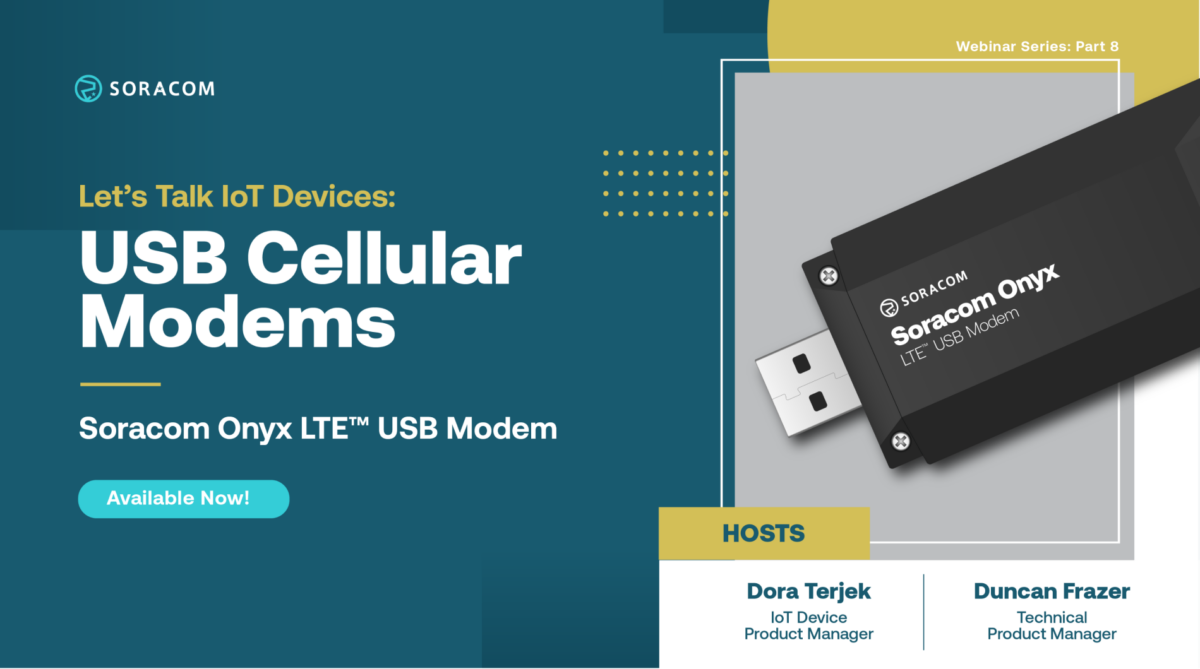
Speakers


In the rapidly evolving landscape of the Internet of Things (IoT) and Machine-to-Machine (M2M) devices, understanding the vast array of cellular connectivity options available to enhance your deployments is important. This webinar is your gateway to USB cellular connectivity for IoT, designed to reduce complex manufacturing choices and streamline cellular technology integration.
What You’ll Discover:
- How Pre-built Hardware Impacts Deployments: Explore the intricate world of pre-certified vs. end-device certified modules, and how your choice can shape the success of your IoT projects.
- How USB Integration Works: Unpack the nuances of adding cellular connectivity over USB to existing hardware, a game-changer for seamless and scalable IoT deployments.
- Real-World Applications: Learn through practical examples, from retrofitting existing M2M setups to enhancing your projects with robust backhaul connectivity.
This webinar is more than just a discussion—it’s a tailored experience for those considering the Onyx – LTE™ USB Modem. Empowering you with the knowledge and insights needed to navigate the choices you’ll make and how the Soracom Onyx stacks up. Whether you’re aiming to upgrade your current M2M applications or seeking reliable backhaul connectivity solutions, this session is your stepping stone to informed decisions and future-ready implementations.
Watch now!
Join us for an enlightening journey into the heart of IoT and M2M communications. Equip yourself with the expertise to make your IoT solutions not just connected, but smartly integrated and future-focused.
Today’s webinar is part eight in our webinar series about hardware. And today, we’re going to be looking at USB cellular modems and the role that they can play with, IoT development and deployment scale. Should probably introduce ourselves and say hello to everybody. Let’s do that. My name is Dora, and I’m working as a device product manager within Soracom. I joined almost two years ago, and I’ve been working within the IoT field mainly dealing with, connectivity and product managing connectivity. In the past ten to twelve years. And based out of Stockholm, Sweden. Can I please speak to you? So I’m a technical product manager here at Soracom. I’ve also been at Soracom for about two years I have, I dare not count it up, ten, fifteen years’ worth of experience working with different companies providing different types of IoT connectivity and and device management or connectivity management services. I’m in the UK, and my main role is looking at some of the the the systems that we use to, provide the underlying services that we provide our connectivity platform. We can touch on what those are as we go later on into the call. Just a quick note then, to let everybody know that we are recording this, and we’ll be sending it a link to everybody who’s registered, either if you could join us now or if you have to come back and watch it later on. So yeah, do watch out for that link in case you want to watch back. In demo, the platform we use for our webinar, there’s a chat panel I can see a couple of messages up there already. Do make sure that you ask questions in there. We’ll we’ll pick questions up later on, and we have a section at the end of the webinar for questions and answers. So we’ll run a Q and A, at the end. Feel free to post your questions during the session. Most probably we’re gonna get back to them during the q and a. And let’s look at our agenda. Yeah. I mean, it’s great to to have slots to to look at cellular modems. We use them a lot at Soracom they they they’re helpful to, customers who may be doing a proof of concept in early phase or starting to understand what they can do with IOT connectivity and the Soracom Onyx one specifically. It can it can be great as a as a way of jump starting, first steps in cellular or first steps in migrating a particular topic that needs a problem solved where there’s value to add with IoT. So in this session, we’re gonna split in into two, sections. So, Dora, you want to, you’ve you’ve got some some topics on actual the topic of cellular modem, first of all. Yeah, we’re gonna look at, cellular modems or IoT dongles as we very often refer to them, in general. And then, step by step, we’re gonna zoom into our own product that we call Soracom Onyx, which is a 4G dongle. And we’re gonna look at, the technical features and the specifications and also some use cases that we see constantly popping up from from our own customers. And what we would like to to look at during the second part of the presentation is how we structure our actual offering how we bring into the connectivity piece to the actual hardware. So we’re gonna be looking at North America and separately also europe because we have two different offerings for these two regions. And, we’re gonna be showing you, purchasing options. And, towards the end of of the session, we are going to have the Q and A that we were referring to earlier. Shall we start? Yes. Let let’s do that. Why don’t you, run through what you think of when you’re when you’re talking about cellular modems? Yeah. Yeah. So we all know that we live in an increasingly connected world, and we are surrounded by by IoT devices. And an IoT dongle is actually to basically allow us to to connect to any device with a USB port. That’s what it all goes down to. This device can be a laptop. It can be a Raspberry Pi. It can be, a single board computer. And these dongles very often use, these devices as as their brain. And, these IoT, dongles should be much simpler but still give much more to the users than, for instance, a mobile broadband, dongle. And what we’re seeing as trending these days is some of the dongles come, with regional skills, with regional, units. That means that you need a special one to deploy for Europe, another one for the Americas, the third one for Asia Pacific, but there are some that come with global bands. And in that case, you don’t really need to worry about, your supply chain and you can you can just deploy the the global version no matter where you you require connectivity. These dongles have a same slot and very often it depends whether it’s an embedded SIM card that they are running on or if it’s, nano SIM, the 4FF form factor SIM card or maybe a micro-SIM. Some of them still have the larger mini form factor And, what also makes this dongle special is that other than having a built in antenna, for the module inside of them, very often they offer external antenna connectors in case you need to boost the signal that you require for for the module itself. AT command support, that’s also very, very relevant and important because you need to be able to send certain commands down to your unit, switch off IPv6 or IPv4 in some cases. And, it’s also very important to mention that, because the devices are very often using, and that all goes very often used is the host devices there is no external power supply required. And, what we see as main applications for these dongles are two fold, one of them is to bring backhaul connectivity to an existing installation. And that installation can be ethernet it can be WiFi. It can be LoRaWAN or Sigfox. So those use cases that are already connected primarily, with something that is not cellular. And then you bring in a USB dongle to get that cellular connectivity, to get that secondary connectivity, behind, behind the primary connection. And the second application example is when you want to retrofit an existing use case. That might not have been connected at all previously, but it has a USB connector, a USB slot, so you can very easily bring a dongle and give it some, cellular power. Or there are some two g three g devices out there that will be no longer viable because of the ongoing sunset activities by the different MNOs. By having an LTE or or four g powered USB dongle, you can very often give them, a few extra years of lifetime. Simply by reusing that USB slot that those devices have. And that’s why we put this, beautiful vending machine on this picture because this is a very, very classic use case, where you can actually use a USB dongle or a USB stick to to give itself that cellular connectivity that it needs, either as a backhaul connectivity or as a retrofit or upgrade to 4G from existing 2G’s 3G connectivity. What about other use cases that we we see cropping up? Yes. We also brought three additional use cases that are kind of, old, but, we also put, public transport that is not so old like, providing connectivity to payment terminals and and ATMs. So as as I mentioned earlier, the dongles usually very quickly connect to to industrial applications, and there is usually very little integration, effort required. And, that’s why in order to to give a peace of mind to, for instance, ATM operators, making sure that all the machines stay connected and safe and optimized, they very often need that cellular backhaul. And the same goes for, payment terminals that you can also see on the first picture. Basically, you can equip IoT sensors with, with the remotely monitored connectivity. And, with the, a USB modem or a 4G modem, you can enable, for instance, proactive maintenance and, and minimize the downtime of these devices. The next one is connected elevators. Those are also relatively old M2M use cases, and very often these elevators have been connected with a fixed line. And that’s how you were linking in to the emergency call centers, or you did some telemonitoring with them. But, usually, this indeed quite high costs. To install, for instance, wrapped, to to install retrofits or upgrades. And what we have seen is that even older elevator models, they are equipped with a with a with a USB connector. So, you can turn unconnected elevators very quickly into smart elevators. And then they collect data. They monitor the traffic flows, you can use the same card for, emergency calls. You can even run some advertisements, within within elevators. So it can be a pretty powerful way of of connecting them via cellular. And, the last example in this case is public transport where we can think about, a USB dongle, that can deliver, different experiences. And we can think about the drivers but also the passengers. So you can cover, for instance, electronic ticketing with cellular connectivity it can cater for infotainment within the bus. You can again think about, different advertisements, boards electronically running on the bus. And, there is a very big thing about real time passenger information display. Here in the in the Nordics, for instance, it’s quite common that every single bus stop is equipped with some digital signage where you can see how long you need to wait for the bus. And that is because there is, a cellular connectivity, very often provided by a dongle onboard that has the bus stop and the bus is arriving. And we’re gonna be looking at a few additional use cases in a few slides. Yeah. Very good. So, when we think about dongles and we think about other, methods of doing this, many many of our viewers or attendees might be thinking, what what is the difference here? We’ve had mobile broadband for a long time. We’ve got WiFi hotspots. What are your thoughts on on what makes an IoT, dongle, or modem, an IoT modem? Yeah. That’s a that’s a very, very good question. And maybe we can even bring in cellular routers and, gateways as part of this this evolution. So, what we have seen, ten years ago, maybe, is that mobile broadband’s were very often used for connecting IoT devices. And it was mainly because of their price points. And that’s that was the the high time for deploying, for instance, three g, modules in those mobile broadband dongles. And, a few years later, the 4G dongle also popped up. And, that’s how customers connected very often, some of of of the IoT applications. They also saw the widespread of of mobile hotspot when it came to providing connectivity to laptop which is, again, bringing us back more to the consumer, face. But with having the smartphone mobile hotspots available, that pretty much ended the era of of mobile broadband. And for a while, there was a little, gap then there were not yet IoT dongles available on the market, but that was also the reason why, for instance, us at Soracom, we started to look at creating not a mobile broadband, but an IOT specific dongle that can be used by by businesses. And, this is where I would like to to bring in the the the routers into this dialogue because there is a lot of pros and cons of of both cellular connections, be it a dongle or be it a router. And we know that a router is usually six, eight, maybe ten times the size of of an actual dongle. So you definitely need space to host those routers. But the dongle is much smaller in its size, but it’s it’s it’s not, such a complete solution as a router, for instance. And what is is gonna give me a kind of, shared connection. It it handles all of the backhaul. That’s right. Yes. You can have, ethernet running via them. WiFi, sometimes even, bluetooth capabilities are added. So, yes. And cellular is one of the options, one of the connectivity options. Yeah. And, I mean, when I think about mobile broadband, the the the kit that I used to use, it’s tied to a an M and O, a carrier. So the when we think about IoT connectivity at Soracom, we’re talking multi country, multi frequency, multi carrier, multi-cellular frequency because we have different frequencies being used by different towers in different parts of the world. So the the broadband stuff that we used to find from some of the major carriers, you it would it’s solved a problem. It got you online with your laptop or whatever you were trying to do in that region, but not great at moving around the world, not great at, providing some of the the features that we we think of using regularly now like network selection. We roam a lot at Soracom, so we need to be able to move between whichever network we need. That’s not that’s not really possible on an old style mobile broadband. No. And you couldn’t find AT commands. Or or application protocols that were relevant for those mobile broadband that were very often logged to a certain operator just as you said. And well, I think it’s probably worth saying that we we it’s kind of we we know that there’s different solutions for different environments to to come back to your router’s uh-uh point. If you’ve got a site that’s got multiple devices, then a router might be the the best option for you is you’ve got the space for it, you’ve got the power supply for it, but if you’re running a single unit, a single IoT device that just needs its own discreet sensor, it’s own discreet connection, and that’s where a dongle comes in. Excellent. Good. Can we look at additional, use cases or applications? Oh, yes. Good. We, brought four more, for you guys. The first one is EV monitoring and, charging. And what we have seen based on some of our customers’ examples is that, these EV chargers are very often equipped with fixed lines. Or built-in ethernet sockets. Plus, there is also a possibility to fit in either a router inside of these devices or there’s the the famous USB socket, and then you can very often plug in and very easily plug in, the USB dongle to them. I think it’s the type of manufacturer they get to choose, don’t they whether they want to build the costing for cellular when it’s not always gonna get used? That’s right. Yes. And, we see the the EV charging use case more and more relevant it’s absolutely something that’s that that keeps popping up around us. So it’s one of the use cases that, that we are pushing very, very much. The next one is, oil and gas. And this is, one area where the machines that need connectivity very often have a longer deployment, a longer lifetime. But also This is where you could use a dongle, for instance, for building a proof of concept other than retrofitting, existing devices. Sure. Sure. So trying to monitor what’s going on on a on a piece of works perfectly well, but frankly legacy kit in in kind of the IoT time space, but you still want to to generate to build a solution to monitor and start gathering data that you can use to extract value from. Yeah. Very good. Industrial automation and predictive maintenance, bringing us towards, AI and gen AI Here, the customer’s pain points, is very often about about the assets requiring reliable and high speed connectivity. And those might not be met by by WiFi or by LoRaWAN or Sigfox. We know that many manufacturers are covered by LPWA and solutions today. And in those cases, a, a dongle can bring cellular backhaul connectivity, again, to those Sigfox or LoRa solutions. And in that case, a cellular dongle would be providing a more reliable, a higher speed alternative even to WiFi, for instance. And a self managing that works, I mean, to go back to your your elevator example earlier on, if the the IT systems in in buildings now, the the the teams that run those are not particularly delighted when someone turns up and says, I’d like to plug in my whatever it is that needs to be sensed to be an elevator, be it a press or a conveyor or a sorting system. So to have the option to to bring your own connectivity in the form of a standalone cellular dongle, it’s a really powerful method that people can use to to manage. The the connected infrastructures of their system is built on. I agree. And we see connected infrastructure requirements from all over, if it with smart factories and wanting to to digitalize as much as possible, within within industrial environments. Shall we look at the last one which is, about smart agriculture? And, this is where we have, for instance, tractors or automated irrigation systems or crop monitoring systems where there is some kind of smart farming hardware that’s, let’s call them like this that need, again, cellular connectivity. Being for them. I really like the some of the experience I’ve had with with working with, tractor manufacturers or or some some of the larger farming machinery where these they tend to be in and out from from the central farm. So, yeah, not so much picturing, static crop analysis. I tend to think of those being solved in different ways, but when you’ve got a tractor being driven around, especially if it’s moving between farms or between fields, and you’ve got different levels of coverage. So having the option to be able to plug in say, you know, connectivity. If that suits that farm in that area of the world, then you can use it. But if you want to use that tractor with a different form of connectivity, don’t necessarily want the overhead of having to build cellular in, in the original equipment. So, yeah, the the USB plug in, modem is a is a real asset to be able to adapt to wherever it is your your whatever the environment you you’re deploying your equipment in. Agreed very, very much. Shall we look at onyx itself? Yeah. Yeah. Let’s do that. So let’s let’s apply that to to our products, the Soracom Onyx. And and and, let people know what what it is that we’ve got on why we think it’s a really good solution. Let’s dive dive and, there is a lot of text on, on this slide. But, what we what we like telling about Onyx is that it’s, of course, IOT optimized. It’s, an industrial grade, USB modem. And, it pretty much provides out of the box connectivity. And, at the bottom part, you can see four different, graphics. The first one says global LTE module, but what is good to mention here is, other than having a a global module inside, I like how how the the picture is actually stripped down And this totally reminds me of when you are actually starting your your your design. So they were talking already about global versus local, regional SKUs for Onyx have a lot of different bands available. We’re gonna look at the tech specs in a minute, in a moment, and then you’re gonna be able to see what are those those brands There is an internal, antenna inside of the device, but there are also two different CRC nine antenna connectors available. On the side of the unit. Yeah. You have to really look hard. Don’t you just see those, especially in the black on the black little plug on the black body Yes. It’s a Oh, that’s it. Good. I hope you can see it. Yeah. And we talked about the importance of of having, different protocols and AT commands available to to steer the dongle, even, even to to shut it down remotely, for instance, those are all there. I’m thinking about what to mention, but I think without further ado, I can just jump into the tech specs. And if there was a lot of text, there is even more. But, this reminds you of a datasheet, I think. What we haven’t talked about is the fact that there is two g and three g fallback available for our Soracom Onyx, and this is the list where the network bands are clearly listed. You can see that there are quite a few LTE networks available. And we we really see, that the unit is capable of from all across the world. They are using it in in the Americas. There are a lot of these devices deployed within Europe. And we also have quite a few in, in Asia. The download speed is limited at at hundred and fifty megabit per sec, and the uplink is, is having a cap at fifty megabit per sec. Its standard, LTE cat four. There are a few protocols, mentioned here. You can see TCP, UDP, MQTT. So there are the most standards on there and, supported. It’s good to pinpoint the the temperature range. Here we added two different temperature ranges. One is operational range between minus twenty. And plus sixty Celsius degrees. Sorry. We only have it in Celsius, not in Fahrenheit, and the storage is a little bit wider. Going from minus thirty five to to plus eighty five degrees. And it’s very important to bring in the certifications that we have on the device itself. We do have North America coverage so far with FCC and PTCRB. There are two Japanese certifications on this list. Those are the middle ones, Jade and Teleg, and we also have CE and UKCA for Europe, and, that includes UK as well. And KC certification for South Korea. The South Korean certification. And we also have some safety and environmental certifications like RoHS and WEEE. And in case someone is interested in deploying the unit, outside of of these areas of these regions, we are happy to discuss to share for instance certification costs. Excellent. Let’s move on and what we wanted to show on on this next slide is actual, examples of of existing customers. And I mentioned that we we do have several tens of thousands of these these units already deployed worldwide. We started selling, Sora Comonics I think back in in twenty twenty towards the end of twenty twenty. And, we see that there is quite some interest out on the market. And it’s a very, very scalable, and as we said, easy to start off with device. And and that’s why it is so optimal to to retrofit and also to future proof, existing IoT applications. So we brought a a few examples. The first one is is a single board computer, that can be a Raspberry Pi, for instance, and we had and we still have quite some some interest coming from, IOT makers and developers who are really in the beginning of their IOT journey. And all they want to make sure is that connectivity can be embedded into into their solution. And instead of purchasing an expensive, an expensive industrial router, they just, fire up their solution. With, with our Soracom Onyx. Then, we we have, a partnership with, CFOs and with different CFOs operators. And they use very often our Soracom Onyx to retrofit, so sorry, to provide backhaul connectivity to their microbase stations. They’re using they basically just plug in the the USB modem and, it’s gonna turn, a Safe Fox base station into a secondary, cellular, tower for them. What we also see is there is there are is that there are quite some, some routers and gateways on the market, that don’t have a built in SIM slot. But they do have the USB slot. So by plugging plugging in, the the the USB dongle, it’s very, very easy to to fire it up. It’s also valid for, existing, two g three g routers, in case you need four g connectivity, and the unit has a, a USB socket, you can very easily turn the device into for into an LTE, cellular connected unit. And, the last one is, again, a bit of cellular backhaul, to industrial routers. I think we covered that previously. Yeah. I think there is there is one additional sort that, I want to bring in. So, sort of, Soracom Onyx is relatively a small-sized dongle. And it is it is really really good to to connect use cases, without space without having space for fragile external antennas. So if you have one of those, it’s definitely worth taking a look at, at this modem. Let’s move on and, let’s check in on our regional propositions. Yes. We can talk to people about what they can order and where, between the well, let’s start with the US and and the the variants we have there. Thank you. We actually brought two very recent additions to our old model that we started selling in back in in twenty twenty. The We added two different types of SIM cards to the existing hardware. As you see, the first one, the top left is an embedded SIM card. And, and the SIM can’t be removed or tampered with. So it’s very much strengthening the security. Around, around the dongle. What one will get, with this version if someone is about to purchase it, is also access to our Plan 01s, SIM card, which we call, Soracom’s global SIM card. And also access to our IoT platform. And What’s also good to know about the Plan 01s SIM card is that you can use so called subscription containers on it. And basically, you can play a little bit with what kind of network operator you are ending or taking away with the help of it. I don’t know, Duncan, if you want to say a bit more about it. Well, I think, yeah, Plan 01s is the, as you’re saying, so our global plan, we we use it a lot in lots of different parts of the world. It is pay as you go, so there’s a a standard daily fee and then a per megabyte fee. And as you say with subscription containers, you can add in some of the plans that we have that are far more targeted to particular regions. So in the US, we have, plan US Max, which brings, coverage from, more carriers in, in the US. We also have plans, that will add bundled pricing instead of pay as you go pricing. So for a for a monthly fee, you’re going to get an an allowance of data which, if that suits our customer our customer’s business model and what they’ve provided their customers, then it’s great. We’ve we’ve got both different types of pricing model on on on that, and Plan 01s is a great, starter for for making that decision or starting that journey. Thank you. Thank you for adding that. And the additional, sim that is pre installed is a nano sim card. That’s the top right corner of the offering. That’s what we call, IOT nano sim that is installed. It comes with the same Plan 01s as our global model, you get access to our platform. You can do the standard troubleshooting, you can set up different, event handlers or triggers on the same card. And one add on is, you can replace the SIM card manually in case you want to switch providers. Yeah. It’s really worth this going up quickly refreshing the three options then. So you’ve got the the the original one. No SIM included. You buy it then there’s a secondary per purchased to to buy your SIM or, the the version with the SIM included. So we’ve already been preloaded this in into the to the modem. We put it in the box so you haven’t got to the customer has our customers don’t have to go and do that. And then with the eSIM version, again, preloaded, but it’s excellent. It’s tamper proof. You you can’t take the SIM out. Not removable. If you if customers are deploying it in somewhere where they’re a bit more, conscious of sims being tampered with, removed fiddle around with, then then eSIM is a great solution for that. Soldered down, can’t be removed. Nope. Cannot be removed. Excellent. Alright. So that’s North America. And then in Europe, we have another, an option that’s targeted to the to the way we we have a European customers come speak to us. It’s right here. We have a beautiful RN SIM that, we are going to be sending out to our customers. And, here we tweak the offering a little bit, and instead of offering a pay-as-you-go model, we created three different bundles. And these bundles include twelve months of data subscription. So you will be basically getting, the amount of data that you can see, hundred megabyte, five hundred megabyte, or one gigabyte, per month per SIM card for twelve consecutive months. And, the SIM card comes with not only access to the Soracom portal/platform, but also to additional services that are part of our bigger platform. And those include data handling, remote device access, and you can do some other pretty cool stuff all covered by the fee. And you can see the price on the right hand side in, in the table. So these prices include one single hard, very fun single, so our common example, the twelve month subscription, and also access to additional solar com platform services. And the RN SIM card is going to come prepackaged with the dongle, but not in the dongle. And they are planning to launch this offering in, less than two weeks time on the force of March two thousand twenty four. And next then, when I think, I think people, customers have been asking for a simpler solution to how they can buy it. Onyx dongle. This is great. And we have an overview slide because this can be a bit too much to take in. So we tried to, get all the pros together all the descriptions the first two columns are for the North American offering the third one with the RN SIM is, for Europe. And the last one is bring your own SIM, just the hardware itself. No SIM card included. Which we we sell from all our reasons, right, the the the original version. Very good. Very good to think. One additional sentence about our, valued partners, Mouser and Digi-Key. We are working with them on the North American, on the North American offerings, but they also carry the European version too. So feel free to to check those out. Dora, we’ve got a question about whether there’s a embedded SIM version for Europe. No. There is none for Europe, but what someone can do to use the embedded version, you can simply go to Mouser and order it from there. And they’re gonna be shipping to to europe as well. And, pay as you go plan is gonna be covering Europe. So we do not carry the plan-X EU version, the RN SIM version, it’s gonna be based on Plan 01s, on the global plan. Thank you. So what do people do then when they want to get hold of it? Or you kind of mention it there, order from Mouser or Digi-Key or from our store directly, and then then get started. Yes. We, have a very comprehensive, information or data gathered under our developer site. This is the second link here. Feel free to go there, look at, all the info we are a quite maker-friendly company, and we definitely do better than just providing with the hardware and say, yeah, use the PPP modem capability. So there is a lot of info there. There is also a very detailed blog post on, MQTT, as a protocol to be used with the Soracom Onyx. There is Python example codes. So feel free to look around. And we also brought in a quick product demo with you. Shall we show it quickly, Duncan? What do you think do we have? Yes. Quickly that. I mean, before I might I’m asking the question, but I know the answer already. For for for getting started, I used our Onyx dongle with a Raspberry Pi. I wanted to check that temperature and humidity at home. It’s super easy. You know, the the scripts on the on the getting started page to install modem manager for a raspberry pi, get it, linked up, and then captured data through to Soracom Harvest, which is storing it, which is our database service, and then visualized it with Soracom Lagoon for a dashboard. So Yeah. I was up and running really quickly. It it it works really well on the the setup guides that are easy to follow. Anyway, let me share my screen because I’ve got the video here, the short clip. The Soracom Onyx is a high performance modem that was designed to make it easy to give fixed and mobile applications cellular data connectivity. With built in antenna, you can count on easy installation without extra wires or accessories. The Onyx can be installed on various devices paired with the Soracom three-in-one industrial grade SIM, you’ll be able to easily add Global four g LTE, three g, and two g, cellular connectivity to your IoT and m to m applications. The Soracom Onyx, LTE, USB, cellular modem, and three in one industrial grade sim. A perfect match. Get both today using the link below. And if you have any questions, please. If you’re, if you’re joining us live and, you have more questions, please put them in a chat. I think at this point we’re wrapping up, Dora. Yep. Pretty much. I think all we have is, one slide about, our introduction, who we are as, oh, yes. We should run through that. Would you like to say a few words about who we are? I really hope you’re somewhat comfortable, for anybody who’s joining us, but doesn’t know Soracom particularly, and I encourage you to ask any any last questions before we wrap up. But Soracom, is a an IoT connectivity platform service We, we’re connecting six million, six million plus IoT devices globally, originally founded in Japan in twenty fifteen, our founders came from, AWS and bought a lot of their, AWS cloud compute insights with them to to add or or develop better solutions for connectivity than the traditional, data center based, core networks. So we provide not only connectivity solutions through through sims and through devices like onyx and the dong the sarcom, LTM button, and and other devices but we also have, quite a range of integration services, security or privacy, controls that that you can use to really take fine grained control of how, you’re using cellular to solve your IoT problems. And, I mean, sometimes seen as odd but the very last bullet point here for reducing power and IoT data transmission cost is quite unusual for a cellular company to want to help our customers reduce their data costs. That’s traditionally where companies make most of their money, but, the sorts of things that we have, we have services which we can work with you if you are developing a new product and you want to really optimize the amount of data to keep it as small as possible. It we will then process that when in which is our servers and turn into a much richer format, maybe into a JSON format before falling onto your service. The power of that is that you’ve had to power up your modem for a smaller amount of time. Therefore, use less battery because you’re bursting a small amount of data. The actual data you’re consuming is there, so your operational costs will be lower. So we we have some some really strong tools to help customers build a strong private, secure, and very optimized solutions. Or if people just want to come and see us and say, we want to we want your global connectivity solutions. We’re happy to speak to those sorts of companies as well. So a big thank you then. Thank you for joining us today to to look at, USB cellular modems and dongles and how we use them. Thank you, Dora, for sharing your thoughts and your experience with with with the modems. Thank you, Duncan. And I hope we could bring a bit of additional insights to what you already knew about cellular modems. If there is anything outstanding, please feel free to reach out via email via LinkedIn. We are more than happy to answer. You can contact us on the Soracom website. So soracom.io, if you want to come and visit the website, read more about the the, the modem or any other services that we have. And we thank you for your attention. And I think we wish you all a wonderful rest of your days. Yep. The slides are in the handout section on on the call. So grab that or we’ll be sending out a link later on this week or into next week. Thank you. Hope to see you in the next webinar episode, guys.


Cloud Native
IoT Connectivity Platform
Soracom built the worlds first cloud-native connectivity management platform, built on AWS. Learn more about going beyond connectivity.