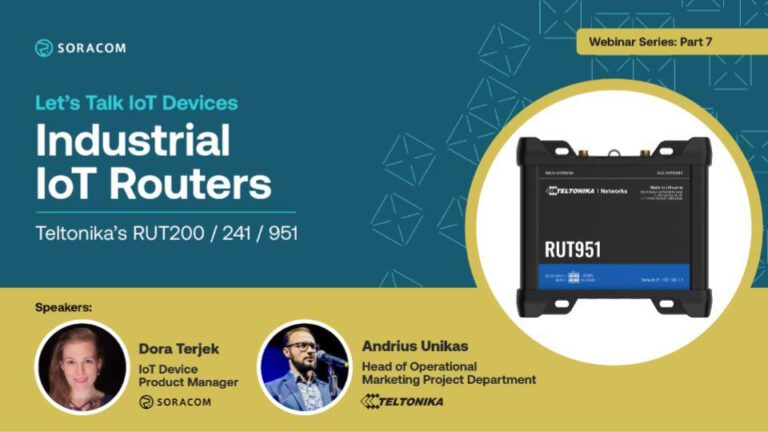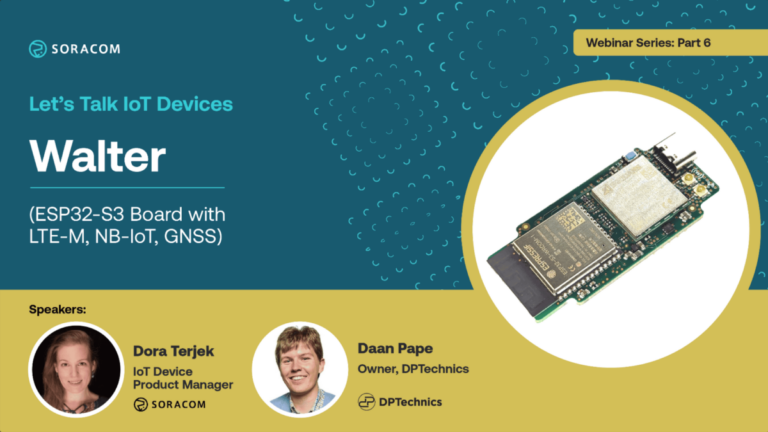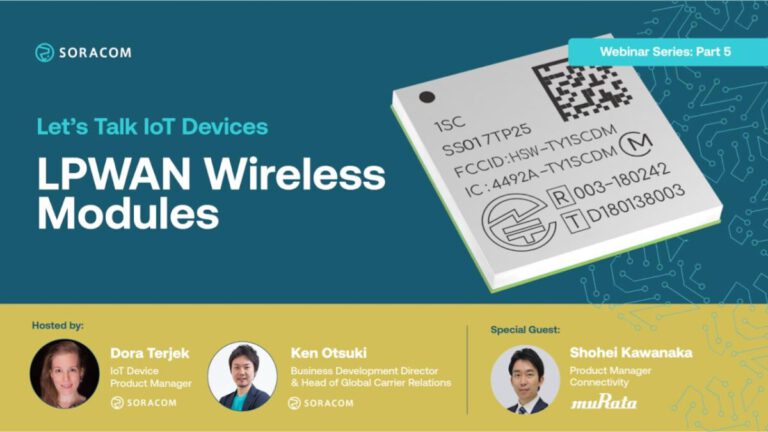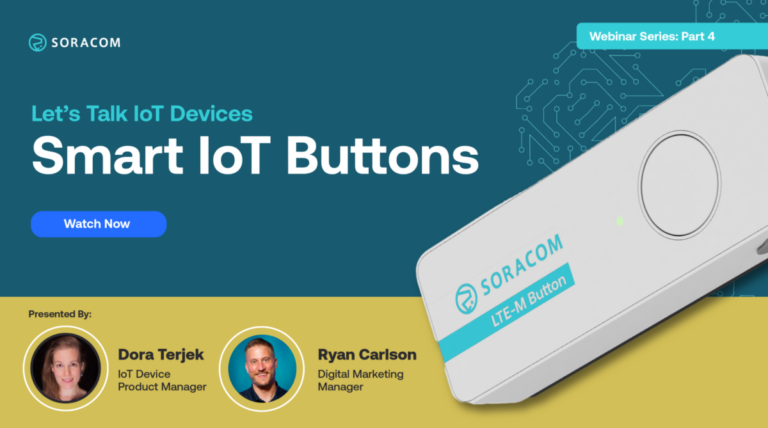
Discover how the groundbreaking Murata Type 1SC-NTN module, featuring integrated iSIM technology and full compliance with 3GPP Release 17 NTN standards, is revolutionizing IoT connectivity. Explore how this next-generation solution bridges gaps in coverage that traditional cellular networks can’t reach.
From remote industries like maritime and agriculture to critical applications requiring uninterrupted service, this webinar will inspire and inform your IoT strategy.
Don’t miss this opportunity to stay ahead in IoT innovation. Watch the recording to explore the future of connectivity—anytime, anywhere.
This webinar is perfect for IoT developers, engineers, and decision-makers in industries like agriculture, logistics, maritime, and disaster recovery, or anyone seeking the latest in IoT innovation.
Don’t miss your chance to stay ahead in the IoT game. Learn how Soracom and Murata are driving the next generation of connectivity with practical solutions you can implement today.
We’re gonna be talking about ISIM and satellite technology. But before we get into the webinar, first, this is brought to you by Mouser Electronics, and some of the hardware we’re talking about will be available through Mouser. Thank you for joining us for the Let’s Talk IoT Devices series. This is the impact of ISIM and satellite technology on IoT, and we’re here with our partner, Murata. We’re gonna be talking about ISIM applications, an evaluation kit that gets you started. We’ll be talking about NTN satellite, what that means for IoT, building applications and some actual next steps, and the actual action items that you’ll wanna take followed by the q and a. I’m your host, Ryan Carlson, the technology evangelist for the Americas here at Soracom, and from Murata. Hi. My name is Shohei, Shohei Kawanaka. I’m a senior product manager. I’m based in Germany. Nice to meet you, everyone. And as an overview for Soracom, Soracom is a global cellular mobile virtual network operator that is solely focused on IoT. The company started in two thousand fifteen and now has customers with deployments that measure in the millions of devices all over the world. We’ve got over a hundred and eighty countries with over four hundred twenty of the major carriers, which puts multi carrier in all of the regions around the globe. The company exists to make it easier to put devices into the world, to deploy them into remote and urban locations, whether it’s using blended radio networks, cellular, Sigfox, LoRaWAN, Wi Fi, and now, NTN satellite, and all wrapping it up with secure networking requirements. The company has its own core cellular network, which allows it to have a lot of control, which we’ll get into some of those pieces and why r and d teams love using Soracom to build their IoT products and pushing the envelope on new technologies. And over to Murata. Let me quickly share the Murata overview. There are weird, electrical component manufacturer that we have a bunch of the product portfolio. That, mainly the passive component like a capacitor, the EMI filters. But we also have connectivity module. This is the, also the main point today. The, the, our company was established in nineteen forty four, in Japan. The, our net sales is, over twelve billion US dollars. We have a number of subsidiaries, in the worldwide. And, we have also the, more than seven thousand employees globally. I was gonna say one of the things that, we appreciate at Soracom is how Murata is focused on communication infrastructure, edge based computing, and mobility. And so you’re really pushing into territories of bringing technology into new new applications, new solutions. And so it’s very exciting to see how partnering with a company like Murata is allowing us to bring, technologies like NTN or ISIM into the world. Let me re-emphasize one point about Murata. We always bring the, smallest components to the market and especially the communication perspective. So that’s why we have, the very good collaborations with the Soracom, for a long time. So one of the things that we will be discussing is the ISIM EVK. It’s a Murata type one SC board, and that’s something that we also are having available at, Mouser. So let’s imagine that we could build very small tracking or asset tracking and monitoring devices that could go on, let’s say, a piece of equipment that is going into the mining fields. It starts in the garage, and it connects to a strong cellular signal back at home base. And as that device is traveling, it’s sending megabytes, maybe even gigabytes worth of video data, telemetry, machine performance, equipment safety, providing a whole series of different types of sensors and data. But then that device moves out of the cellular range and moves further into the mining fields, and it switches over to NTN satellite. And rather than sending all of the telemetry information, it’s still sending the information of where that device is in the world. It can send critical or emergency related notifications. So the any sort of, overrides or overheating or breakdowns will still be reported well before a human even has to pull out a sat phone or a radio and call back. And so these are things that can happen when you have this next generation of technology we’ll be talking about. It’s not just iSIM. ISIM has a lot of value, but now that we’re getting into this world of small, multi spectrum communications, let’s go ahead and explore what that looks like and why. But first, we’re gonna wanna talk about iSIM. So it is a subscriber identity module, the same thing that you’d be putting inside your cell phone, but much smaller. In fact, since about ninety six, the form factor has been shrinking all the way down to today, where you went from an eSIM, the embedded SIM, which comes on reels. Many products are now being built with these. iPhones have made them widely popular largely because this technology is pushing the ability for people to put different cellular profiles on these different types of devices on this equipment. But now we have the integrated SIM, which is going right onto a system on a chip. It’s also significantly reducing the amount of energy that is being consumed by having this smaller piece of equipment. We’ll get into some of those reasons. One of the things from add on to assumed is the idea that SIMs were those add on modules, came on USB. It came on as another board that you’d put on another board to moving on to where it’s been soldered onto the board. And now we just know that connectivity is what is gonna be required for most products being put out into the field. And so those are being integrated into the module itself. And so this impacts the engineering requirements by a number of different ways. The big one is reducing the footprint and lower power consumption. So with a smaller size, this means longer battery life. This means a higher durability as well due to vibration tolerance or wider temperature operating ranges. The other piece is the idea of security. These chips can’t even be removed and replaced. It is now built right into the module itself. This also means one less part, so reducing your bill of materials. And then there’s no SIMs to swap. There’s nothing that needs to be changed, and it’s one less thing to lose on that bill of materials or one less logistic for a distributor or a channel partner to to manage. So when we’re talking about size, we want to talk more about the idea of that impact it has on the layout of a board. So imagine for a moment the number of boards that will have a standard SIM card slot or even an eSIM, this does result in fewer components, fewer solder joints, one less SKU, and also just one less opportunity for an error to occur. The applications themselves, we looked at a wide spectrum of some of the most common IoT areas, and cost, runtime, and reliability are always going to be a factor. But in particular, we know that as you’re looking into mobile metering and wearables, can just reduce the layout constraints. The size is going to be important. This also does reduce cost, which because you’re going to have so many more, right? We’re we’re looking at far more asset trackers or smart meters or wearables than we would connected cars, for example. But when we look on the other end of the spectrum, when we’re not looking at battery operated devices, that an idea of environmental resilience, of putting devices into into more challenging situations with heat, cold, electronic interference by reducing those components just again one less opportunity to impact the connectivity profile of a particular piece of equipment. So when we’re looking at evaluating and implementing ISIMS, right out of the box, the Soracom EVK, it’s gonna have the ability for you to use a physical SIM card if you want to, if you’re trying to check a particular carrier profile. But it does come with ISIM built right into the Type one SC module. You’re going to also see that there is, subscription containers and an ability to handle some of the device credential management with a product like this. And so, for example, the EVK, it’ll have a fully integrated modem hardware, so you don’t need an SDK. You can choose your own development environment, and it’s gonna allow you to do everything you need with all of the common AT commands right through the command line interface. And all of that documentation will be available as far as how you can change it over to, only send a particular data over cellular and the rest might go over another connectivity profile like Wi Fi. It’s gonna give you a whole wide variety of different choices, especially when we’re talking about NTN and cellular connectivity profiles. The process is actually very simple to sign up. So you’re going to receive your package inside. It’s going to have all of the circuit boards. It’s going to have all of the connectors. It’s going to have, documentation inside. Registration is very simple with Soracom. You sign up your free operator ID. You put in your ICC ID that’s right on the packaging, and that’s it. It it will register everything, and you can go ahead and, you’ll start with the global plan is what it starts with. The reality is is that hardware engineers consistently tell us over and over again how much they love working with Soracom for their projects. They get to have one provider, and that same provider is gonna give them cellular and NTN. It’s gonna just be one single SIM that gets them any of the carriers in all of the regions in which they’re trying to deploy for testing, for pilots, or even full production. It’s one invoice that they get for the department, and it’s one development effort overall. Shohei, tell me a little bit more about your thoughts on this. Yes. Exactly. Murata also contributes the hardware engineer in terms of the development side. The Cellular and NTN connectivity enabled by Qualcomm and Murata together. Because Murata also provide, type one SC module, enabling the terrestrial network and non-terrestrial network together. Moreover, the iSIM is also integrated into Murata module. So combination between Soracom and, Murata, that’s gonna be kind of the total solution to, engineer. Absolutely. We look forward to seeing what people are able to create with the EVK and what we’ve, jointly put together out into the world. The thing that I’d like to point out is the subscription containers for profile switching will manage multiple subscriptions, which could be multiple plans with different region profiles, with even some of them being, specific local profiles. So if you’re looking to deploy to Brazil or you’re looking to deploy in particular parts of Europe or the United States, Canada, or, APAC, wherever it is that you’re looking to go, you have the ability to mix and match. And then the SIM OS itself will look at making the switching occur. So you don’t have to have a human in the loop telling your device to switch carriers. The logic is going to be automatic, which allows for an automatic failover. Your radio or your device can have the commands built right in to make switches when you have a signal drop. And this is how you have failover occur between cellular and something like NTN satellite. All of that logic gets to be built in onboard on the device, and so no human needs to send the command to tell it to switch. Because I’ll tell you right now, the one thing you don’t want is when a device loses connectivity, that’s when you wanna switch carriers. And so we’re allowing devices to be intelligent enough to switch carriers on their own without requiring an external force. So one of the common challenges that we have when you’re making IoT devices is it’s around certificate loading and device authentication. So, typically, if you’re a user, you’re going to register your device through a service. It’s going to go through, it’s going to give you credentials and your configuration profile, and then it copies those credentials down to the device itself, and then the device gets to handshake and authenticate and connect with the cloud service. That’s just one user. When you’re manufacturing multiple devices, the steps are lengthy and costly. First, you’re going to register your user and the devices, and you’re going to get a whole slew of these keys. So if you’re fabricating a hundred thousand devices, you’re going to get a hundred thousand keys. You’re gonna have to bring them to your contract manufacturer and securely copy them over in the manufacturing process using a an HSM, a hardware security module, which has its own costs and logistics and oversight, and then embedding them into each individual device during the manufacturing process. So just like serializing a device, you’re putting the unique keys for each one of your devices, which means they’re each maintaining their own version of their software. Then you get to authenticate and connect as they’re brought online. So this is a batch operation before the service that has to happen. There’s been instances in which there could be a credentials breach, and then it’s also just cost and lead time in the manufacturing process. Now there are a number of initiatives today through standards that are looking to change this, but Soracom now for several years has allowed for a process that eliminates the need altogether, having each individual device loaded with its own bootstrapped credentials. You can manufacture a hundred thousand of the exact same device, and they’ll handle the handshake on its own. So a device will initiate a connection in the field. You can grab one of a hundred thousand devices off the shelf, plug it in, turn it on, and it initiates the connection. Soracom will register the device with your own cloud service. The cloud service then issues the credentials, and then it passes those credentials down the device. Now it’s using the unique SIM. So that ISIM, ESIM, or regular SIM has its own, encryption module built right into the SIM itself. So we’re using that unique fingerprint to identify that device in the field and securely move those credentials and even storing them on the SIM itself or on another location within that device. And so this is something that will save a ton of time, and it eliminates a lot of headaches for contract manufacturing. Let’s talk about NTN satellite. This is a non terrestrial network. Couple of things. We’ve heard the names Iridium. We see it in the movies when they’re pulling out all of the sat phones. We’ve heard of Starlink and all of those constellation satellites that are ringing around the globe. So when you’re looking up into the stars and you see a whole ring of lights, it’s probably Starlink, zipping around. There’s also Skylo, which is a company that’s out there. They use geosynchronous Earth orbit satellites. What does this mean? Geosynchronous is gonna have three stationary satellites that are providing coverage to a vast majority of the surfaces of the Earth, and at any given point, they’re providing a fair amount of coverage. Whereas the low Earth orbit, like, the Starlink devices are gonna be moving fairly quickly around their coverage areas, and the difference is is that you need over two hundred satellites. In fact, it’s many, many, many hundreds of satellites to provide the targeted coverage. It does have a much lower latency, and the speeds are almost like a slow broadband. You can actually do some pretty impressive stuff with the low Earth orbit. But when you’re talking about IoT, you may not need that. This is gonna have blanket coverage. It is a higher latency, and the speeds are gonna be measured instead of in megabytes, it’s gonna be measured in kilobytes. We’ll get into what that means for devices momentarily. Let’s talk about the actual NTN technology and some of the scenarios that we’ve been building around. So the big one is gonna be NTN backhaul. This is where you’ve got devices that are into far off remote locations, like maritime is a big one, in which you’re getting all of your mission critical data, and you’re pulling it up through low Earth orbit. So this is where these star links come into, great effect for moving a fair amount of data. Cruise ships will be using something similar to this, and it’s gonna be going from the satellite to the terrestrial networks on land. Then you’ve got air to ground where you’re gonna have planes that are actually in communication with both both ground and air. And this is how you’re getting your inflight infotainment, is you’re gonna be getting any of these updates or how you’re gonna send text message to loved mon loved ones when you’re in the plane is by maintaining this duality between air to ground communications. And what we’re talking about today is the the non terrestrial network applications for IoT in remote locations, whether it’s tracking navigation, communications, emergency, or monitoring. These are the types of applications that are gonna need small bits of data, but it’s important that you’re actually getting it rather than not having it at all. This is something that was a great discussion when we were talking to Murata about NTN, was it’s not just about where you need data, but when you need your data. And so you’re gonna have primary connectivity where there’s no terrestrial coverage or when you’ve got gaps in terrestrial coverage. But then backup connectivity or that failover scenario is when there’s a loss of terrestrial coverage. So whether it’s wildfires, hurricanes, tsunamis, whatever it might be, there are times in which you need this. You’ll notice that some of the latest generation iPhones now give you the option of doing emergency calling over satellite. And that is because the same radio that facilitates cellular communication can now facilitate non terrestrial networks. So some of these use cases that we’re looking at as we get into the, the mix of satellite and cellular is you’re going to go from the logistics to recreation wearables all the way to remote control in some of these livestock and agriculture scenarios, where we can get into some other use cases. But, it seems that safety seems to be one of the big ones in which you’re looking at that failover scenario, or some sort of like workplace safety, site safety, or even things like public safety. Shohei, in your inquiries that you get from people that are looking to build applications, what types of trends are you seeing for people that are looking to explore this technology? Obviously, the emergency call is the one of the main application. Moreover, we we got so many inquiries from the device maker or the system integrator for sport. For example, like, the when the bicycle is going to the countryside, also the mountain, the hiking, etc. Coverage is not, enough, in the such, area. In this case, the NTN, can really help for the, such emergency call. I’d imagine four races you’d want to know at all times where your athletes are both for safety, but then also just to make sure they’re not taking a shortcut, right, for some of those extreme cross country sporting events. No. That’s great. I didn’t think about that. And then are these applications looking at a hundred percent NTN, or are they looking at using both? The the point is the both. The, the NTN could be really the secondary network as a backup. Even the automotive application, like, fleet management and the truck, application. They they continuously send the data via conventional cellular technology like a 4G, 5G. But, while the, the accident is happened, unfortunately, main battery might be broken, but a backup battery is, containing in the, system, and the dot can transmit the data via NTN. Interesting. This is responding to something in an emergency situation, which is less about cost, and it’s more about the need to get the information out. This still does come down to to cost given that up until release seventeen of 3GPP, we’ve been having to build in dual radios, dual antennas, all for a we might use it someday type situation. Yes. So the currently, the, NTN is, a very narrow band. But, I I expect the the in the future, the that’s gonna be the more extended, like the SMS communication, voice communication, data streaming, their satellite communication at the end. But right now, the emergency use case But let’s get into the the meat of building applications that leverage NTN. The reason why we’re even having this conversation is because of the 3GPP Release seventeen. It is the standards that all of the manufacturers and the providers around the world agree on, and this standards body is pushing the technology forward. And so we’re we’ve now got integrated non terrestrial networks, and this means the same antenna, the same module, the same radio will all allow for integrated support for cellular networks and non terrestrial. The Release seventeen is also looking at enhanced IoT support. This is all about trying to move packets quicker and faster with less latency. Then we’ve got additional technical changes that have made it so it eliminates some of the errors. We’ve got improved spectrum. We’ve got advanced mobility management for moving between both of them, and that’s the protocols that handles the handover between one network to another, similar to the air to ground scenario. We’ve got use cases for maritime and aviation that have been driving the release seventeen, and specifically because you’ve got the, like, ships going in and out of port. And so you need to have that hand off back and forth and using the most cost effective means of communicating. And the other is just some global coverage for five g devices, within release seventeen. So, this is all great news, but what does this mean for you and your next steps? This is permission to continue moving forward knowing that the standards are in place, and it’s only going to keep getting better as continuous releases are put out. With the iSIM EVK that we worked with on Murata is the satellite NB IoT enablement. And so it was in twenty twenty four, back in July, We announced our partnership with Skylo. And so that’s where Soracom and Skylo will be Skylo will be providing their services through Soracom, and you’re able to have a single plan, a single invoice, and a single rate card that is going to handle all of your processing. So, you’re not having to work through multiple vendors, and then Soracom will handle all of the data routing for your transactions. So, this is where you can use cloud services to optimize the data as well. And so, when you’re thinking about getting your product that’s gonna be out in the field and you’re trying to connect it to the cloud, you can then use your cellular and your satellite data. It’s gonna go to Soracom’s unified endpoint, and it would so you have the opportunity to then natively communicate with AWS, Azure, Google Cloud, or like a public endpoint or even a private endpoint of your own through a direct fiber channel. So this means you have the opportunity to communicate from a remote location without ever touching the public internet, which is great for utilities and other areas in which the data that you’re handling is sensitive. When you’re developing the products that you’re going to be leveraging satellite and cellular, Very important to look at the lightweight protocols that are available to you. The standard IoT device that we would deploy in our home typically is going to be using HTTPS, and it’s going to be using an encryption header called TLS. Now we’ve got HTTP, TCP, and even UDP. Now what you’re looking at on this chart this is from a blog post with a we’ve got the link below and that is all about how to reduce the overhead of the protocols you’re using. And this is important when we’re talking about being paying for not just megabytes, but now paying per kilobyte if your products are using satellite. So you can go from almost eleven thousand bytes down to fifteen hundred just by eliminating some of the encryption aspects of the packets and leveraging the encrypted nature of satellite and cellular networks that are natively encrypted. Now, this is using Soracom. We have a service that’s called Beam, and it allows for a protocol translation so the devices can use these low data optimized languages, and it will turn them into HTTPS, MQTTs, and allow you to communicate with the cloud platforms. The thing is you cannot send data to a cloud platform from an IoT device unless you’re using that TLS encrypted handshake. And so it’s the thing that allows us to verify you are the device who you say you are, and this is for security reasons. And so Soracom, by handling all of the data in the middle, allows us to leverage the code at the device level, and then turn it into human readable. Here’s an example to help bring this home. If you’re in a low data mode, you’ve got a device that is going to be crop health monitoring, forestry wildlife alerts, seismic event detection, or even bulk water levels for livestock out in the heart of Texas, where you’re thousands of miles from the closest cellular tower, you’re gonna look at what we’ve got here is that this is three different sensing points. And so we’ve got a device that communicates to the cellular network and then the cellular network to the cloud. This diagram is just showing how back and forth your device is going to have to communicate. It says hello, it gets a handshake back, it says here’s my credentials and my keys, and here’s the sensor data, and it moves back and forth until it’s acknowledged at the end. And what we’re looking at is, yeah, two thousand two hundred and forty four bytes over cellular. So if you wanted to go and have your device communicate over HTTP and then have a service like Beam turn it into that secure element, what we’ve done now is on the left hand side between IoT device and the cellular network, that’s what you pay for from a data perspective. Between the cellular network and Soracom and then Soracom Beam to the cloud, that’s all in the cloud. That’s all transactions that are occurring. So right here, you’ve had an eighty two percent reduction in the amount of data that you were having to pay for over cellular by offloading that encryption into the cloud. And so this push the it it pushes that back and forth transmission off the cellular network and lets the secure cloud service handle all of that back and forth and add the encryption that the cloud provider requires. Now we’re going to go one step further. You can go to UDP, which is a binary language that’s not human readable. And so what you do is you would offload that. And so in this particular case, we’re looking at satellite, where you’re being being charged per kilobyte, not per megabyte. And we’re looking at a ninety two percent reduction. So that single packet of binary data is sent to Soracom Beam. It’s translated then into JSON and HTTPS, which developers are probably going to want to see. Uses less battery, less processor, less data overhead. And if we were deploying a hundred devices into the field and just for easy math’s sake, we’re being charged ten cents per kilobyte, and those sensors were transmitting hourly, if it’s the difference per year of paying sixteen thousand seven hundred dollars versus one hundred and thirty dollars just for the data portion of that connectivity plan. So I’m I’m trying to, you know, trying to make this one a little bit more striking close to home and and put it down to dollars and cents. And so NTN is if it’s going to be a failover connection for your devices, you’re going to want to plan for low data modes. Just like our cell phones get ten percent and it says, do you want to save some battery power? In this particular case, a graceful failover to satellite data will require some thoughtful consideration. And this means, like that mining truck scenario, as soon as you leave cellular cellular range and move into satellite range for data, you stop sending all of the telemetry and the video, and it’s gonna store and forward until it gets back into another another connectivity zone. And then on satellite, it’s just gonna be mission critical updates, or might just might just be lat/long and a heartbeat. But that’s the thing you’re going to want to be thinking about when you’re developing these applications if it’s going to be taking advantage of both types of connectivity. One of the ways that prototypes can run amok is when you’re when you’re not planning for something like that, but you could be setting automated notifications that allow you to take action during testing to keep a device from using too much data. So, for example, in Soracom, we’ve got our our event handler. Our support team says it’s their number one most favorite tool because it allows people from day one to just set rules and notify them of when they’re reaching a certain data use threshold to keep their bill from running up thousands of dollars of just running junk data or, dare we say, testing NTN satellite where you’re going from being charged per megabyte to per kilobyte and saving someone’s job. Well, maybe that’s a little extreme, but who knows? You can you can set up the event handler to notify you, and even when you reach a certain threshold to just pause that device so it can’t use any more data. So I recommend when you if you’re gonna get one of the NTN, EVK modules, that you go ahead and when you register it, go to event handler, and go ahead and get that set up right away. And there’s some setup guides that can walk you through what that looks like. Very simple to do. Let’s talk about your next steps. When it comes to the ISIM EVK and the NTN satellite, you’re gonna one register your device, and you can buy them at Mouser. So, you can go to the link provided here. We’ll also be providing in the materials after the fact. Go to Mouser and type in Soracom ISIM and you’ll find our EVK. It’s got all the library of all of the documentation. It’s gonna have everything you need to buy it and purchase it. And then you can go to Murata, the my. Murata dot com, and you can go ahead and get your free account. And you’re gonna have access to a lot of additional evaluation guide documentation. So, Shohei, what are some of the things that people are gonna want to be prepared for when they are they’ve signed up for their account. Is there anything in particular that you recommend as part of this getting set up process for an evaluation? Yeah. Thank you for asking. The the initially, once the customer registered my Murata, then the, the agent downloads the EVK manual and startup, guide. That would be the, the, the first point the, the customer can look up. Then the, once the customer want to, evaluate the, especially the NTN, then the, we will provide the additional documentation a kind of manual. That documentation will be uploaded on the mymurata dot com, the signal writer. Still in a work in progress, but the we can take action accordingly. You’re saying if if some certain documentation isn’t isn’t ready for a hundred percent publishing, you may be able to arrange a early release copy? That’s right. Yeah. So you’ve got your documentation, all that information. There is something that you’d mentioned in one of our earlier meetings, and you said go outside. Give me a few more words about that. Yes. The this is a very important point. You know, the customer came registered mymurata dot com to get a bunch of documentation. But the most important things for the NTN testing, I strongly suggest go outside to see the open sky. The, the two for the NTN communication. The unfortunately, NTN, doesn’t work inside the laboratory, which, the all customers should go outside. At least the antenna should go outside to see the open sky. This is the most important to succeed with the NTN test. I think this is one of those cautionary tales, but there have been so many projects that I’ve even been involved in in which part of the testing process was to not fully go through all of the motions. Like, if this is a product for use in the wilderness, actually, not just go into the parking lot, but go into the wilderness and see how tree cover, how humidity or cloud cover or different types of environmental conditions might change the responsiveness, the latency, the power draw, whatever it might be. And so this is great. This is great, simple advice and a good reminder for everyone So go outside and use your product where your users would use this product to verify it’s meeting all of your specific needs. Awesome. If there’s additional information that you’re looking to learn or if you’d like to learn more about IoT devices technology that’s up and coming, go ahead and sign up for the webinar series, with Soracom. We won’t spam you. We’re not gonna assume that you’re a sales lead. We’re just gonna let you know when new education is offered, when there’s episodes of a particular podcast interview that you might be interested in, and we’d love the opportunity to connect. Now if you would like to actually speak with someone, go ahead to soracom dot I o forward slash contact, and we’d be happy to reach out to you and get the conversation going and see what we can do to help with your testing and evaluation. But not only that, but what your deployment might look like. So most of our customers all have their own custom pricing package put together all based off of what they’re anticipating for their deployment, what types of numbers they’re looking at. So if you’ve got any of that information, we can make sure that something lines up well with your business model. So thank you for attending today’s webinar, and we’re looking forward to addressing some of the questions that we’ve got in the chat. And so we’re gonna move on to q and a. There were some actually really great questions that we’ve got so far, and there’s two of them I wanted to to comment on. The first one is, out to Harold, about the, SGP thirty two. And one, we’re all eager for mass adoption of SGP thirty two for that IT standard for moving profiles around. Following it very closely, it is not yet, fully yeah. It’s not finalized. So it’s in preview. And as Shohei said or Shohei said, the end goal for, the ISIM is to support the latest IoT standard. We look to both eSIM and ISIM, those ones we have to put them in, they will be following that type of standard. So as far as the ability to, I can’t answer the question as far as from the, the process of if something were to update or change in SGP thirty two between now and whenever it’s fully adopted or mass adopted, I don’t know if that’s something that’s can be pushed down at that time. We’ve been doing testing at Soracom with those standards and, it’s really cool. So having built devices myself and had to move profiles around, it’s gonna be a game changer. And then just one other thing too, this goes out to Gabriel. I don’t disagree with you at all as far as having to trust Soracom’s Beam endpoint, if you’re sending data. So if you’re sending identifiable personal health information or any sort of secure or industry regulated data? Absolutely not. You’d wanna have to fully use an end to end encryption model. But if it’s soil moisture sensor or some sort of, like, an alert of some kind, it’s just all about what’s the risk tolerance for that type of data. But the the cellular network itself is encrypted. And then when we set up things like a virtual private gateway, which is actually your own instance, this is your traffic. It’s not something that Soracom can snoop. So it is, it’s like setting up your own virtual private cloud out, out on the web. There are ways of mitigating and addressing security needs, but you’re not wrong. The best way if you do protect the data is to have complete end to end encryption, but you won’t be able to do NTN satellite. NTN requires a UDP, if you’re looking at something like geosynchronous. So it’s the latency on that handshake back and forth is just too much to to work off of. See what other questions we can have. There is a question about the EVK, Murata EVK for the MDM testing. The I need to check actually, the we Murata need to check the the version of the EVK you have. The if it is NTN enabling version or not, but always a new EVK is recommended for the NTN test. As far as the maximum payload, I believe it’s two fifty bytes for the maximum payload over NTN. So we’re not pushing. Faster in the video. That’s for sure. Two fifty six. Yeah. Yeah. The it’s depends on the network connection network circumstance, but, around two fifty byte, including any I IP overhead or so closer to the two hundred thirty bytes or just the payload. So it’s really narrow band, but, yes, this is the fact. Around two hundred thirty to two hundred fifty byte. And this and there was a question around older Murata EVKs. Could you answer that one, Shohei? Yeah. Yeah. I think I I already answered that. All older version. Yeah. The new version is recommended. I mean It’s it it depends how old it is. So when you buy you bought the Murata EVK, it’s it really depends. So the new one is the for sure. Perfect. But, if you have a concern, please contact our sales or distributor contact. We got any other questions out there? Go ahead and throw them out on the chat. The direct port? Does it mean the port in the EVK? What is the direct port? Oh, so the every collection and also the, IP debugging, it can be done in your time for by using the direct. I think it it it it the right answer you expected? Okay. Cool. And it looks like we I I did learn something today. I don’t think Liz is on anymore, but, Iridium has sixty six satellites all cross linked. And so more efficient than the, the constellation, the Starlink ones. But either way, those are the low earth orbit. Those are get some pretty sweet feeds, but you pay for it. It’s not my soil moisture sensor doesn’t necessarily need to be, have the ability to do Xbox gaming or watch Netflix. The reason we assume they announced the release that the news that that they will also enter the NTN market. So now later, they are also a part of the cellular NTN. Any other questions? I’m curious. Did was there anything in particular that as you were watching, was there anything that surprised you or was there information that was I’m always curious to know what it is that people that are interested in this topic, where is it that they where are they surprised by things or new information that they come across? The okay. Maybe I will add some comment about SGP thirty two supports more. The type one SC, they support the today’s webinar’s main topic is a type one SC, which support both iSIM and NTN. Type one SC supports SGP thirty two with external eSIM perfectly. The the question is the iSIM plus NTN. The this gonna be support, with the new Murata module. It’s called the type two g d. It will be launched, this year, middle of this year. It supports ISIM plus SGP thirty two point. And that assumes that the three GPP standards are finalized by them? Yeah. Very recently. Yes. Yeah. Okay. Looks like there’s a question about Yeah. Any if there is update needed to fire on satellite. The the it’s very fundamentally the GNSS location is required for NTN because the, the device need to know the exact satellite location. So GNSS is a mandatory feature for the NTN communication. But the Murata type one c also has the GNSS feature as an option. You can utilize either the GNSS inside of type one c or you can put the external GNSS chip or GNSS module beside this module to get exact GNSS location. But you don’t need to get the satellite location, every time, at least to attach the network, at the beginning, to attach the network, you need the GNSS location. Thanks, Harold. Harold. Yeah. This is correct. The the type one is they also support, this o three bar. Two hundred fifty five, two hundred fifty six, and twenty three. Twenty three and, two hundred fifty five is, for mostly the North America. Correct. And the latest question is the latency things. The practically, the latency at the sub second, some seconds. The the some sometimes three seconds, sometimes ten seconds, roughly, because GEO is very far from Earth. Alright. If you’ve got any additional questions or if you’d like to learn more, we’d be happy to talk to you. Until then, thank you all for tuning in to the latest Let’s Talk IoT devices about ISIM and NTN. And if there’s additional details that you’d love to learn more about or if there’s content you think that we should be, like, talk IoT devices and we’re not covering them, let us know, and we’d love to dig in and see if there’s, more opportunities to share wealth of knowledge that we have at our disposal between our companies. So thank you so much, and until next time. Thank you.
Cut your IoT development time in half while slashing costs: Discover how industry leaders are redefining smart device connectivity. Join us for an insightful discussion featuring Alistair Fulton, COO & VP Ecosystem at Blues, and Dora Terjek, IoT Device Product Manager at Soracom.
Learn how these two innovative companies are reshaping the IoT landscape by solving critical device connectivity and cloud integration challenges.
✅ Simplify IoT Hardware Design: Discover how to drastically reduce development time and costs.
✅ Avoid Costly Mistakes: Learn how to make the right connectivity choices and sidestep the hidden expenses of in-house IoT development.
✅ Low-Power, Data-Efficient Solutions: Explore technologies that simplify product development and extend battery life.
✅ Scale Globally with Ease: Leverage Soracom’s multi-carrier connectivity and Blues’ wireless cloud data pump to seamlessly deploy your IoT solution worldwide.
✅ Real-World Use Cases: Get inspired by successful IoT implementations across a range of industries, including environmental monitoring, energy management, AgTech, EV charging, healthcare, micromobility, and refrigeration.
This webinar is a must-watch for anyone looking to streamline the development and deployment of IoT products.
This is the ninth episode of our Let’s Talk IoT Devices series, and it’s super nice to have you today. We are going to focus on some super exciting topics today around hardware design and how we can actually reduce development time and costs. We are going to be talking about a new product that we have recently launched together, which is, the Blues Notecard for Soracom. And I really hope we can have some valuable insights to our audience. Alistair, before I ask you to say a few words about yourself, I would like to quickly introduce myself and say a few words about what’s gonna happen in this session. My name is Dora. I’m working as the device product manager within, Soracom. I’m based out of Stockholm, Sweden. It’s afternoon over here, and, I’ve been working within the IoT sphere for over fifteen years now, mainly with connectivity, but also quite a lot with hardware. Maybe a few sentences about Soracom, who is joining us for the first time. We are a full scale MVNO originating from Japan. We are headquartered in Tokyo, but we also have, regional teams within Europe and also within North America. We have our core network, which is rather unusual for for, for an MVNO, and, we based it on AWS. We have over seven million SIM cards all over the world now, and, we are working with a lot of different type of IoT customers starting from startups through SMEs to enterprise customers. And we are, having this session live today. We are going to record it. And if you are watching, you are going to receive the recorded version, after this session, one or two days after. So keep an eye on your mailbox. We are not going to use slides today, or, Alistair, you might be wanting to drop in a few things here and there. But this is going to be more like a friendly chat between the two of us, but we are very excited to receive any type of questions from you. So if you look at the right hand side of your screen, you are going to be able to see the chat function. So feel free to raise anything, and we are either going to pick it up during our discussion, or we are going to have a dedicated section after, the dialogue. I think these are the most important points. Alistair, can you say a few sentences about yourself, please? Sure. I I I also have been in the messy space of of connecting things, probably for the last, well, thirty years or so, if I’m honest, in a variety of different spaces. I’ve I’ve kind of focused throughout really on trying to, really enable developers and customers with the tools that we’ve invented over the course of this time to analyze and understand what’s happening in the physical world and and essentially make better decisions. The I think the core goal of that really is, you know, the true purpose of the IoT, which is aligning economic goals of producing more from less and more efficient production with environmental goals of of actually reducing harm. I currently am COO of Blues, and we’re really focused on the nitty gritty of of connectivity, and and we’ll talk about that. But I my background is is varied. I used to run, Semtech’s IoT division, so semiconductor space. We brought, LoRa to market, to fill, what I saw as a gap in in low power wireless connectivity, for customers, particularly in the industrial space. Power and connectivity are often two things that run, you know, counter counter to each other. I spent a couple of years before that building Hitachi’s Lumada industrial IoT platform. So on the platform side, how do we actually start using in what was the early days of AI and machine learning, how do we start using some of these tools to really drive intelligence into the machines that Hitachi, delivers to customers? And before that, I spent eight years at Microsoft. I I started what became Azure IoT as an incubation project back in two thousand and nine and kinda grew that through the business. And and before that, I spent a bunch of years actually building solutions with customers, so industrial, enterprise level, use some utility stuff, monitoring train tracks, you know, that sort of nasty, gritty, you know, difficult problems. Which honestly is what led me into the platform space to begin with because it was horrible to figure out what to do with the data and then ultimately into the connectivity space because even though there are lots of tools available to use the data, actually just getting the data still to this day remains a real challenge that a lot of customers struggle with. Indeed. And, as I understand, the vision of Blues is basically to transform every physical product into an intelligent service. Right? To send data from point a to point b. Yeah. We focus on one very simple problem, which is exactly that, Dora. You know, we when I look at the IoT, we have not made it easy as an industry for customers to adopt these technologies despite, you know, I think what has been good intent, because of variety and because of differentiation, which which, you know, is often cast as a good word. But when it comes to things that you as a customer are trying to put together and make work together, differentiation has been one of the things that has really hindered adoption of the IoT. And I think for a lot of customers these days, they kind of look at the the mess of of options that are available, you know, ten, fifteen different types of connectivity that they could use. Yeah. Five hundred plus different IoT platforms that are out there. It’s a very, very confusing space. And so what Blues is focused on is one problem that is universal, and that is how do I make this machine or this sensor or this device intelligent? How do I give it connectivity? And we’ve really focused on getting data from A to B. We get the data from the device, we deliver it to the cloud of your choice, and and so in that context, partnership, and this, you know, is why we’re working with Soracom, partnership to me is is as intrinsic to the IoT as the very concept of connecting devices. Because if we’re going to do our jobs, but, you know, for customers well, it’s going to be through working together and making sure that everything that we do is interoperable and can be integrated without customers facing this massive integration tax or worse, being locked into a single supplier. And so partnership within the context of what Blues is doing is really a critical part of our business, and and it’s an area that that I joined the company really to kinda drive. We have, you know, a product that is incredibly easy to use, which I which I think is the start point for everything. Mhmm. We have a we have an enterprise sales team that that works directly with large scale customers. Yeah. But our main go to market is through partners. Brilliant. Do you want to tell us a little bit about what type of partners you are working with? Yeah. We work across the range. I mean, really, when it comes down to it, I see what Blues does as an enabler for companies, you know, offering services in this space. Now sometimes that’s systems integrator type services. I’ll come and build it for you, mister customer. I’ll put it together. I’ll integrate the best in class tools that I select. Sometimes they’re solution providers, and and you could argue there’s not a lot of difference sometimes. A solution provider is is doing what a systems integrator does, but doing it on a replicable basis. They do it for a number of different customers, and they package the product. We also work with hardware design companies. We work with hardware manufacturing companies. We, of course, work with with cloud platform companies and platform companies like Soracom. You know, there are there are a lot of companies, you know, offering parts of the jigsaw, and pretty much Blues is an enabler for for every single one. So while our customers range from, you know, global scale enterprises down to, you know, midsize companies, our partners similarly scale from from global scale, operators down to more specialized companies. In the IoT, you get a lot of and when I say IoT, I’m pretty much exclusively referring to industrial IoT. You get a lot of companies that have really deep specialized knowledge and understanding of the sector, say, oil extraction. And they work with the base of customers in that market. They know what to do with the data. They have a a broad experience in delivering value to customers, but what they’re struggling with is connecting the next device. And that’s that’s really where Blues comes in. And it’s I mean, you’re probably surprised to hear me say hardware companies because, you know, if you go to most hardware companies and say, hey. You know, I need to design device X. They may start you with the chip down design. They may say, oh, great. You know, I I can build a custom solution just for you. And the problem that that that has created over the years is custom equals cost, custom equals risk, and custom equals challenges in optimizing for low power. So a lot of the hardware companies that we work with, they use the Blues module, and it’s a we sell a hardware module and a cloud client in the back end where the data lands and routes to your cloud. They take the Blues module, and they use it to accelerate their own development processes. Even though they can do chip down design, they use Blues because it means that they can deliver POCs. We’ve had customers deliver POCs in two or three days. They can deliver a POC pretty much immediately, and they can move very quickly into production. And that means they can deliver more value ultimately to their customer. Exactly. Yeah. Because if you care about time to market and and time to revenue, and, of course, you wanna focus on your core business instead of trying to build your own little device. So note card definitely has a lot of value on this market. Can you tell us a little bit about, the typical customer journey that what’s looking that like at this? We, I mean, we tend to see customers fall into and I’ll talk about end customers. Our partners, you know, our job our job is to enable our partners to be successful, period. That that’s what we do. But our our partners service a very broad range of customers. There are companies that are, you know, what I’d call transformers. You know, they’re they’re taking an existing, business model, an existing product, and they’re trying to transform what they’re offering by connecting that device, by making it intelligent. And those sorts of companies, you know, they tend to they can range from being manufacturing company. They they generally make something. They make a device, a machine, refrigeration unit, battery, you know. And and so they’re taking Blues. They’re adding connectivity to their device, and then they’re able to go into market and offer their customers incremental value. And those that that that can be very, I’ll say, very disruptive in some instances. But a lot of the time, it’s really more about more customer value, being able to compete. And and as you said, time to market in those sorts of situations is absolutely critical, particularly if you have competition that is coming in from the left field and and offering a connected product as is often the case in most, most manufacturing market. Yeah. And then we have more kind of innovative companies that have come up with a novel and new idea who who, you know the thing that they they know is is what to do with the data. I mean, we work with a number of companies in the environmental space, and they’re building solutions that do everything from monitoring ocean currents and temperature to predict more accurately, more efficient shipping routes, which has a significant reduction on, on the fuel consumption. And then things like water quality and so forth. And those guys, they know what to do with the data. They very often are not experienced in the in the embedded space. They may be experienced in the sensor space, but that connectivity part, that’s the thing that really trips them up. And and, you know, going back to the day when I used to actually build, you know, end to end solutions, the assumption that those folks will often make is that, well, connected is easy. I mean, it must be. If you if you take a quick look out there, there’s networks everywhere. You know, there’s lots of providers. Everyone’s telling me it’s simple. It must be simple. I’ll just focus on building the application and maybe some of the hardware, and then they run into this brick wall of connectivity. For transformers, it’s often to transform a type customers, it’s it’s often the same. They’re really, really good at making industrial refrigeration. You know, they’re that’s that’s their core, And they tend to think that connectivity is simple, and then they run into that brick wall. And you see both types of customers spending at what is on average an eighteen to twenty four month cycle going through initial iterations of hardware design, figuring out that it doesn’t work, and then going back to the drawing board and starting again and testing and then having to take those designs through testing, through FCC, and through and then having to figure out, well, jeez, you know, which which MV and L am I getting? I’ll I’ll get it. I’ll I’ll use your card. I’ll take the SIM. I’ll put that in. I’ll test that for it. Then I have to figure out how to manufacture the device. Then I have to figure and often, those customers just give up. It it it becomes such an expense and such a distraction that they think, well, I’m I’m gonna I’m just gonna spend my time doing something else. Yeah. With Blues, what those customers tend to do is shorten that timeline from a couple of years, ideally, down to, like, three to six months. And the main the main driver of that timeline is more the internal transformation they’re doing within their business or other kind of deployment issues. We’ve managed to take the connectivity, you know, conundrum, if you like, off the table. It it’s no longer a blocker for them. And that’s incredible to see. To see when customers say, really? You you this I I built this POC that actually worked first time, and and that’s that’s kind of the intended goal. We get that quite a lot from customers, actually. It’s really good that you also mentioned a few use cases where Notecard and its deployment has been successful. When it comes to greenfield versus brownfield applications, Would you say that one of them is more suitable than the other for the Blue Note card? It it depends. I mean, I think Blues Notecard really fits into the proper kind of problem set I described, which is I want to connect this device. It hasn’t been connected before. I need to figure out how to do that. Now innovator transformer to a degree, greenfield, brownfield, it doesn’t doesn’t map exactly and they differ, which is why we kinda tend to look at them as separate groups. Greenfield I paused because of this. Brownfield, the business case is proven. And when I say Brownfield, I don’t mean a device that’s already connected. I mean an environment where some devices are connected, an existing factory, you know, existing production units, etcetera. Those those use cases are often driven either by regulation. I have to do this, otherwise, I’m gonna get fined business, or they’re driven by competition. And so the impetus to get the thing figured out and get it done quickly is very strong, and they tend to move really quite quickly. Innovators at greenfield sites often have a lot more things to figure out. But from a Blue’s perspective, our ideal point is before you finalize your first hardware design. Now we work with customers who are already in the second and third iteration of their hardware, and they’re desperate to throw it away and start again. But our ideal point is, I’ve got this great idea. I’ve got a business that that needs this. I’ve got a customer that’s ready for it. I know how to make everything else. The connectivity part is what I don’t want to spend time on. And, you know, I don’t want to build a customer solution because that means I have to manage it. I don’t want to have to figure out how to optimize for low power and design my own card because that’s actually surprisingly hard. I don’t want to have to worry about, did I get the security model right? You know, am I am I creating a backdoor into my network that’s that’s gonna create some huge problem? And then, of course, the business side of it, which is the simplicity of working with a partner like Soracom that can provide access to the world. And that part, again, is is a hurdle that once people have been through their hardware design, they said, well, obviously, there’s networks everywhere. Then figuring out which network. And very importantly for industrial customers, where you’re talking about fifteen, twenty year life expectancies, cellular networks in particular don’t run for twenty years in in most instances. And so these customers need to have a hardware solution that enables them to change the radio without having incurring any cost. And with Blue, you know, one of our initial design principles was you need to be able to take one Blue’s note card out of your product, that maybe runs CAT one, and you need to be able to put in another card that runs NB-IoT, say, with no code change, with no need to retest Mhmm. And no need to do anything to to the security model. It’s plug and play and it just works. And that kind of insurance model is really important, really for both types of customers. But, yeah, we that’s where we tend to come in. Where customers have, like I said, got their hardware solution established, you’d be surprised at the number of customers who say, I’ve worked out it’s costing me a million dollars a year to have this custom hardware solution because I have to employ a team of five people to maintain it, and I had to, you know, please spare me this. So we do get quite a bit of that as well, but greenfield is often, cleaner a cleaner path. Yeah. And what we also see from Soracom is that many, many people underestimate the the complexity of of software integration when it comes to a brownfield application, for instance. And they don’t they are not thinking about the long term maintenance or the security aspects or the interoperability pieces. And, that’s why it is very interesting to hear that Blues figured it out, and you made it into something very developer friendly. Yeah. It’s and it’s I’ve I’ve known, I’ve known Ray for a number of years, since my days at Microsoft. Ray Ozzy, he’s our CEO. He’s Your CEO. Yes. And he he really set out down this path about six years ago. And, honestly, to as someone who perhaps may be a little bit jaded by being in the industry for a long time, the dream that Blue set out to deliver, you know, I I honestly thought at the time was was a bit dreaming. I mean, to actually be able to design something that is both, extraordinarily efficient in power terms and takes all of the radio and abstracts it behind the JSON API, so that I you know, we talk a lot these days about cloud first developers. Now the reality is that most developers are cloud first, which means there there is an expectation of flexibility and a flex expectation of security, inherent security, and there’s an expectation that the data just kinda turns up. And these developers don’t have the skill set necessary to get down into the messy world of c or c plus plus They’re operating in Python, JSON, you know, PHP, Ruby, or it it it’s that world in which we’re talking about. And so taking all of the complexity of the radio and sticking it behind the JSON API seemed to me incredible at the time. But that’s what the company has done. We spent the first three years of life really grinding away at that problem, to deliver a solution that not only solves the problem, but critically is also scalable. Because there have been companies that have got very close to solving the hardware problem, but the difficulty is that that that what they sell you is a hundred dollars per unit. And when you’re talking about a a piece of earth moving equipment, maybe hundred dollars is not a big deal. But the majority of the industrial IoT, particularly the wireless industrial IoT, deals with marginal, value. So it is marginally valuable for me to connect a pallet, but it’s not worth a hundred dollars. The value I I get from my solution is that I’ve connected a hundred thousand pallets, and I can see where all of them are within the network. But the incremental value or the marginal value of connecting each one needs to be low, and so those those companies failed. What Blues has done is offer both an extraordinary cost effective kind of starter point in the note card, but also in a product called note card XP that we introduced recently, a path to production, which essentially is the ability to redesign your board, take it and tone it down to exactly the components and capabilities that you need Mhmm. And manage your bond cost so that you can still, if you like, afford to connect that pallet or that battery or that vehicle or that lighting unit or that HVAC unit or you know? And that really in industriality is where, again, the industry as a whole, and I, you know, include myself in this, has failed up until now to to to couple both simple and scalable. You can do simple or you can do scalable. But often, putting those two words together is very difficult, and that’s what Blue’s has set out to do and I believe has has delivered. Superb. Let me go back a little bit to the connectivity topic. How how do you think companies can can secure that they make the right connectivity choices? We talked about you having quite some experience with LoRa, for instance. All Notecards are cellular enabled. How would you say a customer chooses the right connectivity upfront, and how can Blue’s help customers with this? That’s a great question. I mean, and I think that that when you ask customers, and I think there’s been a as an industry, we have not spent enough time actually sitting down with industrial customers and saying, what is it that you really want? You know, what how do you want this development process to work? How do you want this value to be delivered? You know, what do you need this to be? Because very often, those customers will say, well, I don’t want to choose. I don’t actually want to make a choice that is is deterministic and and unidirectional. Because in the past, you know, it was like Russian roulette. I mean, you had to kinda sit there and think, well, if I’m gonna design single SKU, well, firstly, if I’m a global company, I can’t do that Mhmm. Because I’m gonna have to mod I’m gonna have to, you know, adapt to different network topologies. Now LTE and and the emergence of LTE’s replacement to three g helped solve quite a lot of that, so there’s more interoperability. But still, I had to sit down and think, well, is the device going to be inside a building? Is it gonna be under ten feet of concrete? Is it gonna be moving at such a speed that cell hand off’s gonna be an issue? Is it going to need low power? Is it gonna need a lot of data? Is it gonna need a but all of those questions, you know, faced with a choice of of either making twenty SKUs to provide a you know, if you walked into a building where there’s a thick concrete wall, you pick this one out of your bag. It was an incredibly complex thing for people for customers to figure out. When you layer on top of that the risk of network sunset, which has you know, I still talk to customers today who were impacted by the two g network sunset in the US and are angry, you know, still about the cost that they incurred as a result. Customers don’t really want to make a choice that that that comes with a tax if they’re wrong. And and for Blues, that means our job is to make that choice largely cost free. So if you get if you get it wrong, that you should you don’t have to rewrite your code. You don’t have to redesign your device. If you started out, say, with Wi Fi only, yeah, sure. That might be a good solution. Cellular in general is the better solution if you can abstract away from complexity and protect against network sunset. But the real answer to your question, Dora, is I don’t think customers want to make a a choice. I think they want to have flexibility. I think they want to be able to pick the best connectivity for any given, you know, environment. As you say, we tend to focus on cellular, but cellular plus. So cellular with Wi Fi, cellular with Bluetooth, soon cellular with LoRa, cellular with satellite, LoRa with satellite. You know, those sorts of combinations are ones that that customers need, but they want to be able to make that choice without some huge risk attached to it. Superb. Thank you. Yeah. They definitely need that long term security. Yeah. Superb. So tell me about I mean, we’re working together as you said. We we worked we announced quite recently a a tie up between, Blues and Soracom. We’ve we’ve worked with you to produce a a Blues note card that’s specifically, you know, provisioned for the Soracom network. You know, honestly, one of the one of the things that attracted us to Soracom is the speed with which you are able to identify and deliver against customer need. You know, you quite often start with a developer’s perspective, which I think is very important. Yeah. But you somehow managed to figure out how to really, you know, deliver very significant incremental value. I mean, you described yourself as an MVNO at the outset, which I think is underselling what you’re doing quite a lot. There are quite a lot of MVNOs, and they do a very nice job of of providing a a single SIM that works across multiple networks. But Soracom does a whole lot more. So do you wanna talk talk about that a little bit? Yeah. Absolutely. And thank you for, for asking about Soracom itself. So for many, many customers, we are an MVNO. We provide connectivity, and we do have a connectivity platform where you can manage and monitor your SIM cards. But on top of the connectivity, we have a hellish amount of crazy good value added services where you can see the data that you are collecting. And very recently, we actually launched two Gen AI related new services. And you can just query that data, that you are storing, for instance, in the Soracom Harvest area and pull out and analyze the data. That service is actually called Soracom Curie, just to make some advertisement to that. And we also come up with a, a pro a product that’s called, Soracom Flux, that is also moving towards the Gen AI area. That is more like an application builder. So, basically, you can automate different areas. You can capture, for instance, images. And then with the help of Soracom Flux, you can translate those images to various forms, send the data, and then analyze what is being received on that end. So, yeah, we really try to be more than an MVNO. We have all the additional layers on top of connectivity. We are cloud agnostic. We are also very often technology agnostic. We are not only sticking with cellular even though that’s our main profile, but we are looking into satellite. We also have some LoRa deployments, And, we are very, very excited about this collaboration on the Notecard. And maybe this is the moment where I’m gonna do a bit of self advertisement and just copy a link that’s gonna lead the audience to the Blue’s note card that was developed for Soracom that actually has our embedded SIM card. It is a global SIM card that provides connectivity in over a hundred and sixty countries. And if someone is interested in talking about it, feel free to to reach out to us. Yeah. And that that I think the goal with with that really is that you actually get to access all the Soracom platform offers, and I still think you’re underselling yourself. But, that that you can get access all of the Soracom platform offers just by plugging the card into an m two connector on your device. Yeah. That that that it it it comes pre provisioned, and I think both both of us, ourselves, and Soracom are really focused on getting to the value really quickly. I mean, you mentioned, the Gen AI services that you launched. I was at the event back in in in, earlier in the year in Tokyo. Those those services are really tailored, I think, to what industrial customers are trying to do. You see a lot of the the AI is a very interesting topic for a lot of folks at the moment. It’s not a new one. You know, these techniques have been around for a while, but we’ve seen a very rapid acceleration. And I think uniquely, a a a a a set of developments that have have been experienced directly by people in their everyday life. ChatGPT Yeah. Has kind of brought an experience that is AI based to, you know, your grandma. And and so there’s a very pervasive perception of AI as transformative. I think for a lot of industrial and enterprise customers, there’s the danger of layering on more more choice. You know? Oh my god. There’s more tools. And so it’s really important for us as an industry to package AI and machine learning, and customers don’t really care the difference, honestly, into services which they can actually utilize. That that you don’t need to have a PhD in data science in order to be able to take that tool and do something amazing because, actually, what you want to do may be not that amazing. You may just want to recognize is someone trying to break into my building. You may just want to be able to query with some intelligence rather than writing fifty queries in SQL. Exactly. Query a database and say, tell me the answer. How has this changed over time? And so I think it’s incredibly important. AI stands to be a really big driver, I think, of interest in in in collectively what we do, which is called the IoT, getting data, putting it somewhere, allowing you to analyze it. It it stands to drive a great increase in interest, but I worry that without folks really understanding what customers want and and try to give it to them, we will, in a year’s time, if we’re not already, be in this huge trough of disillusionment where everyone says, well, I I didn’t really do the thing. You know, it will have changed the way in which we interact with chatbots. It will have changed the way that we customer service works. It would it would have changed a lot of consumer focused things. Yes. But the core of industry where the dirt and c o two emissions are produced, you know, as a unintended byproduct of trying to do the right thing. The core of industry will not adopt those tools, and therefore, we will not get the benefit. And I think that’s that worries me a lot. So companies like Soracom that really, I think, are tailoring and packaging and saying, it’s not the universe of AI. It solves this set of problems for you is incredibly important. Yeah. And they try to be, positive and hopeful that with the help of AI, we are also gonna come across more and more additional use cases that will open up the door for for IoT no matter the connectivity type. Well, I think very often once you’ve solved the first problem a customer has, then they start to see more opportunities. And I think often that first problem of basic connectivity, maybe for a regulatory reason, if you’re trying to monitor food quality in a in a cold chain or you know, once they’ve once they’ve solved the immediate pain point, if you can provide them with easy to use easy to use tools that don’t lock them in, that don’t you know, then there’s lots of other things that they quite quickly come to. But it’s that first problem that often goes unsolved, and as a result, customers end up just they end up struggling. And it and and it’s I mean, it sometimes it feels a little bit like in this industry being a bit of a counselor because the number of customers that at least I talk to who they’ll tell you horror stories about what they’ve been through over the last, you know, five, ten years trying to build and maintain a connected device Right. Solution. And and, you know, they they and they’ve still done it. You know, they’ve still soldiered on through. Talking about, you know, Brownfield earlier, you find a lot of customers who who say, well, you know, I had to do this. You know, my competitor did it or the regulator required it. But goodness, you know, it’s to be nothing but a drain. If we can be free of that, then we can spend all that resource on doing something with the data rather than just trying to get the data. We can actually spend Agree. Money in those times on doing something that’s valuable, not just a cost. Out of curiosity, and we are slowly slowly coming to to an end, do you have, Alastair, a favorite IoT use case? Oh god. I mean, there are so many. It’s it’s, one of my I’ve got to say one of my favorites at the moment is a solution that one of our customers is building. And it they are, they provide, the the vehicle batteries. They’re one of the largest providers of vehicle batteries in the world. What they’re doing is they I think they started out with a vision of being able to connect, batteries and then, you know, provide additional services around it. And I think that very off very quickly kind of morphed into a thought of well, if you have the stature about how battery is behaving on a commercial vehicle, you have up to six batteries Powering the HVAC, you know, the the the chiller unit on the back, powering the start, powering it, the cab, powering the if you have all of that information about what those batteries are doing, what could you do with that information? And very quickly, that’s led them into thinking, well, we can optimize the life of that battery, but we can also optimize the usage of that vehicle because we can tell whether the battery if the vehicle is sitting idling, and we can provide advice on, you know, when not to do that. So it’s the it’s it you see that sort of thought process, you know, ignited by by, you know, thinking about, well, what if I connected my product? There are one of my perennial favorites has has always been, rhinos in in, West Africa, with holes drilled in their horns and small sensors inserted in those horns that come with the LoRa radio. Fantastic. Yeah. Data is used actually to it’s an AI based model. It’s used to determine when the rhino is being poached, because the behavior of the rhino, the movement Yeah. You can analyze and actually build a predictive model that says, given the behavior of this rhino, is it being chased? And you can send game warden to to do it. And the third, I would say, is the one I mentioned earlier about, ocean buoys. That simple kind of concept of, well, if you knew the current and and you knew the water if you knew the condition of the sea and you were able to model that on a global basis, you could reduce the fuel consumption that is inevitably going to take place as freight has moved globally on on huge, great big containerships, you can reduce that by ten, fifteen, twenty percent. I mean, that that in itself, the enormity of that impact is incredible. The actual solution itself, I won’t say simple because it’s not super simple. But but, actually, the core concept really is quite simple. If I can tell how the buoy is moving, I can tell the ocean current. If I can tell get the temperature of the water, I can start building a granular model of sea conditions. Now all of that’s enabled by connectivity because if you can the concept’s great, you know, but actually connecting a buoy in a in a reliable way without, you know, costing an absolute fortune is really quite challenging. But honestly, Dora, I mean, like, you see I see every single one of our other customers, they make portable toilets, you know, and and and, you know, their main competitor, produced a portable toilet, and so they have to, you know, they have to catch up. Their their their company, their their, private manufacturing business, they’re based in North America. They know really well how to make toilets. I don’t know who knows how to make a portable toilet, but the value in being able to tell their customers and to manage the fleet to tell when someone’s tipped over to I mean, it sounds really basic, but if you don’t have a portable toilet that’s functioning on a worksite in in America Yeah. How to have workers. You’re not allowed to have workers working. To shut down the whole area. Yeah. But I could I could carry on for hours. I mean, I come you come across every single day. I come across two or three things where I go, holy crap. That is really cool. I mean, wow. The fact that someone actually thought of doing, you know, a b c, you know, I can I can do this? It’s amazing. And I think it really shows what happens if you if you give developers and I’ve always believed this. If you give developers simple tools that do the job well enough and that are easy to use, what they will do is I I agree. And we definitely need to have them on our side. Yeah. Well, I think we we need to be on their side. That’s the thing. As an industry, we need to be on their side. Yes. And and, you know, I think I’ll I’ll I’ll I’m not talking about Soracom, certainly not about Blues. You know, there have been a there’s been a bunch of things that have happened in this industry over the years that you think, did you actually ask anyone who has to work with these tools what this would do to their lives? I mean, did you actually think about that? And there’s been quite a few of those head scratchers. Fewer now. Much, much, much fewer now than there were maybe ten years ago. I think that’s a very, very good closing line. Let’s see if we receive any questions, any incoming questions. Let’s wait one or two more minutes. Yeah. I’m always hopeful we get some difficult questions. They’re like good good hard questions. Marcus is asking, what are some of the hidden expenses of in house IoT development that people often overlook? It’s a very good one. That is that is an excellent question. I mean, I think simple answer would be all of them. But, you know, the hidden expenses often are it’s very easy if you’re starting down this path as a developer to to go on Google and you search for solutions, etcetera. You’ll find very quickly a a range of options on the hardware front, all of which will tell you that they’re simple to use. You know? All of which will tell you, you know, I’ll say with the exception of Blue certainly and and others, that they solve the entirety of the problem and all you need to do is use them. And and I think the hidden expenses, you know, once you click that link and you go down that path and you start investing time, you’re kind of on this road of you’re soon enough, you’re learning custom AT commands and then you’re coming to go so so it’s it’s the the unappreciated impact of lock in, I’d say, is a significant hidden expense. There are some obvious ones like, you know, testing and certification. Often, yes. Everything needs to be certified. Compliance. Yeah. Which if you don’t know how to do I mean, even in where you’ve got a strong relationship with the testing house like we do and I’m sure you do, and you know how the system works and you kind of can really work work well within it, it it can be challenging. If you if you’re new to it, it it it can be incredibly daunting. And it can add six months, nine months to your your development cycle if you’re lucky. Because if you fail test and you don’t haven’t anticipated, you know, where the issues might be, you can be in multiple cycles of hardware redesign. Yeah. And every single time they press that button, you’re flushing you’re flushing everything you’ve done. And for a lot of customers, these are these are they run into million dollar, impacts. To get a working piece of of hardware that’s relative you know, let’s say, a relatively complex device, to get that up and running, can cost, you know, a very significant amount of money and everything it could be, you know, a million bucks to get to the point where you’ve got production ready, hardware. Every single time you have to redesign, you hit the flash button and you start over again. So those costs are incredibly high. I think the other cost is network cost, honestly. I think that’s where Soracom comes in. That that, you know, have being able to to look at Soracom’s rate card and say, well, I not actually know how you know, how much this is gonna cost me. I can predict with accuracy how much this is gonna cost me over the lifetime of the device. That’s not always been the case. Even even, you know, with when MVNOs started coming into being a few years ago. And it’s it it sometimes, particularly when you’re dealing with edge cases where, say, in the oil and gas industry, ninety percent of my, machinery might be within reach of a cellular network. Mhmm. If it’s not in reach for cellular network, it might be in reach for LoRaWAN network. But what do I do about the ten percent that requires satellite connectivity? And that can be enormously expensive. So it it’s it’s being able to start at the outset and see the product the the development process and to be able to predict at each stage to answer the question. You know, that’s what developers have to be able to do to avoid, you know, those hidden expenses because those hidden expenses can be really significant. Very, very good. Thank you, Alastair. You got a thumbs up. Next question. Well, I we talk about security as well, but that’s, you know, that’s a hidden anyone anymore. You know, if you, if you get through the hurdles and actually produce a piece of hardware, but you messed up the security model, You know, that’s that’s that’s your name and face on the front page, you know, sadly in some instances, and that’s something that often, you know, impacts customers very significantly. Yeah. Next. Any other questions? No more questions. I think with that, I say a very, very big thank you to you, Alister, for today. Likewise. Likewise. I very much enjoyed. Thank you everyone for staying with us. Enjoy the rest of your days, and take care everyone.
In the rapidly evolving landscape of the Internet of Things (IoT) and Machine-to-Machine (M2M) devices, understanding the vast array of cellular connectivity options available to enhance your deployments is important. This webinar is your gateway to USB cellular connectivity for IoT, designed to reduce complex manufacturing choices and streamline cellular technology integration.
What You’ll Discover:
This webinar is more than just a discussion—it’s a tailored experience for those considering the Onyx – LTE™ USB Modem. Empowering you with the knowledge and insights needed to navigate the choices you’ll make and how the Soracom Onyx stacks up. Whether you’re aiming to upgrade your current M2M applications or seeking reliable backhaul connectivity solutions, this session is your stepping stone to informed decisions and future-ready implementations.
Watch now!
Join us for an enlightening journey into the heart of IoT and M2M communications. Equip yourself with the expertise to make your IoT solutions not just connected, but smartly integrated and future-focused.
Today’s webinar is part eight in our webinar series about hardware. And today, we’re going to be looking at USB cellular modems and the role that they can play with, IoT development and deployment scale. Should probably introduce ourselves and say hello to everybody. Let’s do that. My name is Dora, and I’m working as a device product manager within Soracom. I joined almost two years ago, and I’ve been working within the IoT field mainly dealing with, connectivity and product managing connectivity. In the past ten to twelve years. And based out of Stockholm, Sweden. Can I please speak to you? So I’m a technical product manager here at Soracom. I’ve also been at Soracom for about two years I have, I dare not count it up, ten, fifteen years’ worth of experience working with different companies providing different types of IoT connectivity and and device management or connectivity management services. I’m in the UK, and my main role is looking at some of the the the systems that we use to, provide the underlying services that we provide our connectivity platform. We can touch on what those are as we go later on into the call. Just a quick note then, to let everybody know that we are recording this, and we’ll be sending it a link to everybody who’s registered, either if you could join us now or if you have to come back and watch it later on. So yeah, do watch out for that link in case you want to watch back. In demo, the platform we use for our webinar, there’s a chat panel I can see a couple of messages up there already. Do make sure that you ask questions in there. We’ll we’ll pick questions up later on, and we have a section at the end of the webinar for questions and answers. So we’ll run a Q and A, at the end. Feel free to post your questions during the session. Most probably we’re gonna get back to them during the q and a. And let’s look at our agenda. Yeah. I mean, it’s great to to have slots to to look at cellular modems. We use them a lot at Soracom they they they’re helpful to, customers who may be doing a proof of concept in early phase or starting to understand what they can do with IOT connectivity and the Soracom Onyx one specifically. It can it can be great as a as a way of jump starting, first steps in cellular or first steps in migrating a particular topic that needs a problem solved where there’s value to add with IoT. So in this session, we’re gonna split in into two, sections. So, Dora, you want to, you’ve you’ve got some some topics on actual the topic of cellular modem, first of all. Yeah, we’re gonna look at, cellular modems or IoT dongles as we very often refer to them, in general. And then, step by step, we’re gonna zoom into our own product that we call Soracom Onyx, which is a 4G dongle. And we’re gonna look at, the technical features and the specifications and also some use cases that we see constantly popping up from from our own customers. And what we would like to to look at during the second part of the presentation is how we structure our actual offering how we bring into the connectivity piece to the actual hardware. So we’re gonna be looking at North America and separately also europe because we have two different offerings for these two regions. And, we’re gonna be showing you, purchasing options. And, towards the end of of the session, we are going to have the Q and A that we were referring to earlier. Shall we start? Yes. Let let’s do that. Why don’t you, run through what you think of when you’re when you’re talking about cellular modems? Yeah. Yeah. So we all know that we live in an increasingly connected world, and we are surrounded by by IoT devices. And an IoT dongle is actually to basically allow us to to connect to any device with a USB port. That’s what it all goes down to. This device can be a laptop. It can be a Raspberry Pi. It can be, a single board computer. And these dongles very often use, these devices as as their brain. And, these IoT, dongles should be much simpler but still give much more to the users than, for instance, a mobile broadband, dongle. And what we’re seeing as trending these days is some of the dongles come, with regional skills, with regional, units. That means that you need a special one to deploy for Europe, another one for the Americas, the third one for Asia Pacific, but there are some that come with global bands. And in that case, you don’t really need to worry about, your supply chain and you can you can just deploy the the global version no matter where you you require connectivity. These dongles have a same slot and very often it depends whether it’s an embedded SIM card that they are running on or if it’s, nano SIM, the 4FF form factor SIM card or maybe a micro-SIM. Some of them still have the larger mini form factor And, what also makes this dongle special is that other than having a built in antenna, for the module inside of them, very often they offer external antenna connectors in case you need to boost the signal that you require for for the module itself. AT command support, that’s also very, very relevant and important because you need to be able to send certain commands down to your unit, switch off IPv6 or IPv4 in some cases. And, it’s also very important to mention that, because the devices are very often using, and that all goes very often used is the host devices there is no external power supply required. And, what we see as main applications for these dongles are two fold, one of them is to bring backhaul connectivity to an existing installation. And that installation can be ethernet it can be WiFi. It can be LoRaWAN or Sigfox. So those use cases that are already connected primarily, with something that is not cellular. And then you bring in a USB dongle to get that cellular connectivity, to get that secondary connectivity, behind, behind the primary connection. And the second application example is when you want to retrofit an existing use case. That might not have been connected at all previously, but it has a USB connector, a USB slot, so you can very easily bring a dongle and give it some, cellular power. Or there are some two g three g devices out there that will be no longer viable because of the ongoing sunset activities by the different MNOs. By having an LTE or or four g powered USB dongle, you can very often give them, a few extra years of lifetime. Simply by reusing that USB slot that those devices have. And that’s why we put this, beautiful vending machine on this picture because this is a very, very classic use case, where you can actually use a USB dongle or a USB stick to to give itself that cellular connectivity that it needs, either as a backhaul connectivity or as a retrofit or upgrade to 4G from existing 2G’s 3G connectivity. What about other use cases that we we see cropping up? Yes. We also brought three additional use cases that are kind of, old, but, we also put, public transport that is not so old like, providing connectivity to payment terminals and and ATMs. So as as I mentioned earlier, the dongles usually very quickly connect to to industrial applications, and there is usually very little integration, effort required. And, that’s why in order to to give a peace of mind to, for instance, ATM operators, making sure that all the machines stay connected and safe and optimized, they very often need that cellular backhaul. And the same goes for, payment terminals that you can also see on the first picture. Basically, you can equip IoT sensors with, with the remotely monitored connectivity. And, with the, a USB modem or a 4G modem, you can enable, for instance, proactive maintenance and, and minimize the downtime of these devices. The next one is connected elevators. Those are also relatively old M2M use cases, and very often these elevators have been connected with a fixed line. And that’s how you were linking in to the emergency call centers, or you did some telemonitoring with them. But, usually, this indeed quite high costs. To install, for instance, wrapped, to to install retrofits or upgrades. And what we have seen is that even older elevator models, they are equipped with a with a with a USB connector. So, you can turn unconnected elevators very quickly into smart elevators. And then they collect data. They monitor the traffic flows, you can use the same card for, emergency calls. You can even run some advertisements, within within elevators. So it can be a pretty powerful way of of connecting them via cellular. And, the last example in this case is public transport where we can think about, a USB dongle, that can deliver, different experiences. And we can think about the drivers but also the passengers. So you can cover, for instance, electronic ticketing with cellular connectivity it can cater for infotainment within the bus. You can again think about, different advertisements, boards electronically running on the bus. And, there is a very big thing about real time passenger information display. Here in the in the Nordics, for instance, it’s quite common that every single bus stop is equipped with some digital signage where you can see how long you need to wait for the bus. And that is because there is, a cellular connectivity, very often provided by a dongle onboard that has the bus stop and the bus is arriving. And we’re gonna be looking at a few additional use cases in a few slides. Yeah. Very good. So, when we think about dongles and we think about other, methods of doing this, many many of our viewers or attendees might be thinking, what what is the difference here? We’ve had mobile broadband for a long time. We’ve got WiFi hotspots. What are your thoughts on on what makes an IoT, dongle, or modem, an IoT modem? Yeah. That’s a that’s a very, very good question. And maybe we can even bring in cellular routers and, gateways as part of this this evolution. So, what we have seen, ten years ago, maybe, is that mobile broadband’s were very often used for connecting IoT devices. And it was mainly because of their price points. And that’s that was the the high time for deploying, for instance, three g, modules in those mobile broadband dongles. And, a few years later, the 4G dongle also popped up. And, that’s how customers connected very often, some of of of the IoT applications. They also saw the widespread of of mobile hotspot when it came to providing connectivity to laptop which is, again, bringing us back more to the consumer, face. But with having the smartphone mobile hotspots available, that pretty much ended the era of of mobile broadband. And for a while, there was a little, gap then there were not yet IoT dongles available on the market, but that was also the reason why, for instance, us at Soracom, we started to look at creating not a mobile broadband, but an IOT specific dongle that can be used by by businesses. And, this is where I would like to to bring in the the the routers into this dialogue because there is a lot of pros and cons of of both cellular connections, be it a dongle or be it a router. And we know that a router is usually six, eight, maybe ten times the size of of an actual dongle. So you definitely need space to host those routers. But the dongle is much smaller in its size, but it’s it’s it’s not, such a complete solution as a router, for instance. And what is is gonna give me a kind of, shared connection. It it handles all of the backhaul. That’s right. Yes. You can have, ethernet running via them. WiFi, sometimes even, bluetooth capabilities are added. So, yes. And cellular is one of the options, one of the connectivity options. Yeah. And, I mean, when I think about mobile broadband, the the the kit that I used to use, it’s tied to a an M and O, a carrier. So the when we think about IoT connectivity at Soracom, we’re talking multi country, multi frequency, multi carrier, multi-cellular frequency because we have different frequencies being used by different towers in different parts of the world. So the the broadband stuff that we used to find from some of the major carriers, you it would it’s solved a problem. It got you online with your laptop or whatever you were trying to do in that region, but not great at moving around the world, not great at, providing some of the the features that we we think of using regularly now like network selection. We roam a lot at Soracom, so we need to be able to move between whichever network we need. That’s not that’s not really possible on an old style mobile broadband. No. And you couldn’t find AT commands. Or or application protocols that were relevant for those mobile broadband that were very often logged to a certain operator just as you said. And well, I think it’s probably worth saying that we we it’s kind of we we know that there’s different solutions for different environments to to come back to your router’s uh-uh point. If you’ve got a site that’s got multiple devices, then a router might be the the best option for you is you’ve got the space for it, you’ve got the power supply for it, but if you’re running a single unit, a single IoT device that just needs its own discreet sensor, it’s own discreet connection, and that’s where a dongle comes in. Excellent. Good. Can we look at additional, use cases or applications? Oh, yes. Good. We, brought four more, for you guys. The first one is EV monitoring and, charging. And what we have seen based on some of our customers’ examples is that, these EV chargers are very often equipped with fixed lines. Or built-in ethernet sockets. Plus, there is also a possibility to fit in either a router inside of these devices or there’s the the famous USB socket, and then you can very often plug in and very easily plug in, the USB dongle to them. I think it’s the type of manufacturer they get to choose, don’t they whether they want to build the costing for cellular when it’s not always gonna get used? That’s right. Yes. And, we see the the EV charging use case more and more relevant it’s absolutely something that’s that that keeps popping up around us. So it’s one of the use cases that, that we are pushing very, very much. The next one is, oil and gas. And this is, one area where the machines that need connectivity very often have a longer deployment, a longer lifetime. But also This is where you could use a dongle, for instance, for building a proof of concept other than retrofitting, existing devices. Sure. Sure. So trying to monitor what’s going on on a on a piece of works perfectly well, but frankly legacy kit in in kind of the IoT time space, but you still want to to generate to build a solution to monitor and start gathering data that you can use to extract value from. Yeah. Very good. Industrial automation and predictive maintenance, bringing us towards, AI and gen AI Here, the customer’s pain points, is very often about about the assets requiring reliable and high speed connectivity. And those might not be met by by WiFi or by LoRaWAN or Sigfox. We know that many manufacturers are covered by LPWA and solutions today. And in those cases, a, a dongle can bring cellular backhaul connectivity, again, to those Sigfox or LoRa solutions. And in that case, a cellular dongle would be providing a more reliable, a higher speed alternative even to WiFi, for instance. And a self managing that works, I mean, to go back to your your elevator example earlier on, if the the IT systems in in buildings now, the the the teams that run those are not particularly delighted when someone turns up and says, I’d like to plug in my whatever it is that needs to be sensed to be an elevator, be it a press or a conveyor or a sorting system. So to have the option to to bring your own connectivity in the form of a standalone cellular dongle, it’s a really powerful method that people can use to to manage. The the connected infrastructures of their system is built on. I agree. And we see connected infrastructure requirements from all over, if it with smart factories and wanting to to digitalize as much as possible, within within industrial environments. Shall we look at the last one which is, about smart agriculture? And, this is where we have, for instance, tractors or automated irrigation systems or crop monitoring systems where there is some kind of smart farming hardware that’s, let’s call them like this that need, again, cellular connectivity. Being for them. I really like the some of the experience I’ve had with with working with, tractor manufacturers or or some some of the larger farming machinery where these they tend to be in and out from from the central farm. So, yeah, not so much picturing, static crop analysis. I tend to think of those being solved in different ways, but when you’ve got a tractor being driven around, especially if it’s moving between farms or between fields, and you’ve got different levels of coverage. So having the option to be able to plug in say, you know, connectivity. If that suits that farm in that area of the world, then you can use it. But if you want to use that tractor with a different form of connectivity, don’t necessarily want the overhead of having to build cellular in, in the original equipment. So, yeah, the the USB plug in, modem is a is a real asset to be able to adapt to wherever it is your your whatever the environment you you’re deploying your equipment in. Agreed very, very much. Shall we look at onyx itself? Yeah. Yeah. Let’s do that. So let’s let’s apply that to to our products, the Soracom Onyx. And and and, let people know what what it is that we’ve got on why we think it’s a really good solution. Let’s dive dive and, there is a lot of text on, on this slide. But, what we what we like telling about Onyx is that it’s, of course, IOT optimized. It’s, an industrial grade, USB modem. And, it pretty much provides out of the box connectivity. And, at the bottom part, you can see four different, graphics. The first one says global LTE module, but what is good to mention here is, other than having a a global module inside, I like how how the the picture is actually stripped down And this totally reminds me of when you are actually starting your your your design. So they were talking already about global versus local, regional SKUs for Onyx have a lot of different bands available. We’re gonna look at the tech specs in a minute, in a moment, and then you’re gonna be able to see what are those those brands There is an internal, antenna inside of the device, but there are also two different CRC nine antenna connectors available. On the side of the unit. Yeah. You have to really look hard. Don’t you just see those, especially in the black on the black little plug on the black body Yes. It’s a Oh, that’s it. Good. I hope you can see it. Yeah. And we talked about the importance of of having, different protocols and AT commands available to to steer the dongle, even, even to to shut it down remotely, for instance, those are all there. I’m thinking about what to mention, but I think without further ado, I can just jump into the tech specs. And if there was a lot of text, there is even more. But, this reminds you of a datasheet, I think. What we haven’t talked about is the fact that there is two g and three g fallback available for our Soracom Onyx, and this is the list where the network bands are clearly listed. You can see that there are quite a few LTE networks available. And we we really see, that the unit is capable of from all across the world. They are using it in in the Americas. There are a lot of these devices deployed within Europe. And we also have quite a few in, in Asia. The download speed is limited at at hundred and fifty megabit per sec, and the uplink is, is having a cap at fifty megabit per sec. Its standard, LTE cat four. There are a few protocols, mentioned here. You can see TCP, UDP, MQTT. So there are the most standards on there and, supported. It’s good to pinpoint the the temperature range. Here we added two different temperature ranges. One is operational range between minus twenty. And plus sixty Celsius degrees. Sorry. We only have it in Celsius, not in Fahrenheit, and the storage is a little bit wider. Going from minus thirty five to to plus eighty five degrees. And it’s very important to bring in the certifications that we have on the device itself. We do have North America coverage so far with FCC and PTCRB. There are two Japanese certifications on this list. Those are the middle ones, Jade and Teleg, and we also have CE and UKCA for Europe, and, that includes UK as well. And KC certification for South Korea. The South Korean certification. And we also have some safety and environmental certifications like RoHS and WEEE. And in case someone is interested in deploying the unit, outside of of these areas of these regions, we are happy to discuss to share for instance certification costs. Excellent. Let’s move on and what we wanted to show on on this next slide is actual, examples of of existing customers. And I mentioned that we we do have several tens of thousands of these these units already deployed worldwide. We started selling, Sora Comonics I think back in in twenty twenty towards the end of twenty twenty. And, we see that there is quite some interest out on the market. And it’s a very, very scalable, and as we said, easy to start off with device. And and that’s why it is so optimal to to retrofit and also to future proof, existing IoT applications. So we brought a a few examples. The first one is is a single board computer, that can be a Raspberry Pi, for instance, and we had and we still have quite some some interest coming from, IOT makers and developers who are really in the beginning of their IOT journey. And all they want to make sure is that connectivity can be embedded into into their solution. And instead of purchasing an expensive, an expensive industrial router, they just, fire up their solution. With, with our Soracom Onyx. Then, we we have, a partnership with, CFOs and with different CFOs operators. And they use very often our Soracom Onyx to retrofit, so sorry, to provide backhaul connectivity to their microbase stations. They’re using they basically just plug in the the USB modem and, it’s gonna turn, a Safe Fox base station into a secondary, cellular, tower for them. What we also see is there is there are is that there are quite some, some routers and gateways on the market, that don’t have a built in SIM slot. But they do have the USB slot. So by plugging plugging in, the the the USB dongle, it’s very, very easy to to fire it up. It’s also valid for, existing, two g three g routers, in case you need four g connectivity, and the unit has a, a USB socket, you can very easily turn the device into for into an LTE, cellular connected unit. And, the last one is, again, a bit of cellular backhaul, to industrial routers. I think we covered that previously. Yeah. I think there is there is one additional sort that, I want to bring in. So, sort of, Soracom Onyx is relatively a small-sized dongle. And it is it is really really good to to connect use cases, without space without having space for fragile external antennas. So if you have one of those, it’s definitely worth taking a look at, at this modem. Let’s move on and, let’s check in on our regional propositions. Yes. We can talk to people about what they can order and where, between the well, let’s start with the US and and the the variants we have there. Thank you. We actually brought two very recent additions to our old model that we started selling in back in in twenty twenty. The We added two different types of SIM cards to the existing hardware. As you see, the first one, the top left is an embedded SIM card. And, and the SIM can’t be removed or tampered with. So it’s very much strengthening the security. Around, around the dongle. What one will get, with this version if someone is about to purchase it, is also access to our Plan 01s, SIM card, which we call, Soracom’s global SIM card. And also access to our IoT platform. And What’s also good to know about the Plan 01s SIM card is that you can use so called subscription containers on it. And basically, you can play a little bit with what kind of network operator you are ending or taking away with the help of it. I don’t know, Duncan, if you want to say a bit more about it. Well, I think, yeah, Plan 01s is the, as you’re saying, so our global plan, we we use it a lot in lots of different parts of the world. It is pay as you go, so there’s a a standard daily fee and then a per megabyte fee. And as you say with subscription containers, you can add in some of the plans that we have that are far more targeted to particular regions. So in the US, we have, plan US Max, which brings, coverage from, more carriers in, in the US. We also have plans, that will add bundled pricing instead of pay as you go pricing. So for a for a monthly fee, you’re going to get an an allowance of data which, if that suits our customer our customer’s business model and what they’ve provided their customers, then it’s great. We’ve we’ve got both different types of pricing model on on on that, and Plan 01s is a great, starter for for making that decision or starting that journey. Thank you. Thank you for adding that. And the additional, sim that is pre installed is a nano sim card. That’s the top right corner of the offering. That’s what we call, IOT nano sim that is installed. It comes with the same Plan 01s as our global model, you get access to our platform. You can do the standard troubleshooting, you can set up different, event handlers or triggers on the same card. And one add on is, you can replace the SIM card manually in case you want to switch providers. Yeah. It’s really worth this going up quickly refreshing the three options then. So you’ve got the the the original one. No SIM included. You buy it then there’s a secondary per purchased to to buy your SIM or, the the version with the SIM included. So we’ve already been preloaded this in into the to the modem. We put it in the box so you haven’t got to the customer has our customers don’t have to go and do that. And then with the eSIM version, again, preloaded, but it’s excellent. It’s tamper proof. You you can’t take the SIM out. Not removable. If you if customers are deploying it in somewhere where they’re a bit more, conscious of sims being tampered with, removed fiddle around with, then then eSIM is a great solution for that. Soldered down, can’t be removed. Nope. Cannot be removed. Excellent. Alright. So that’s North America. And then in Europe, we have another, an option that’s targeted to the to the way we we have a European customers come speak to us. It’s right here. We have a beautiful RN SIM that, we are going to be sending out to our customers. And, here we tweak the offering a little bit, and instead of offering a pay-as-you-go model, we created three different bundles. And these bundles include twelve months of data subscription. So you will be basically getting, the amount of data that you can see, hundred megabyte, five hundred megabyte, or one gigabyte, per month per SIM card for twelve consecutive months. And, the SIM card comes with not only access to the Soracom portal/platform, but also to additional services that are part of our bigger platform. And those include data handling, remote device access, and you can do some other pretty cool stuff all covered by the fee. And you can see the price on the right hand side in, in the table. So these prices include one single hard, very fun single, so our common example, the twelve month subscription, and also access to additional solar com platform services. And the RN SIM card is going to come prepackaged with the dongle, but not in the dongle. And they are planning to launch this offering in, less than two weeks time on the force of March two thousand twenty four. And next then, when I think, I think people, customers have been asking for a simpler solution to how they can buy it. Onyx dongle. This is great. And we have an overview slide because this can be a bit too much to take in. So we tried to, get all the pros together all the descriptions the first two columns are for the North American offering the third one with the RN SIM is, for Europe. And the last one is bring your own SIM, just the hardware itself. No SIM card included. Which we we sell from all our reasons, right, the the the original version. Very good. Very good to think. One additional sentence about our, valued partners, Mouser and Digi-Key. We are working with them on the North American, on the North American offerings, but they also carry the European version too. So feel free to to check those out. Dora, we’ve got a question about whether there’s a embedded SIM version for Europe. No. There is none for Europe, but what someone can do to use the embedded version, you can simply go to Mouser and order it from there. And they’re gonna be shipping to to europe as well. And, pay as you go plan is gonna be covering Europe. So we do not carry the plan-X EU version, the RN SIM version, it’s gonna be based on Plan 01s, on the global plan. Thank you. So what do people do then when they want to get hold of it? Or you kind of mention it there, order from Mouser or Digi-Key or from our store directly, and then then get started. Yes. We, have a very comprehensive, information or data gathered under our developer site. This is the second link here. Feel free to go there, look at, all the info we are a quite maker-friendly company, and we definitely do better than just providing with the hardware and say, yeah, use the PPP modem capability. So there is a lot of info there. There is also a very detailed blog post on, MQTT, as a protocol to be used with the Soracom Onyx. There is Python example codes. So feel free to look around. And we also brought in a quick product demo with you. Shall we show it quickly, Duncan? What do you think do we have? Yes. Quickly that. I mean, before I might I’m asking the question, but I know the answer already. For for for getting started, I used our Onyx dongle with a Raspberry Pi. I wanted to check that temperature and humidity at home. It’s super easy. You know, the the scripts on the on the getting started page to install modem manager for a raspberry pi, get it, linked up, and then captured data through to Soracom Harvest, which is storing it, which is our database service, and then visualized it with Soracom Lagoon for a dashboard. So Yeah. I was up and running really quickly. It it it works really well on the the setup guides that are easy to follow. Anyway, let me share my screen because I’ve got the video here, the short clip. The Soracom Onyx is a high performance modem that was designed to make it easy to give fixed and mobile applications cellular data connectivity. With built in antenna, you can count on easy installation without extra wires or accessories. The Onyx can be installed on various devices paired with the Soracom three-in-one industrial grade SIM, you’ll be able to easily add Global four g LTE, three g, and two g, cellular connectivity to your IoT and m to m applications. The Soracom Onyx, LTE, USB, cellular modem, and three in one industrial grade sim. A perfect match. Get both today using the link below. And if you have any questions, please. If you’re, if you’re joining us live and, you have more questions, please put them in a chat. I think at this point we’re wrapping up, Dora. Yep. Pretty much. I think all we have is, one slide about, our introduction, who we are as, oh, yes. We should run through that. Would you like to say a few words about who we are? I really hope you’re somewhat comfortable, for anybody who’s joining us, but doesn’t know Soracom particularly, and I encourage you to ask any any last questions before we wrap up. But Soracom, is a an IoT connectivity platform service We, we’re connecting six million, six million plus IoT devices globally, originally founded in Japan in twenty fifteen, our founders came from, AWS and bought a lot of their, AWS cloud compute insights with them to to add or or develop better solutions for connectivity than the traditional, data center based, core networks. So we provide not only connectivity solutions through through sims and through devices like onyx and the dong the sarcom, LTM button, and and other devices but we also have, quite a range of integration services, security or privacy, controls that that you can use to really take fine grained control of how, you’re using cellular to solve your IoT problems. And, I mean, sometimes seen as odd but the very last bullet point here for reducing power and IoT data transmission cost is quite unusual for a cellular company to want to help our customers reduce their data costs. That’s traditionally where companies make most of their money, but, the sorts of things that we have, we have services which we can work with you if you are developing a new product and you want to really optimize the amount of data to keep it as small as possible. It we will then process that when in which is our servers and turn into a much richer format, maybe into a JSON format before falling onto your service. The power of that is that you’ve had to power up your modem for a smaller amount of time. Therefore, use less battery because you’re bursting a small amount of data. The actual data you’re consuming is there, so your operational costs will be lower. So we we have some some really strong tools to help customers build a strong private, secure, and very optimized solutions. Or if people just want to come and see us and say, we want to we want your global connectivity solutions. We’re happy to speak to those sorts of companies as well. So a big thank you then. Thank you for joining us today to to look at, USB cellular modems and dongles and how we use them. Thank you, Dora, for sharing your thoughts and your experience with with with the modems. Thank you, Duncan. And I hope we could bring a bit of additional insights to what you already knew about cellular modems. If there is anything outstanding, please feel free to reach out via email via LinkedIn. We are more than happy to answer. You can contact us on the Soracom website. So soracom.io, if you want to come and visit the website, read more about the the, the modem or any other services that we have. And we thank you for your attention. And I think we wish you all a wonderful rest of your days. Yep. The slides are in the handout section on on the call. So grab that or we’ll be sending out a link later on this week or into next week. Thank you. Hope to see you in the next webinar episode, guys.
Dive into the world of Industrial IoT Routers with our special guest, Andrius Unikas, from Teltonika Networks. Hosted by Dora Terjek, IoT Device Product Manager at Soracom, this webinar will equip you with valuable hardware knowledge to support your IoT deployments.
Watch the recording of this webinar to:
Don’t miss the spotlight on Teltonika Networks’ Industrial Routers
Why Teltonika?: Uncover the unique advantages of partnering with Teltonika Networks and Soracom.
Product Showcase: A detailed comparison of RUT200, 241, and 951 – exploring hardware and software features.
Whether you’re a seasoned professional or new to the world of IoT, this webinar is tailored to provide insights and practical knowledge on IoT routers for all.
Good morning, everybody, and welcome Andrius at the Let’s talk IoT devices webinar series. And I’m really excited about, this morning’s topic, which is industrial IoT routers. And I’m really happy to have you onboard Andrius. Yes, me too. Shall we do the introduction round? Alright. So as as you see from the slide, I’m Andrius, I’m working at Teltonika Networks, for approximately seven years. My journey started as a sales manager. So, So, yeah, so I’m the head of operation marketing project department, and and I’m happy to be there. Great. Super happy to have you as my cohost today. Good. Let’s look at what we have for today. The main topic is industrial routers or IoT routers. And we would like to talk a bit about the importance of, of why it’s important to have IoT routers installed, especially at industrial locations or for smart agriculture instead of going with off the shelf consumer grade routers. We still very often see customers who actually pick up those consumer grade ones and start using them within IoT, and then they want they wonder why they cannot scale. Or why they have some, some security loopholes. So we’re going to look at the benefits and also some use cases we can actually check out what are the dominant vendors, for IoT routers. And then we’re gonna close the first section by looking at the key factors, which will be a kind of summary of, of the entire first session. What we, what are the key factors when choosing an IoT router? In the second part of the webinar, we’re gonna deep dive in Teltonika’s router portfolio, we are going to zoom in to three different devices, the RUT, two hundred, two forty one, and nine fifty one. we are also going to talk about the Teltonika Networks RMS feature, which is a remote management functionality. And I’m really excited to to learn a bit more about it. Good. Let’s start. So industrial routers, based on the definition, an industrial IoT router is is part of the network infrastructure, and it’s used to send data to and from IoT devices. And some of the routers actually went through quite some evolution over the past decades. They used to be regarded as very simple networking elements. And, they turned into more aggregation points for devices. Implementing advanced functionality such as security, edge computing, and we’re gonna be talking about, support pieces and different connectivity options as well. Industrial routers, and I hope end users, you’re gonna agree on that. They they’re really excellent in harsh environments. They offer robustness and high reliability. We’re gonna be talking a lot about security as well, and that performance is so much more above standard consumer grade ones. Consumer grade routers can be very good for home environments or for small and medium customers, but I I think whenever we talk about IoT, we highly recommend going with the industrial routers. You’re on board with that? Yeah. For sure. For sure. For sure. Yeah. We have actually prepared, a quite detailed chart, and we were zooming in on three different specifications. One is the actual hardware part, the hardware piece of the of the routers. And we talked about the robustness and durability. Consumer consumer routers are very often about compactness, small size, and also the look and feel so that they actually blend into the home environments. While the industrial routers, they need to stand, withstand those those harsh environments. Here in Sweden, temperatures can easily drop to minus thirty or forty degrees, especially up in the north, and then you definitely need some routers. Routers that can be placed also outdoors in different, for instance, construction areas. The environmental considerations are very, very important IoT routers need to tolerate. Temperature is very, very high end load temperatures, humidity, moisture, we can think about vibration as well in certain applications. And the redundancy and fault tolerance is also just as an important factor. Consumer routers very often have one or two, connectivity options. Usually, it’s ethernet or Wi Fi. But in industrial environments, redundancy is vital. you need to make sure that your downtime is minimal or even non existent. So you need to have a router that is gonna have different backup options, connectivity options, and also backup power supplies. Let me jump to the second section on this slide, which is about performance and reliability. We can talk about bandwidth and throughput requirements because consumer grade routers are very often designed to take care of moderate network loads. They don’t need to, stand high bandwidth, or low latency, while the industrial routers have to be very, very specific, especially if you have hundreds of different endpoints connecting to them. Network resilience and uptime, needs to be also prioritized for industrial routers. And and the the the absolutely agreed that consumer routers just don’t offer the same level of resilience. And the last one is I would say the most important piece which is, firewall as well as VPN option capabilities. We see more and more often that cyber security is becoming part of, of local, especially country based, legislations. So whenever you, you are about to pick your router for for IoT use cases, you need need to make sure that, it’s gonna be resilient against security threats. So, yeah, having VPN support, allowing the router to have a network layer protection additionally can really mean a lot. This is, I think, yes. I’m amazed by by the information that is in the slide because it’s like, you know, the the main main features and basics of, understanding what’s the difference between industrial ones and consumer ones. So thank you very much. I hope you didn’t get very overwhelmed by it. It’s a lot of stuff, but the main takeaway is, I think, do not pick a home grade router or a consumer grade router for your industrial application. For sure. My agreement. Are you ready to look at some use cases? Yeah. Yeah. For sure. Let’s go. And, this is where I hope to to get a bit of, input from from you since, you’ve been with Teltonika Networks. For for quite some time time now. When it comes to actual use cases and and applications for routers, what would you say? What are the industries that have shown the most interest or potential in utilizing your routers? Well, there are hundreds of different applications. I would say probably thousands of them. If somebody doesn’t believe that, just visit Soracom’s web page or our web page, and that’s it. But basically, there are main six industries or we call main six industries. It’s, energy and utilities, industrial and automation. It’s, smart cities, transportation, and two others, you know, So I think we can move to the topologies where we able to describe, more or less a few of them. Right? Yes. We’re gonna have four specific use cases. The first three are explicitly using the RUT around those areas, from Teltonika. And the last one is going to go more towards 5G. Let’s see the very first one, which is about providing connectivity for self-service Parcel terminals. Thank you. Can you tell us a bit more about this one of the importance of of providing reliable connectivity? In this case. For sure. You know, if you would look into the research of of, let’s say, self-service terminal. You would see that, countries like UK is is probably number one or at least number in the top five countries in the world that has the most, lockers or parcel terminals, in in one country, and specifically in UK, mostly, it’s called Amazon lockers. I think it’s the number one country, that has the most Amazon lockers in in in in that specific country. So, talking about reliability and connectivity, it’s, it’s a must to have a cellular router. One one for for the backup or, or to have, like, a main connectivity if the parcel terminal is more like a mobile one. So why do you need a router? Because, you have, three things that needs to be connected. It’s the payment terminal. Right? It’s the security cameras, and usually there’s an HMI, for user experience for, adding the the the correct code, etcetera. So for all these, things you need to have the internal connectivity, and you have to have a control like a cloud, where you can reach the camera to watch the security, live stream or, or, just recorded one. For the payment terminal, you need to have the connectivity because you won’t be able to make the payment, right, without internal connectivity. And, you all know that those parts, the terminals. Most of them are standing outside at least in my country in Lithuania. All of them are standing outside. Outside of the shopping mall or or any other building. And the the products that are in that parcel terminal must withstand different temperature ranges, different humidity ranges. So if, for example, now I think for two or three weeks in Lufina, we have, from minus one to minus twelve fourteen, something like that. Yeah. Really imagine like a consumer grade product in the parts terminal. It it will stop working, and that’s it. You won’t be able to make the payment. You won’t be able to to watch the camera, the live streaming. So basically the solution will be, useless. Indeed. When I look at this actual picture, Andrius, what I really love is how you distinguish between wireless and wired connections. And you can see that the actual router is connected most probably, by ethernet cables to the actual parcel terminal, while the actual maintenance or repair personal has a Wi Fi based app that they can control the terminal with. And the router itself has nine fifty one has, I think, a dual SIM holder. So you can actually have two different cellular SIM cards inside. And two different operators to to have as a as a backup. Yeah. Yeah. As a backup, for sure. And the wifi is needed, basically, for the on-site management maintenance or management. When, the parcel, let’s say, worker comes to the parcel terminal and he needs to just scan all the barcodes to check against the tablet. If all the parcels are Let’s see. It should be in this parts terminal or not. So for this purpose, you can use either the WiFi of the router or you can use, like, I know the same router in in in his car, or he can use, a tablet with with SIM cards. So there’s different options. But if you have one device for the past terminal, then, why could you buy another device for for the tablet? Beautiful. Great. Let’s move on to the next one, and I would say that this is my my favorite from today’s application. Mhmm. Okay. And this is about energy storage management. Right? And it’s connected to one specific customer Mhmm. Redors in Australia. Yeah. So in this, use case, in this applications, who, we are also partnering with that company, I know that for the connectivity, they chose Soracom. Right? Yes. Yes. They are running with Soracom SIM cards and their routers. Yeah. So for this purpose, basically, you know, that solar panel was generating electricity. Right? And in Australia, it is very popular to have those solar panels because the weather is way more beautiful. Sorry to say, but then okay. So, when you have a lot of electricity generated, you need to have batteries where you can store them, for, let’s say, different purposes. In Lithuania, most of, those, panels provides electricity to you, like, a national provider of electricity. But in Australia, it’s very popular popular to have, like, a backup batteries where you can store at least a part of the electricity it generates. So the router, provides a possibility to reach, the controller of this old solar panel farm or or or even the battery system, to reach them remotely because imagine that there are thousands of those, endpoints, right, which you need to maintain. And rather, a company offers the possibility to provide the maintenance to them. So if something happens to the system of the solar panels, you get the notification. You connect to them remotely using our remote management system. The functionalities of of our mess connect, and basically you can do whatever you want with them. So in this way, you, save a lot of money, cut your expenditures by not sending the engineer to the location, but just by sitting at the table and managing everything. And I also understand that they brought in quite some data analytics aspect. To Yep. To the maintenance on top of the maintenance of the actual solar panels and, energy storage systems. Because they are even showing to consumers how is the availability of of the actual electricity coming from these green sources. Yeah. You know, every every physical person because most of these solar panels are located at the, at the households of physical person, or not, like, a company’s all of them have the application made by the company rather. They can track how many, how much energy they are generating, how much energy they are using real time and how much energy they are storing. So Yeah. It gives a lot of control to the actual consumer as well. Beautiful again. Let’s go to retail, and this looks like a, supermarket. Large supermarkets? Yeah. It can be a supermarket or in any other perspective. It can be like a closed store, bigger closed store, etcetera. Which has the inventory, like a warehouse area, and they have the retail area. Right? So, for the same purpose, you can have, let’s say, one router or ten router of our company. You can provide WiFi for the barcode scanners, because you need to know how many products you have in your warehouse, real time, not like you sell everything in the retail area, and then you check if you have any other products in the warehouse area. It doesn’t work like that. So, you have all the information in real time, and you know what you need to order and what you don’t need to order. And on the other part, the retail area, our products are providing Internet connectivity via ethernet cables, to payment terminals, for the same purpose as in the parcel terminal machines So, just, you know, for for the connectivity, for the backup, for the connectivity. And, obviously, can check all the information, you can reach all the devices through the the same operating our management system RMS, which provides quite, wide, great user interface, and it’s very simple to use. And I love again the fact that on top of the wired connections, you are bringing in the WiFi connectivity, which is utmost for for barcode scanners. We know that they are falling back usually on on WiFi. Yeah. So that’s how the the warehouse and stock management is fulfilled. Mhmm. Thank you. Thank you for that overview. And the last, practical use case for today is from smart agriculture. And, I think when we think about smart agriculture, it’s more and more about connecting not only IoT, but also artificial intelligence. Right? And this is where the five g part of the RUT series comes in. So, what people should understand about 5G products that, it doesn’t offer only higher speeds, but it offers zero latency. So you can get the answer, which you want in in less than milliseconds just just by a simple press of the button. So in this particular topology, we have, like, a smart tractors like, and you send them into the field. And, you have the controller controller in it. You have our product connected to the controller. And in this way, you can check if the tractor is, moving to the right direction if all the sensors are working because those sensors are connected to the main controller, meaning that they are connected to the router in in simple words. And if something is wrong, you get all the notifications And if you need to, let’s say, stop the tractor, you do not go and run, just, to the tractor. You just connect your tablet using the WiFi from the RUT M50. And, basically, that’s it. You can control the tractor. You can, turn it back to you. You know, you can check all the sensors. You can clean them and whatever you want to do with that. So what you are saying is that the tractors actually run autonomously? Yeah. Yeah. It it runs autonomous. Wow. This is really the future. Yeah. It’s not the future. It’s a reality right now. Excellent. Really really cool. Thank you for these insights again. No worries. The next section is, looking a little bit at the actual IOT router market. And we brought a pie chart to you that has a lot of different colors but what we would like you to notice is that the more than half of the of the actual IoT router market is dominated by five different vendors. And I think you, Teltonika Networks, should be extremely proud because the growth that you have achieved, that many, many fault growth that you have achieved in the past few years has brought you to to be the top the the the third biggest, IoT router manufacturer in the world. Yes. We are very proud, and we will be in the first one in the first place. So It does the matter of the time. The sky is the limit. Yep. The first one, when we when we quickly, deep dive into this chart, chart Cradle Point, is is number one. They are very, very dominant in the North American market, and they have been purchased by, Ericsson, I believe, during twenty two. The second one is Sierra Wireless, again, a US based company, and, they were acquired by SamTech earlier this year in two thousand twenty three. Then comes Teltonika Networks, earning almost ten percent of the market, Cisco, and then Digi International is the fifth one. And then there are quite a few, companies coming from, the Asia Pacific market from China, from Hong Kong, Tokyo, sorry, Taiwan. And, yeah, there are a few, for instance, Swedish companies on the left hand side. At hand side. Another very, very interesting, part is, the actual pricing of this router. And then linking back to the previous, slide, what we wanted to visualize here is, how much more the price sensitivity is relevant on the European and, and also on the Asian markets. What we see is that the pricing for for US based manufacturers, such as Cradle Point or Sierra, they are usually higher than, what that only cause price ranges. On this page, by the way, we were, comparing Cat4 capable routers. And then we reach the, end slowly of the of the first section. What we wanted to do in the next few slides is basically sum up what someone needs to think about when wanting to the first thing that comes to mind is that the actual router should have a to into someone’s mind is that the actual router should have a robust design to withstand those environmental conditions that we were discussing earlier. Also, the speed is very, very important. You mentioned, high bandwidth low latency for five g. Or almost zero latency. And, it is also just as important for four g applications. Range is extremely important. No matter if we are talking about an an a smart factory or back to to the smart tractors on the field. Whatever you are choosing, it needs to cover the the expected range needs to cover the actual area. Where the connected devices will replace that. We haven’t been talking about different standards yet, you’re gonna deep diving those, within the next section, but the different communication protocols and standards are very, very important. So make sure that your chosen router is gonna be definitely compatible, with those communication protocols that your systems are using. Security. Again, we cannot talk enough about it, firewalls, options, encryption, VPN tunnels, bring it all in. And, what the Teltonika RMS also helps with, but also just the general user interface where you, where you set up an actual router is the actual ease of use. And I have to say that I tried to to connect the Polycom routers before, and you have recently done quite some improvement to your interface. And you made it into a very customer centric, site. So we’re done on that. Let’s look at what Teltonika Networks is about. Andrius, can you introduce us to, to that one? Yeah. And can you tell us a bit about what Teltonika routers stand out on the IoT market? Yeah. So, Yeah. So, everybody should understand that Teltonika Networks is a part of Teltonika Group. Like another company, you know, having five other companies inside of it, not inside of it, but, together with it, So Teltonika Networks is a company that, produces, networking devices, industrial networking equipment. We have everything in one single country and a small country of Lithuania. So we have r and d, manufacturer, We have management teams. We have sales teams, support teams, everything in one country. What does that give to us? Well, flexibility and speed. Imagine that there are competitors who are just if you want, let’s say, to buy a device in UK, you need to make an order to the manufacturer, which is located, let’s say, in Czech Republic, then they send a device to another lens because then the there’s the main logistics center, and then this on only then they sent to you to UK. So we do not do that. Basically, so, it gives us the speed, and the speed not only to send devices and produce them, but to make decisions faster. If, we want to make a new product, it won’t take us three years two years. It will take one year or even less to make the device from the scratch. Yeah. The main key point of our let’s say, strategy is cost efficient devices. Why? Because, many years ago when we went into the industrial cellular gateway and router market. We saw that this market is a very greedy one. Everybody was so greedy that we thought why the hell they are selling this device for this much and we thought, okay, this is a good opportunity. And we came to the market with the very cost efficient devices, and now we are in the top three in the world. So this is our short history, how we, you know, how we dealt with dealt with that. And, what you remember when you are choosing the the electronic networks device is not only the price. It’s, about the reliability security and ease of use. Because these are the three main pillars of our product, philosophy. We are producing reliable devices. We have examples, that devices are already in use for approximately ten years, even in my city in Kaunas, Lithuania, we have lifts, that are using our first products. I repeat one hundred and I repeat one hundred and four. Mhmm. So it it gives us, like, a view that they are very reliable. The security, because we even have our security department, which tests the device’s security and approves them and ease of use is that our operating system is very easy to use, and we have remote management system, which is for managing the device remotely. So I think we can move to the second slide. Right? Yes. Let’s do that. But before we we we we jump to the next one. I actually have a question to you. Okay. Since yours at at Sayers previously, you probably know what is the average warranty time? For your routers and gateways? Warranty time or a life expectancy? It could be interesting to bring up both because they very often deal with with customers from smart metering, and they have very long, expectations on on a lifetime would be ten to fifteen years. Mhmm. Yeah. So So let’s take here the example of of the ten plus year from the corner. Elevators. Yeah. Yeah. So, obviously, when we stated that, more than five years of what the expectancy would take, like, a a safe telling. Right. We cannot tell that, they will, live for more than twenty years. I know because we are not making, let’s say, the device for thirty years or twenty five years, but, regarding the warranty, we provide the standard warranty, which is, like a must in European Union. So we are the European Union provider. So you must follow the rules. So we give them that warranties. Okay. Cool. Thank you. Thank you. And In the rest of, of, the presentation, when we talk about routers, we are deep diving in three different RUT models. But on top of routers, you also have gateways and modules and access points and also switches. Right? Yeah. Yeah. So we are, let’s say, we are very strong in industrial cellular market. We are moving also to industrial switching market. And, we are thinking not thinking, but we are starting to go into enterprise market with access points and the other devices that you will see in the future. So talking about these particular three devices that we will check today. We should understand, not understand, but, think about, the RIT two hundred as probably the device which is used in most applications by our clients because it is very simple. Very friendly to use. It has two ethernet ports, and there’s a very interesting story behind that, behind that two ethernet ports is that I think five years ago, we have launched to the market the RUT 240. The product, the first ever cellular router which had only two ethernet ports. There was no other device that had only two ethernet ports in the market. And what we saw that it was probably the best decision that we have ever made because it it instantly became our best selling product. And, why we produced two hundred. And even the product, we which we will see or detail later, the RUT 241, because of the COVID, why COVID? Because after COVID, there was a component crisis. There were manufacturers which did the component crisis seem to you different perspective than we did. So there were manufacturers who told the, the buyers of their that, okay, with one year, and you will get your devices. No. We didn’t do that. We made analog devices. So we we were checking. We were looking for different, vendors of components. We found them, and we produced two devices, not one, but two devices basically for, for changing the RT two four zero for having a products which we can sell to the market. Right. Which we can satisfy the needs of our clients. And talking about this specific product, it has the four g cat four connectivity. It has the Wi Fi. Our Wi Fi comes with the hotspot functionality and access point and station modes. Not every manufacturer offers that. With the hotspot, you get default landing page. So you do not need to spend additional money on just configuring that because it comes directly from the it comes directly from the manufacturing plant. Right. And as I understand, r u t two hundred targets, mainly the European as well as the Asian and Pacific markets. Yep. Yep. While the RUT 241, has even the global, SKU available. Yeah. So the RUT 240 can be used globally with different versions of it, but basically, these are very similar devices. I think we can go to directly to the graph where we compare these two devices because it Okay. Not those two devices, but, it’s gonna show, the difference between RT two four zero and two four one. You can see that there are not many differences in it. It has the same features, It has the same operating system. The differences in the CPU. The component which was basically due to pandemic due to COVID, which had the shortage of that. And we switched to media tech, and with that, we got a little bit more rams and, a product which we can sell. And which turbines we use? And which models do we use? it’s about to be end of life. At the end of this year. But I think our RUT 240 was a phenomenal device that actually helped Teltonika networks raise to to the top three position where where you are. I think this used to be, as you said, the the best selling device. Yeah. Yeah. And it’s still right now. So it’s the best seller device. Looking forward to look at its successors, Andrius, are you to two hundred forty one and how are they gonna perform? Oh, basically the same. Everything is the same. Just, if your components are different. So Yeah. Yeah. When you will take the RUT 241, you know that, you can use it the same as you used the RUT, it’s two four zero. Thank you. Let’s jump over to to the nine hundred series, which is, targeting more industrial applications. How is nine fifty one compared to two forty one, for instance? Yeah. So the main differences is that the RUT 951 has two SIM cards. Instead of one, that the RUT 200 series has why dual SIM cards are, let’s say, a great thing is that you can use two SIM cards. Basically, you will have more options for the backup. You have, all time connectivity, and for industrial applications, it in most cases, it is a must, not in most cases. In in some of the cases, it is a must. You have two SIM cards. And r u nine five one has four ethernet ports. So you can connect up to four different devices. Also it has the same Wi Fi. The same, let’s see, pacing from from, the same, I don’t see. Let’s see. From the same things. Like, it has an aluminum casing with the with plastic panels from the front and back. Yeah. With, possibility to mount on the din rail. You can see from the side there is, like, a scratch on the casing which you can use to mount it on the DIN rail. You can see simple accessories. Yeah. and the nine fifty one is the actual successor of the nine fifty. predecessor of the nine fifty. And here as well, you did a, chipset swap, but the rest of the dimensions, the form factor is just the same as it used to be with, with the nine fifty. Brilliant. And this was the page that you were referencing earlier, very, actually, zoom into the hardware specs of all three devices. We are not gonna walk anyone through this, but, the main differences are clearly marked. So this is gonna be included in the in the handout material. Feel free to compare these three routers. And as we said, there are many other types of routers as well as gateways and and, other applications available, where I would like to take an extra minute is is talking about your RMS system. Because it brings a lot of additional features for for remote management. So if you can introduce us very briefly to Teltonika’s RMS would be great. Yes. I will try not to steal a lot of time, from from you and from the participants. So, Teltonika RMS is the remote management system created by us. It is constantly updated, developed, and because we have a team of, for more than twenty people who are responsible for that, it has four main parts, management, connect, VPN, and API. APIs like a simple term and probably everybody, if you understand what what’s the purpose of it. So I will stick to the management, connect in VPN. So with management, you can control our devices remotely from any parts of the world. But you have one thousand devices in the Lithuanian Republic and you’re sitting in UK office, you can control them, reach them, do whatever you want with them the same way as you would sit next to them. So, management provides also functionalities like multi configuration. So, again, thousand devices, you need to put the same configuration, you can configure those thousand devices in in the same moment in in a single window. Yeah. Yeah. You just select all the products, and and that’s it. Then you put the the configuration. Going to the connect, with connect, functionality can reach third party devices. So, through different protocols. So if you have, let’s say, no. Like a laptop or or a TV or whatever, you can reach it, via connect. You will see the same window as you see, right now. Talking about VPN. You can reach any probably any device in the world that, that that supports the VPN. And, and yeah, and do whatever you want with them. If you need to reach the sensor, you you can reach it. If you want to reach the tractor, You can reach it. You can control it. If you want to reach, no payment terminal and restart it, you can do that easily. So, basically, it’s it’s a perfect system for managing the whole network, industrial network, or any other network in the world. Great. Thank you for that quick, walk through. We are reaching the, end of of today’s session. What we wanted to say is is that we are we are extremely proud to, to be a Teltonika Networks value added reseller. And, I’m gonna be talking about Soracom in a minute. What we usually offer is is connectivity services. But by having, Teltonika Networks as our very, very valued partner, they turn into a one stop shop. Because we bring together an IoT device, the platform services behind that, and also the, the connectivity itself. So in case you are interested in, the price tags and our offering, you can see three different Teltonika products up on our web store as of today. However, if you are interested in any other Teltonika products, we are very open to to discuss, letting them test it or even ordering something as than than what we have available as of now. to our sales team. And some of you might actually wonder what Soracom is it might be the the first time that you hear about us. We are a connectivity and platform service provider, we’ve been up and running for about eight years now. We are rooted back in Japan to Tokyo, and, we also have physical offices in Seattle as well as in London. However, most of us are actually working, digitally and remotely. And we are happy to to give you a taste of our connectivity offerings. So please feel free to to reach out. And with that, we are reaching the Q and A section. And the reason why I was pushing, these last few slides is because I’m very curious whether we have any at your questions coming in? Not much. Andrius, I actually have something for you. I’m very, very interested if you if you think that there are any barriers or or any drivers as of today for the actual cellular router market? What are the pits the the the pitfalls? What does someone need to think twice about? What you should think twice about maybe once, what you should think about once is that the market is increasing, and it’s increasing by, I think, approximately, from twenty to thirty eight percent each year. Meaning that, don’t miss the train right now, because it will be very hard to catch it in the future. And, obviously, check the recording of this presentation because it shows, the main information, what you will need and how how to choose the right device and then what you should know before entering the industrial the industrial cellular gateway router market. Great. Great. Great. Thank you ever so much for joining me today, Andrius. It was great to have you here. I’m really looking forward to our collaboration. And, I hope everyone will have, his or her takeaway from today’s session. Thank you everyone for joining us, and, have a great rest of your day.
Walter isn’t just a product; it’s your new best friend. An ESP32-S3 board equipped with NB-IoT, LTE-M, and GPS, it’s designed for low power consumption and high efficiency. Whether prototyping or in full production, Walter is your open-source solution for seamless IoT integration.
In this next episode of our “Let’s Talk IoT Devices” series, delve into Walter’s technology through exciting use cases and understand how its features make it ideal for IoT applications:
Whether you’re a business looking to expand into the IoT realm or a developer eager to build your next connected device, Walter is your key to a world of possibilities. Don’t miss this opportunity to learn, engage, and innovate with the experts!
Good morning, and good afternoon, everyone. Welcome to the Let’s talk IoT devices webinar series. Today, we are going to focus on Walter, which is a new ESP32-S3 board. Let’s talk about who we are, and today’s special guest is Don, Don, Popp, papa, who is the actual creative mind behind the Walter board as well as DP Technics. Done, do you mind saying a few words about yourself? Of course, at first, thank you for having me here. So I am the founder of DP Technics and IoT Development company. And my specialty is actually designing the hardware and embedded software design. And together with my team, we create IoT applications in various sectors and also building blocks for the IoT where Walter is one of them. Great. I’m very, very happy to have you here today. And my name is Dora. I am a device product manager working at Soracom. I’ve been working with the IoT and connectivity for over ten years, and I’m really looking forward to to driving this session with you today, Daan. Let’s look at what we have on the agenda. We’re gonna talk a little bit about ESP thirty two s three processors and microcontroller ports, then we are going to deep dive into Walter and its specifications. We are also gonna look at some practical use cases. Let’s look at ESP32-S3 itself because a lot of people know that it’s a low cost, low power microcontroller board, but very few people might remember that adding for instance Wi Fi to an IoT project used to be a very, very costly part whenever you build an IoT product. So when we bring you down a little bit on memory lane, when Espressif Systems came out with the first ESP board back around two thousand fourteen. Those boards cost only three dollars. So they revolutionized the IoT market. ESP thirty two itself is, a very energy efficient board that is capable of handling and working in quite rugged environment. And I think many of us remember Pycom and its rise as well as its fall. And I think, Daan, you have seen an actual gapave seen an actual gap when Pycom disappeared during last year. Can you tell us a little bit about your drivers for creating Walter? Yes. Exactly. So as an IoT development company, we have been creating projects mainly remote sensing projects based on cellular IoT, were also the Wi Fi and Bluetooth component to read out local sensors was very important. So, therefore, we needed a board that had both these local radio technologies, WiFi, and Bluetooth, and the cellular technologies, like LTE, and narrowband IoT. And at the time, the Python board was one of the only small form factor modules that had all of these capabilities into a single board and it was also certified so that we could use it for commercial use. And having made these projects and deployed them successfully, it was, disappointing to see that Pycom went away, but on the other hand, it was an opportunity because that’s how the idea to create Walter was was born. And we actually took on the challenge to create Walter as an updated version of the Pycom g GPy, but, with still compatibility, both hardware compatibility as well as and also software compatibility. And that is actually how the idea to develop Walter started. And this is a perfect bridge over to our next slide where we actually look at what Walter is consisting of. So you mentioned that it has a Wi Fi as well as a ble support What type of module did you bring in and and why? Mhmm. So the original Python had an ESP thirty two But in our upgraded version, we use the ESP thirty two s three. And it’s actually a very, very capable Wi Fi and Bluetooth system on chip that has a very powerful processor, but on the other hand, also focuses on low power. So it has a low power RISC-V processor. It has a lot of security options inside So it’s actually the ideal choice to to run it as the main processor of the Walter board. Great. In terms of a cellular capability, what type of cellular modem did you build in? Again, here we looked at what was in the Pycom, and they used, Sequans modem. And Sequans is actually a European vendor. They are based in Paris, and they make their own chipset. And that is what is really important for us that we use this European chipset and that the actual modem maker is also the designer of the chipset in the module. And besides that, Sequans is already an established player in the field, And their software stack on the modem integrates a lot of protocols, not only the basic ones such as MQTT or HTTP, but also more advanced protocols such as co op or lightweight end tool. So that made us choose the Sequans chips. And also very important for former Pycom users is that although it is the newer version of the original Pycom chipset. It’s the monarch two. It is still compatible. So the AT commands are exactly the same. And it’s capable of handling LTE-M and NB-IoT IoT as well. Yes. Yes. Exactly. So Both these access technologies are present. They are also, narrowband IoT version two. So it’s, and it’s upgradeable to even release seventeen, which is remarkable, and also, not to miss upgrade, in regards to the original Python is that we have a GNSS capability inside of the modem. Chip. Very, very good. When you think about, customers and, target buyers, Do you have mainly builders and hobbyists in mind, or are you also thinking about R and D engineers working on on on different volumes and different projects? Actually, both are possible. So you can use Walter to make a proof of concepts of your product or ID, but what we see in the cellular IoT market is that there are many companies that work in low to medium volume products. I’m thinking, volumes between one thousand and ten thousand pieces a year. And there, these volumes are not enough to make a custom cellular solution because you have, of course, these certification costs you have the antenna tuning costs. So in this kind of medium volumes, you need a good certified module that has a longevity guarantee. And that is a problem that we also strive to solve with Walter. We both have been, working on certifying the module and also, working with the suppliers, Espressif, and Sequans, and other component suppliers to guarantee an availability of ten years. That’s really, really important in IoT that you can rely on a component your product to be available for a longer time because these kind of IoT applications are in the market, not for two or three years, like a cellular handset or something, but they are deployed for ten to fifteen years. Indeed, they see more and more, especially low power wide area use cases exceeding five or even ten years, as you say. Brilliant. Let’s look at the different benefits of Walter on the next slide. And some of it, we have already touched on, like, open source. Pycom used to be a closed source product. Right? Yes. Exactly. Being open source is really important for us. And maybe we’ll zoom in on that now. We’re a bit later, but it is really important that we mentioned open source. And I think it makes the different engineers very, very enthusiastic about Walter as well. C and FCC certification, you mentioned just before the the importance of certification and also the related costs. When you think about the the geography that Walter is going to target, especially initially, what do you have in mind? Well, currently, the hardware is capable to be deployed worldwide. But, of course, you need to have the right certifications. And to start with, we are certifying Walter for use, in Europe with CE certification, in the US with FCC certification and also, New Zealand and Australia through SDOC certification. But, of course, as we are progressing in in this project, and customers have questions to use Walter in another part, of the world. We are really open to that, and the certification methodology that we are using allows us to certify for other parts of the world really easy. So it’s also based on market demand, to see if we are going to certify, for example, IC in Canada or for, the Asia or Africa region. Very, very good to that you are open depending on on where the actual demand will come from. Mhmm. Flexibility and I/O pins, I think we can talk about it, on the next look, two slides where we’re gonna deep dive in the actual physical features. Multiple languages. You already mentioned the support for Arduino ID, MicroPython, and JavaScript, and also as per as per se. We talked about the different connectivity support. And you are very, very proud that the actual manufacturing and design is both done within Belgium. Yes. Yes. We are very proud of that. And it’s really, nice for you to highlight that because we see in the IoT world that given the political situation that it is an important, plus for us to, be able to manufacture in, in Europe. And also the cellular chipset is coming, from a European vendor, and it’s all designed and built here in Belgium. And last but not least, we need to talk about the very small form factor that Walter has. The actual size is fifty five millimeter by about twenty five millimeter when when it comes to the module. Which is very impressive, and I think it opens up a lot of doors to different projects requiring such small form factors. Yeah. Thank you. Okay. This is, the first slide about the different features and, specifications. When we looked at the initial slide about ESP thirty two s three, we have seen that there is a dual core CPU inside, and we touched on, Sequans Monarch version two. I think what’s really good to to maybe ask here or mention here is the actual power consumption. We all know how important power efficiency is, especially for for any type of of low power wide area use case. So how is the power consumption comparing of Walter when we take, for instance, the Pycom device. Mhmm. Mhmm. Well, actually, both the monarch two chipset and the ESP thirty two s three chipset are upgrades from the original Picom. And when looking at power consumption, of course, the time that is active is important, but it’s even more important to look at what the device is consuming when it is in sleep mode. And then we have, focused on getting this sleep current as low as possible And currently, we are hitting value of twenty five, micro amps when in PSM or eDRX mode, and it’s not transmitting. But actually we have invested in, special equipment like the Joulescope to bring exact measurements to the documentation of Walter. Because, as a software developer, you need to zoom in on this power consumption and that’s also, one of the very important things about why we work with Soracom as, PSM and EDRx are so important in this cellular technology. And you need to have good control also from the operator side to get your power consumption as low possible. How do you handle power hungry applications? Well, on Walter, there is also a three point three volt output. This was also present on the original Pycom but it was not software controllable. So the three point three volts to peripheral devices was always present. In Walter, we have made this three point three volt output, Mosfet switchable. So you can control it from software. So that allows you when you have peripherals such as industrial sensors that consume quite a lot of of power when they are doing actual measurements. And, as they are designed to be connected to, for example, the PLC and don’t have a sleep mode, you can still use them by just turning off the power from software. And this is a real, yeah, game changer, such a simple thing, but it a game changer in comparison to the original Python. I totally agree with you, and this is also going to attract, I think, a lot of exciting use cases. Definitely. We haven’t talked yet about, the GNSS, especially about the the GPS availability on Walter. So, there is an integrated, GNSS, GNSS And, I wonder what is the recommended, tracking interval when we talk about tracker use cases that, you would recommend to to any of the audience if they are about to to to build anything that is tracker related with Walter Yes. So the GNSS is actually sharing the radio with the LTE connection. So it’s a single radio that does the LTE and the GNSS. So you cannot use them concurrently. This lowers the price of the chipset, but also lowers, the power consumption. So it’s actually you can use GNSS when you are in PSM mode or when you are not attached to the cellular network. And this makes Walter ideal to do, like, asset tracking or even tracking a vehicle or a cargo container or just just to know where your sensor is deployed. So to speak, it is not so, advisable to use it to do, like, high speed tracking. It’s not a continuous tracking device. You need to take into account that it takes about thirty to sixty seconds to get a fix. But it definitely helps when you have an LTE connection available, then the technology inside the modem is using assisted, GNSS. So it actually downloads all assistance data from the cloud and then uses that data to really shorten the time that the radio needs to listen, and that means lowering the power consumption. And that’s also why we have integrated the LNA. So the low noise amplifier, on the Walter, and that’s, when you see here the the antenna is really a passive antenna. There is no active antenna, and that allows us to, get the power consumption when receiving is only seven milliamps. So really, really, really low. And it it’s it’s about lowering the power consumption of GNSS reception, but also lowering the, refresh rate of of the tracking solution. Very, very impressive. Thank you. Let’s move on. And, this is one of my favorite slides within this because it really shows the potential, possibilities that you can do with Walter. Namely because of its twenty-eight physical pins. Can you tell us a little bit more about what you can do with these different I/O pins. Definitely. And it’s also one of my favorites things about upgrading to the ESP thirty two s three. The multiplexing inside this microcontroller is really giving you all the flexibility you want because you can actually get any peripheral being it I squared c SPI, UART, CAN bus, I²S, you name it. There are a lot of, peripherals in the ESP thirty two, and they can be multiplexed to any pin on Walter. So that allows you to have this backwards compatible compatibility with the original Pycom but it also allows you to really optimize, the routing of the carrier board that you are going to place Walter in. Yeah. Great that you also mentioned the the the pin and footprint compatibility with Pycom. Mhmm. The sky is the limit. Yes. Yes. Exactly. And and so that’s the nice thing about IoT. It’s it’s your imagination and it definitely with this module, you can, there are going to be use cases that we cannot even imagine today. Brilliant. We have already discussed how important it is to have an open source device, and we touched on some of the supported software. Would you like to tell us a little bit more about what made you decide to to keep Walter open source? And what will the future bring on top of the supported software? Mhmm. Yeah. That’s also, again, in comparison with the closed source Pycom solution, that’s actually in our opinion, a limitation of the system. Also when thinking that IoT applications are deployed for ten to fifteen years, it is important for you as a developer or as a company to be able to take the software development in your own hands. And open source allows you to actually do this. So the schematics of Walter are completely open source so that you can deep dive in how the product works and optimize every single bit inside of the software. And on the other hand, our development team can write libraries, and we do support many, software tool chains, like the Espressif IDF, like arduino, like MicroPython, but also in the future Toit is going to be used, and they actually already made a library. And that kind of cooperation and working together between us as a hardware provider and software companies that make these great languages such as Toit, that really shows the power of being open source, and you can just not achieve that by remaining closed source. I fully agree with you, and this is what’s going to make Walter in my opinion into one of the next generation developer boards. By now, we understand that, Walter exists as a standalone solution, but I I also know that, you thought about, an additional device that can add some additional peripherals as an extension board. Can you tell us a little bit more about Walter Fields? Yes. Definitely, Dora. I can. So I have Walter Fields here with me. So, as you said, Walter can be used standalone, but of course as you are developing an application, you will want to create a carrier board, which can do your power management, which allows you to have better connections, with with other sensors and to get you as a developer started right away, that’s why we designed Walter Fields. It’s actually a showcase of all possibilities that Walter can control. And we have integrated, quite an extensive power management which can accept renewable energy sources such as wind energy or solar energy from small panels that only send out three volts up to larger panels that send out thirty six volt, and you can also connect a battery there are multiple chemistries that are supported from, lithium iron phosphate to lithium iron to lead batteries, and single cell or multiple cells, and that’s really important because many IoT applications are only going to use a single cell to lower BNS costs. And on the other hand, we have integrated various sensors on Walter Fields temperature, humidity, barometric pressure, but also a gyroscope, and even, a possibility to install an absolute CO₂ sensor for air quality monitoring. But, of course, there are also a lot of more ruggedized and industrial sensors that you want to connect to. And therefore, we have on Walter fields, RS four eighty five. RS-232 and a CAN bus, CAN bus. So it’s all on this board, and we also thought about storage. You can add an SD card, on the board. So Right. Probably for many applications, it’s too much, but it allows you to click Walter on it, develop your application, do some proof of concepts with customers and take this also open-source design. Start with it, throw away what you don’t need, and it really kickstarts the development of your IoT product. Indeed. Yeah. Yet again, the sky is the limit. For your imagination with Walter Fields too? Yes. Yes. Exactly. And and Walter Fields allows you to be creative without the need to design a hardware first. So you can do a software first approach and optimize the hardware later. And I really love how you bring in the the sustainability and also the, alternative energy source aspects. So well done, Daan. Thank you. In the next section, we are going to jump into three different target applications or use cases where Walter has been already physically tested by different beta testers. The first one is going to cover the tracker use case that we also previously mentioned Can you tell us about the board that you can actually see on this picture? Yes. Definitely. So, Tracker is the easiest use case to do with Walter because you don’t even need, a carrier board. And all the beta testers all over the world when they put up Walter for the first time and it appeared on the demonstration platform. And the use case that we see on the picture here, was a really fun one, because one of our beta testers has installed a few Walters on small fishing boats in Cyprus. And, they’re the the fisheries needed a solution to to track the boats on an easy, an easy way and without the need to install large antennas, onto the vessels. And that’s where also LTE-M and NB-IoT IoT, come to play because, they can have tracking in the area that they are on the sea, even when cell phone is out of range. So normal cat one or cat four is out of range, with just the the the Taoglas antenna that comes with Walter. So and, the the boats that you see here in the picture are actually the ones that were first installed with a Walter demo case. Really, really cool. And I’m especially proud because it’s, Soracom SIM cards. That are powered that have been powering, this use case Yes. Out of the Mediterranean Sea. Great. Thank you for that summary. The next one is going to be also bringing us to to the sea, but, more of a weather station. A remote weather station. And this is where a Walter Fields has been also put in practice. Right? Yes. Exactly. So Here, there was a customer that needed to do, an installation and, with industrial sensors that these were sensors that are installed underwater and they monitor various water parameters, such as conductivity, water temperature, salinity, turbidity, and these sensors, talk through a Modbus connection. So Here, immediately, Walter Fields, was an exact match, for this problem as we could connect these modbus sensors directly to the RS four eighty five port, of Walter Fields, and Walter Fields itself was installed in a a watertight cabinet, in the in the in the measuring station. And also here it was again nice to see that when they installed this, proof of concept, again, there was no cell phone range. So they could not even make a phone call to to to do support, but Walter connected right away, and we even have good signal strength, on the measuring pole. Fantastic. Yeah. Using LTE-M, we actually sent out fifty measuring values, every five minutes. So LTE-M was the, it was a very good solution because we can have near real time data coming from the pool. And you mentioned that, you needed to apply a watertight box. But we also know that you have done this at the North Sea, and we know how rugged the condition there can be. Yeah. So it’s in a in a in a metal case with an external antenna there. But it’s like a small pack antenna. So this also was a good test for us because it showed that Walter can be used with various LTE antennas. Really cool. And the third and last use case we’re gonna look at is about tank level sensors. And I think this is also where we are going to prove that LTE-M is a very powerful, connectivity option, especially when it comes to to down, deep down in the earth’s connectivity. Yes. Exactly. Here, there was a customer that actually had some kind of, monitoring solution with an older, first version narrowband IoT only chipset. And they actually came to us and said we want to monitor the level of diesel tanks, like, domestic diesel tanks for domestic heating, but their success rate of getting connectivity, under a metal cover or two stories below ground. Was really low, like only sixty to sixty five percent. So we said we looked at the design and We saw some issues with the antenna design, and we say, okay, we are going to redo these tests using Walter and with the Taoglas antennas that that come with the Walter development kit. And, we have tested the sensor at about two hundred locations in Belgium, outside in metal cabinets and a thick metal metal lid, underground, two stories underground and, like, concrete buildings, And we actually went up from only sixty percent success rate to ninety eight percent success rate. So, that’s impressive. Yes. So there you see that, we do see there, and it’s expected that narrowband IoT is the winner here. It’s a stationary application, and it has just this tiny bit of extra power that, made this test successful. Again, with the Soracom SIM cards, of course, which support both narrowband IoT and LTE-M. Thank you. Really really cool three use cases. And as we said, we can most probably see very, very new and cool stuff popping up in the near future. Definitely. Shall shall we look at that future and what’s in store for Walter, actually, you are about to launch on the crowd supply website. Right? Yes. Yes. And that’s really exciting for us. Of course, with this new module, it’s all about spreading the word and, showing it to everybody who’s interested that Walter is is here to come. And, as we are an open source module, we are very proud that we were accepted by crowd supply. Which is a Mauser subsidiary, to be crowdfunding Walter, through this platform. Actually, we are already working on the certifications. So nevertheless, the outcome of crowd supply Walter is here to stay as we are already a lot of, interested people, and we are already hearing the first commercial projects with with Walter that are are, in the pipeline. But, launching on the crowd supply, is definitely part of our strategy to telling everybody about Walter, and also it confirms that we are open source because only open source projects are accepted on Crowd Supply. Congrats on being accepted. Thank you. When when is it planned to actually go live? Do you have any any estimate, any timeline estimate? Mhmm. We should go live at mid December. That’s the planning. So we are currently finishing up, certification in California with the CE and FCC. So that’s going full steam ahead, and we are now preparing, the crowdfunding campaign, like, making the information movie and so on and so on. So on the planning now is to have it live somewhere mid December just before Christmas. So it’s an ideal Christmas present for any developer, I think. Indeed. Indeed. And for the time being, you already have some of the commercial packages available and there are a few test units that, can be already shared with some developers. Can you tell us what’s the difference between these three preliminary packages. Mhmm. Yes. Definitely. So the bare package is it’s important here. We really, really did our best to keep the price low because Of course, you can have, like, cellular modems that cost hundreds of hundreds of euros, but that makes many use cases not commercially viable. So the first bare Walter package is it’s just Walter without any antennas. You can use it’s, like, a UFL connector. So you are free to use, any antenna that you want. Of course, taking in regards to game factor and so on. But this is the bare Walter board that you can use on on the carrier. And then we have, being, ten years or guaranteeing ten years of delivery also meant that we needed an antenna prior that could guarantee us an availability of the antennas for ten years. And that’s why we chose, Taoglas as the recommended antennas for Walter. They are compact. They can easily integrate in a housing because they are just stick on, and that is what the connected package, means that you get Walter together with the antennas. And then we have the developer package, and that’s really meant for people who want to kick off an IoT development project with Walter. So you get Walter, you get the antennas, and you get, a Soracom SIM card included, and a prepaid amount. So it’s really the kit that you want, you just plug it in and start developing. And it’s also important to mention that within the the developer package, there is, support included from our engineering team. So when you have a question during development or you want advice on how to design something on the hardware, then it’s included in the developer package. So that’s really the way you want to go when you want to, start working on your, commercial IoT product. And that one to one call can can really mean a big difference, I believe. Yes. In in the success of the commercial package. Especially considering your experience guys with different IoT applications. Mhmm. Yes. Yes. Exactly. Very nice. Here we actually gathered all the different information about Walter. There is a dedicated, product page at quickspot.io, there is a version four data sheet available because Walter went through quite some improvement in the past year. You have a dedicated GitHub. And in case someone is interested in creating, their own case for for Walter, they can take a look at the 3D print that your team has put together as an inspiration. Yeah. Exactly. It’s a small case that you can use. Put Walter as a standalone tracker inside. So, it’s just fun fun to print. And also, I want to say exactly we are on GitHub. So we do welcome, any input, like, create an issue if you have a question or if you want to do a pull request, it’s actually, a work in progress, and we really are open for input from others to improve our libraries, on the GitHub page. It’s something that we think is also very important as also in the software, we have, taken a lot of time to optimize it, but, of course, with software, it can always be improved. The power of open source. Right? Exactly. Really cool. And, towards the end, we actually left two different slides. One is to give a brief overview of DP Technics. So if you don’t mind saying a few words about your company done, Definitely. So DP Technics is established in two thousand seventeen, and we are an IOT development company. And that means that for our customers, we work from an idea on paper up to a finished product and also the whole road behind that. That’s in many cases. It’s forgotten, but actually the development is twenty to twenty five percent of your IoT trajectory, and the maintenance software updates, and so on is seventy five percent after. And to make IoT available for small companies and SMEs. We also develop, what we call IoT building blocks. And Walter is one of the building blocks, but we also have a Linux system on module, and we also have the blue cherry dot I o IoT platform. Which is a completely in house, developed platform that we supply to customers if they want to connect devices. And yes, that’s actually what we do: engineering, and we have expertise in many fields. That’s one of the most fun things about running this company is that we learn, we are in smart lighting, HVAC, marine industry, agriculture, automotive. So we can bring a lot of experience to the table for IoT projects. Great to hear. Sorry. My fingers were too quick. Yes. Indeed, you have a lot of different experience from a lot of the different areas. And we are very, very happy to power Walter with, Soracom connectivity. And now I’m going to press the next button. And those of you who who do not know us, Soracom, global connectivity and IoT platform service provider. We are based out of Japan. We are headquartered in Tokyo, and, we also have some regional headquarters in Seattle in the US, as well as in in London, in Europe. The, powering over five to six million IoT devices today. And, we offer a pay-as-you-go model, but also we also cover monthly subscriptions. If you are interested in in learning more about Soracom, please come and visit soracom.io And under Soracom Partners, there is also a dedicated page that we have dedicated for our partners. And DP Technics has been recently added to that soracom partner space. We are very proud that, you guys are part of our our ecosystem. And, I am very much looking forward to to seeing Walter revolutionize the field of of different development boards. Thank you very much. We’re also delighted to have become a partner of Soracom as the platform is so extensive and has a lot of options that you just don’t find with others like, the the virtual private APN is like a really, interesting one for Walter and Yes. We are really happy with, Soracom. And test it out already all over the world as you if you take a look at the Walter demo page, you will see that our beta testers have tested from Europe to Africa to the US over the single SIM card. So How nice can it become? Great to hear. Really good to hear that it’s been working. And it’s time to look at, the the different, Q and A. There are a lot of lot of different questions. Daan. I think this is gonna be for you. Mhmm. Okay. Just a second. No. I’m I’m skipping that. Actually, there is there is a submitted question here, from Mike asking if Walter can be used with any other SIM provider than Soracom. And, what I see is that there is a nano SIM slot on Walter. And yes, it can be used by any type of carrier. Please confirm, Daan. Yes. Absolutely true. So Walter is not simlocked. We have the the nano sim card slot at the back of Walter. It supports plastic sims from any provider. So, yes, that’s definitely Then there is another one from Gary, and Gary is asking when m q t t will be available. On Walter. Mhmm. MQTT is actually in beta test, but I need to nuance this a bit, because, you can, of course, use mqtt directly, from the AT commands in the modem. But we do know or you should know for cellular IoT that mqtt and or any, TCP based protocol in combination with narrowband IoT, it’s it’s not a good choice. So, therefore, we have in the modem a library from Walter, and we have implemented a CoAP to MQTT bridge. And this is actually in beta test so that you can use MQTT transparently. It’s really easy. Just publish, subscribe, And also on the cloud side, just publish and subscribe to, the the blue cherry broker. And in the in the back end, in the modem library, it’s actually sending these messages through, CoAP. So that’s definitely, available. And something that we can help with when you choose the developer package. Thank you. Another one landing, on your table done, can you send web requests directly from the device? Like POST and GET requests. It’s from Mike. Yes. Yes. Definitely, Mike. That’s, supported in, in the modem library directly. We have no protocol translation for that. So also bear in mind that you best use LTE-M, to do that, as with narrowband, I would say no TLS or TCP based connection is guaranteed to work. We’ll probably work. It’s not your best option, but a normal HTTP post is definitely supported already in the open source, version, both in the micro Python as in the arduino, version. And I see in the chat that also, Kaspar from Toit, is present here in the chats and also in toit. It’s easy to do HTTP requests. Mike is also asking how do we stay up to date with updates and releases on Walter. My initial answer will be check GitHub constantly, but you might have a better answer done. Yeah. So we actually, GitHub is, of course, if you want to be notified of, pushes into the the repositories, then you can, of course, follow GitHub. But I also want to mention that on quick spot, that you can subscribe to our newsletter. We are not going to spam you. We send about one to two newsletters every month to keep you up to date, not only about the software part, but also about how it’s going with the certifications, how production is going, what beta tests that we are doing. So it gives you a general, look about the Walter project and where we are, with the project. Thank you. I can see two more unanswered questions that we can very quickly take Hank is asking that when GNSS is unreachable, can you actually fetch location info from the cell towers directly? Yes. This is possible, of course. You can use the modem to know about, which provider you are connecting but also to which cell tower ID that you are connecting to. Then, of course, you will need an external service to translate this, to a location. It will not be as accurate as an actual GNSS fix, but it will give you a general idea of where you are in the world. Cool. And, I think this is gonna be the last one for today. Does the BLE module support coded PHY. So that one, I will need to look up. I think yes, but I would need to verify and the ESP thirty two is three data sheets. So we’re gonna get back to Stewart on that. Thanks for the questions, George. Great. I think we have, covered pretty much everyone’s questions In case there is anything left for you, please feel free to reach out to us via LinkedIn. That’s, one of the options, but you are also going to receive the handout of this presentation that also includes our contact details and email addresses. I think with that, we can Both thank you for your time and, wish you all a wonderful rest of your day. I hope, I can see you at, some of the upcoming webinars. Thank you once again, and thank you, Daan, so much for joining us today. My pleasure. It was really nice being here and interacting with the audience. So thank you again for having this session with us. Thank you for coming. Take care, everyone.
The world’s best IoT engineers understand the importance of LPWAN connectivity for increasing the battery life of M2M devices and reducing cellular coverage costs.
In this session, IoT leaders from Soracom and Murata will share industry insights, highlighting different low-power cellular LPWAN modules supporting various communication standards like LTE-M and NB-IoT.
Join this webinar to learn:
Don’t miss this opportunity to access Murata’s expertise in wireless communication modules and Soracom’s cutting-edge connectivity solutions. Watch today to secure your place at the forefront of IoT innovation.
Hello, and welcome everyone to Soracom’s Let’s talk IoT devices webinar series. In today’s session, we are going to focus on low power LPWAN Wireless modules. My name is Dora. I’m going to be today’s host, and I’m working as an IoT device product manager at Soracom. Let’s look at some housekeeping items. The most important thing is in case you have any questions, There is a built in chat functionality within this webinar tool. So please feel free to raise your question there. We will be more than happy to answer during or after the webinar. It’s also good to know that we are going to send out a link to this recording as well as the deck that we are sharing over here. I’m very happy to have two Japanese IoT experts today with me. Shohei Kawanaka from Murata, as well as Ken Otsuki. From Soracom. He is a fellow employee. Sure. Hey. Would you mind introducing yourself? Thank you for introducing me. Hey. I my name is Shohei. Shohei Kawanaka. I’m a product manager for connectivity module, especially LPWA modules for Murata. I’m based in Munich, Germany. And I’m really happy to to have this opportunity with Soracom. Thank you. We are also very happy to have you here today. Ken, would you like to say a few words about yourself? Sure. Thanks, Dora. Hi. I’m Ken, Ken Otsuki, based in London and UK. In charge of the business development in Soracom and also the head of Global Carrier Relations. We are already looking forward to have this webinar with Murata today. So let’s get started. Let’s indeed get started and look at what we have on the agenda for today. We are going to look at LPWAN and have a brief understanding about what it is, then we’re gonna take a look at Murata’s LPWAN modules and your portfolio. We’re gonna take a look at some use cases as well, and we’re gonna talk about how we can future proof cellular, low power wide area from the same point of view. We’re going to also leave some time a few minutes at least for some questions and answers towards the end of this webinar. So once again, if you have something to ask, please rate within the chat. A few of you might not know Soracom, so let me give a very brief introduction about our company. Soracom is an IoT connectivity and platform service provider. We have been founded in Japan over seven years ago, by former AWS, SaaS, veterans. We have three physical office locations. One in Tokyo, another in Seattle, and the third one in London. We are very proud to enable over five million different IoT devices, as well as over twenty five thousand different businesses worldwide. From startups through small and medium enterprises to large enterprises. We are also very, very proud to have a strong relationship and partnership with Murata. And Murata has actually recently joined the Soracom partner space which is our partnership program. Shohei, would you like to say a few sentences about Murata? Yes. So let me introduce Murata itself briefly. The Murata is the main file manufacturing electrical components and the solutions. Our strength is that we are innovators in electronics. We have a bunch of product portfolios like passive components, capacity, EMI filters, and application specific products, like RF components, connectivity module, sensor, timing device, battery, and the solution as well. The we have a bunch of manufacturing site and the sales network worldwide. Our company was established in the nineteen forty four. So it’s been almost eighty years. Our net sales is around over twelve billion US dollar. That’s sales ninety five percent of our sales is out outside from the Japan, even though our company headquarters is located in Japan. The number of the affiliate is over eighty, and our employees number over seventy three thousand people. Thank you. Brilliant. Thank you so much, Shohei, for this introduction. Now look at let’s look at what is LPWAN technology. LPWAN or low power wide area network, it’s actually a wireless, a network technology, that connects low bandwidth and battery powered devices that send low byte rates over long ranges. It consists of a diverse range of differing network technologies that compromise of both licensed and answer unlicensed frequencies. We have a more detailed overview of what type of technologies, what types of low power wide area, belong to this technology umbrella. And on the left hand side, you see the cellular low power wide area networks. LTE-M and Narrowband IoT, we very often refer to these two as license bands. License band. On the right hand side, you can see non cellular, low power wide area, LoRa and Sigfox, and these are the technologies running in unlicensed bands. And on the absolute right hand side, you can see LTE CAT one, or even CAT4 can belong to this terminology, to this technology type. These are the four g’s of the networks. Four G is also a licensed band, similar to LTE-M and Narrowband IoT, and it’s offering a quite high data transfer rate and how it compares to LTE-M and Narrowband IoT. Basically, you equip the LTE base stations or antennas with a different software, and that’s how you enable LTE-M or Narrowband IoT. So the licensed band cellular low power wide area is actually based upon the four g technology. But we very often call LTE-M and Narrowband IoT as technologies paving way already for 5G. Those of you who have been using 2G and 3G, a cellular connectivity for your IoT use cases or applications, You have been probably already eyeing LTE-M and Narrowband IoT because we look at these two technologies. As the successors of 2G and 3G. LTE-M, if we would like to deep dive in these two technologies, it boasts the highest bandwidth of the cellular LPWA as well as the highest data rate and also it offers low latency. It’s ideal for mobile applications and we see that LTE-M is the most widespread on the western part of the world. Narrowband IoT on the other hand offers lower data rates. High building penetrations, that means that it’s perfect for static applications that are deep underground or far far away or remote locations. And when we look at the unlicensed bands, LoRa and Sigfox, they are they serve similar use cases. LoRa is regarded as a bidirectional technology that supports both uplink and and downlink. Sigfox is very often referred as a technology that supports uplink. Both of them have relatively narrow data transfer rates. Then we look at the different considerations of our customers. The technology always brings us to a different choice, depending on what type of use cases you are trying to solve. The as a cellular network connectivity provider, we very often say that Sigfox and LoRa are actually not competing technologies, but they are complementing cellular offers. Kelly, when it comes to tough considerations from our customers, can you summarize for us? What are those? When it comes to choosing one of the right technologies, what are our customers should look at? Yes. So Today, we do not need to say which one which technology is the best. As you already mentioned in the previous slides, each technology has the advantage and the characteristics successful. So it depends on the customer’s use case and applications. The best fit in technology might change. So we put, like, five bullet points in here. So, like, one of the biggest thing is the how much, like, consumption will be important to the customer’s device and applications. So especially since if if you have to deploy the IoT devices quite far away. And if you don’t have any chance to replace the battery, and if we are expected to run more than three years, like five years, then using the the quite high bandwidth technology, like Cat M1 or Cat 4 doesn’t make sense because it consumes much more data and much more power consumptions. So maybe you can run, like, well, up to, like, one week, but you you you you can’t expect more to work more than, like, one year, like, two years in that sense. But in the case of, like, using the, LTE-M or NB-IoT or perhaps, like, say folks’ technologies by having the low power consumption technology. Maybe you can try to utilize these technologies and so on. So and also depends on how much, like, the frequency that you need to send or what’s the actual life data consumption or how much like you would like to make it richer for your application side and so on. So for instance, in the case of, like, a utility device you may simply require to send, like, one byte, like ten bytes per day. So that’s gonna be the lowest data consumptions. But in the case of like asasset tracking devices, you may try to send more data frequently for instance. So so it depends on your target applications, the best fitting technology by change in the end. Thank you for that summary. And we actually collected five different benefits or advantages to cellular LPWAN. Very briefly, they had power efficiency, as you mentioned earlier, long range, wide area coverage, cost effectiveness, and the coverage of of diverse applications. We will deep dive into each and every one of these. Would you mind to to walk us quickly through each and everyone. Yes. Let’s try to take a look from the first one. So the first one is the power, as mentioned. Right? So, yeah, that’s right, as the name says: low power. So power consumption is one of the crucial point for any IoT deployments. So if you have the the power supply with the with that capacity, then, of course, you don’t need to care anything about about consumptions. But in many cases of the IoT device deployments, you always need to work with the battery. And I think the most the the mission critical, the use cases will be, like, utility, like a gas metering, like a smart metering project. So and once the device will be deployed, perhaps you may expect to work the device more than like five years or ten years. So just to try to reduce the power consumptions and how efficiently they manage the power consumption will be one of the crucial points. So this is the first bullet point. And the the next like, two items will be how far you can communicate with your communication modules. So the long range will be one of the the important points. So, of course, if you manage inside with your office, then your existing WiFi or Bluetooth might be fair enough. But if you’re expecting to install your IoT devices quite far away, like, say, like, a mountainside or, like, a country, like, a farm side or even, like, marine marine time, something like the sea or, like, a pea farm fish farming or something like that. In that sense, there is no having the long range, the communication will be quite important. So and that you need to have more wider communication from your module to the actual base stations. Thank you. How about the wide area coverage aspect? Yeah. I think this will be also quite important point as well. So you could try to deploy your IoT applications or devices by using like WiFi or like Bluetooth, then you need to prepare the corresponding, like, base stations to your target areas and the kind of like a coverage so that you can have the the nationwide or the better coverage with your IoT devices. But the installing and the preferring, those the enormous number of these, like, WiFi hotspot like base stations are not so much like a realistic realistic approach. So if you have any plan to deploy your IoT devices, to any of the world like Nationwide in, like, UK, nationwide in the US, nationwide, in Japan. Then the just to try to utilize the existing, like, sale base stations will be one of the best solution. So in that sense, like like LTE-M, like NB-IoT, since the local carriers already have deployed and upgraded their base stations in any of the world already. So And so that means the you already have the the quite wide area connectivity. And you can more focus on your device side of the implementation and the development by having did not buy the area coverage. Brilliant, and the cost effectiveness is also a very important factor. Yes. I think there are mainly, like, a two points for this. So one is the since the LPWA module is been greatly simplified, the module structure inside. So the module price has already been decreased quite a lot. And the one, like, the straightforward thing is the we don’t need to use, like, antenna, like, to which used to be, like, to when it comes to, like, legacy IoT like Cat 4 modules. But in the case of, like, a LTE-M, like NB-IoT, we can reduce the antenna from two to, like, one. So and of course, the module inside the structure has also become quite simplified And because of that, the actual module of, like LTE-M, like NB-IoT has already decreased quite a lot compared to the previous day modules that we have. And therefore, the rest of the cost effective points will be more for, like, the monthly recurring fee. So if you send, like, one gig data, ten gig data for that, of course, you need to pay quite a lot for the data consumptions. But in the case of typical IT device use cases, it’s your expected data consumption will be up to some, like, a kilobytes, like, after like one megabytes or, like, ten megabytes. So in that sense, you can optimize your monthly recurring payment to the carrier’s, like, our carrier partners, and so on. So having the low data consumption will contribute to your data consumptions, and the power consumptions as well. And, also, you can save your course as well. Thanks for this summary. Great. And the last one is about the different and multitudes of applications. Yes. So yeah. As we already have seen the characteristics of the LPWA technologies, there are many applications or the use cases that that we can think about. For instance, like, asset tracking, environmental monitoring, or smart metering, or any other, like, agriculture use cases or perhaps like industrial automations and so on. So but problem next size, we can take, like, more for the details together with Murata. Exactly. And our next slide is actually showing three different layers that consist of of the connected world by LPWA by Murata. Sure, hey, would you mind giving us a glimpse into what’s the base? Of these three different layers? Yep. The actually, we’ve rather has but through covered for each areas, as you can see the first infrastructure, the the we’re very good at the business for the such infrastructure area, like a smart meter, water meter, gas meter, street lighting, gas station, EV charger, such kind of infrastructure. We’ve used several LPWA connectivity. The as a second point, the industrial market the, like, a factory automation, as Kim mentioned, warehouse tracking smart building monitoring, and each of the assets tracking also could be used. And also, the last point consumer grade, existing technology are using the conventional WiFi Bluetooth technology using the smartphone. As you can see. But, like, home health care devices, smart appliances. And also, the wearable devices can also use several API technology. In that case, they don’t need to use the smartphone anymore to transmit the data to the cloud. That also has a rod to make a more happy future. Thank you. Before we deep dive in five additional use cases, LPWA use cases, let’s look at Murata’s modules and how they are different compared to the competitors’ modules. What are the key advantages, Shohei, that you bring on the table? Thank you for bringing up these topics. Though we have mainly four good points as a Murata LPWA module. The first feature is supporting measure word worldwide operators like local m n o’s and also m v n o’s Also Soracom is one of our partners, and those operators can cover really worldwide area that is of a very good point. And the second point is the mobility the Murata module is quite tiny, and it makes a small form factor as a device level. In the sense, the like a a mobility use case, for example, wearable devices, asset any types of the asasset tracking they can make a small phone factor at the end. The certain things is the stability and the reliability point of view. The industry the industrial and infrastructure market, they really need the high reliability devices and good stability as well. You know, smart meters require five to ten years as a lifetime. In the sense yeah. In the sense is such a high reliability module is needed. Murata tested a bunch of reliability tests in the production line and in the design phase as well. So I’m sure that the Murata module is a very good match and a high priority for sure. And the last point is the strong security. The thanks to the our chipset’s partners, the they’re having a very strong security, not only the chipset and also the same connective is related to the same Soracom provide very good security and module level itself. The we have a bunch of the lineup of the secure connection to connect the real server API connectivity. So those four yeah. Thank you. So those four points are combined into the one merge. Indeed, and all of these four points are really valid. And there is one additional, very important aspect of of the Murata modules and that is the size of it as you can as we can see it on this slide. Yes. So the as you can see, It looks like a not metal lid package, but the normally Murata used a resin mold seed, it makes it much more smaller than the existing module existing module using the metal lid construction. That helps to make a small form factor. The model also using the many of the in house components to miniaturize our module in the design phase, the partner also makes a smaller chip sets the such kind of the technology can be utilized. And we also have a very wrong experience to develop the WiFi, Bluetooth, and also, you can see the LoRa module itself. So such kind of the technology are also related to our small cellular connectivity module. Great. In this miniaturization that you are bringing up is gonna be especially relevant. For the first target application that we’re going to be looking at, which is wearables. One brilliant example for variables is when you are trying to track your kid via a smartwatch, for instance. Do you want to give us a deeper example or a or a, yeah, more detailed example on this use case? Yeah. Sure. So for as you send as you can see, the the child location detection or even the elderly monitoring itself, the you can imagine that the every children or every every people not have not have the smartphone every time. So It’s hard to detect their location or their condition continuously. For example, sometimes they don’t have the smartphone and and to go outside, and the smartphone’s battery is low Such things often happen. The compared to that, the where the device having the cellular connectivity can directly transfer the data to the base station the that helps a lot in case of the emergency response system, the and improving health care monitoring to enable the more independent living. And it gives a peace of mind to parents, wider family or even caretakers. Right? Yes, indeed. Cool. Thank you. Let’s look at the next one that is smart metering. What are the main applications that you see under smart metering? Yeah. Sure. Of course, the smart metering has a lot of the devices. But mainly, we are targeting gas metering and water metering. Because electricity meter has the power supply, of course, But the gas meter and the smart water meter doesn’t have it, and they normally use the battery. So in the sense that when data is transmitted, the battery consumption is a really important thing. The if such a connectivity doesn’t have it, a field worker or data collector need to go to the each meter, whether it’s not sufficient it’s not effective Of course. So that’s why they having the connectivity is needed, but even though such connectivity is having a data collector may still be needed in some cases. The having said that’s the cellular connectivity solved such a issue at all. The and in in that case, the I’d say, the efficient monitoring and the high level management of the utility could be possible. And the automation of the of the reading as you said. Yet another brilliant example. Thank you. How do you see asasset tracking and smart labels that Murata is quite famous for. Yes. Exactly. The smart waybill is one of the most notable active products that I can show, the for it is exactly the light solution using the cellular connectivity. Because each postal parcel and each truck should be moved to all all over the world, and server connectivity can only cover such a wider area. For sure. So it makes precise tracking with real time, monitoring condition of the goods, And our system can be possible. The like a theft anti-theft system is really realistic using the such as cellular connectivity. The but our our problem is the low power consumption and the size. The a Murata can help the boss, the consumption power consumption wise and small form factor wise, such features really contribute, help make smart labels smaller. Just out of curiosity, what’s the average life cycle of your smart labels? It depends on the use case, but it’s right create a more than one year, two, three years. Yeah. And — That’s awesome. — transmitting is not so frequent, but for sure, the emergency, timing, and For example, that once the parcel is opened, the transmit should be needed. Such kind of the transmitters could be covered. It’s so important for those companies that keep on resending the same material, the same boxes, for instance, and they still want to keep on tracking it to multiple different destinations. Yeah. A brilliant example. Let’s move forward. We also have environmental monitoring, where low power wide area can play a very important role. And here again, I think we can talk about monitoring the temperature, the humidity, the the wetness of the soil with different sensors. Right? Yes. Exactly. The as Ken mentions the rural area and the count countryside and even the course site, that’s the area the cellular LPWA connectivity cam cover. So in the sense, the as you can see, the like, cargo ship tracking, the bridge inspection, monitoring, the the soil cent so so sorry, monitoring for crops could be possible with a very wide area. And the last one is about point of sales or payment equipment. We see this all over us these days, be it in restaurants, in shops, boutiques, food stands or taxis. We have these mobile terminals, equipped with low bar of wide areas and guards. Right? Yes. Exactly. The we we can see a lot of the POS even every today. As of today. But they are using the WiFi Bluetooth or existing LTE like a Cat M1 or Cat 4 detectors. Mhmm. The that makes really costy. And compared to that, cellular LPWA, like Cat M1, can save a lot of money. And that’s becomes more popular And even for the taxi, like, mobility use cases, the coverage should be really sufficient. So such taxi drivers can also use the POS even for rural area. Without — To — the cell cell phone as well, of course. Indeed. Thank you for sharing these five examples. These were just some of the examples that we have for low power of wide area. We can go on and on, but we saw that these five are some of the most important ones. Moving forward, we would like to talk about how we actually future proof, cellular, LPWAN from the SORACOM site. And what we prepared here is a little overview of how SIM cards has evolved over time. And what we would like to bring up is the future. What it’s gonna look like, and it was hands in hands with that compact miniature word that you have been describing earlier, Shohei, about the modules. Kenny, would you like to to introduce us this slide? Sure. On top of the typical LPWA advantage that we already have discussed today, I think the size was another side of hot keywords today that we talked. And let’s take a look briefly what was the previous SIM evaluation was. So in the beginning, many years ago, the SIM card began as the credit card size, which was really the big one. But as you may know, it became 2FF size, 3FF size, and now it’s 4FF, which is also called nano size. And probably most of the end of customers are using with your smartphone with this one factor. And that these are more for, like, a consumer side of customers and smartphone use cases. And in the case of the IoT, like in-device SIM, Of course, they can still use the plugin card type of sim card, but recently embedded so that type of the e sim is becoming more popular in many the productions and the mass productions devices and all applications, which is normally called MFF2 the size is six by five millimeters. So and so this is the current the evaluation and the kinda like history of SIM card. So the question is what is what’s next? So how it goes? That’s been like becoming much smaller or the that fully virtualizer like a software based solution. So so let’s take a look for that. And What we can introduce today is about the iSIM. The iSIM stands for the integrated SIM. And the as you can see here, the previous plug-in SIM or like eSIM solution was based on the the actual physical connections between your cellular SOC or the between cellular SOC and the cloud SIM or, like, eSIM. So And the other concept of the iSIM is the as you can see, the name integrated The same functions will be integrated inside the cellular SOC and the module. So that means, you don’t need to have the physical SIM card anymore. But eventually, the SIM card functionality will be moved and put into the the module. But the technology will try to keep the same be deliver with the previous SIM card, like eSIM. So that is briefly the introduction of iSIM technology. Out of curiosity, what will be the major benefits of iSIM other than the small size, the compact size and being embedded into into the actual module. Yeah. Let’s take a look about what is the the advantage of, like, the end of hit seven. That’s as well. So, yeah, as we already have discussed, the size will be one of the the benefits. Because the even like eSIM, it’s already became much smaller compared to the call size of SIM card. But for some specific use case for the IoT customers like utility or, like, wearable devices or some other, like, asasset tracking devices. Sometimes, then the customer feel the current MFF2 of 6 by five millimeters still too much big. And they just want to make it smaller to make available, their device will be much much smaller. So and having this kind of iSIM footprint was the one of the challenging. So but in the case of the iSIM technology, we can get rid of all the footprint to, like, sim card slot from your devices. So just to try to make it small will be one of the the biggest the advantage of the icing. And, of course, not only about the size, but we can expect that’s the the whole the the total cost reductions. From the cost point of view, of course, you will not purchase the physical SIM or eSIM anymore. So simply you can reduce this kind of like the physical component cost. And also, you can get rid of all the, like, soldering or SIM card handling. Cost from the from what you had with eSIM, as we’ve seen before. So this kind of physical footprint and getting rid of the production the part of the production scheme will be another side of things. And the also, since you will not purchase sync other like eSIM. Then you can also skip many, like, the a somewhat complicated supply chain wise importing, exporting using, and try to pay, like, tax wise, and the shipping, and so on. So so this can, like, supply chain simplified in the supply chain will be another side of the cost effective and the merit by using iSIM solution. And the also, we talked about security a bit today. But since iSIM itself is the standardized technology, and that which also mandates to have the physical secure element inside as the hardware solution. So so I assume it’s not the fully, like, software based solution. But we can also still ensure the security level from the software point of view and also the hardware level. So that’s another side of the benefit by using iSIM technologies. Thank you so much for this summary. I think this is something that many of the IoT ecosystem players are looking forward to testing and commercializing as well. Yep. Alright. What’s left is to look at our next steps. We would like to show you where you can find more information about Murata’s products. And you see this link here which is going to bring you to the developer documents of Murata, where you can see the data sheets, the hardware design guides, frequently asked questions, different videos. So feel free to come here, click around, and familiarize yourself with one of our own products. On top of this, we are also inviting you to come and look at our soracom dot io website There we have multiple blog posts as well as another webinar on loop our wide area and how you can maximize your IoT device battery life. Via PSM and EDRx. In case you have questions, about our soracom products, feel free to connect us to contact us via soracom.io/contact, our colleagues will be more than happy to to reach out to you. And I think this is the moment where we can take a look at if there is any unanswered question in the chat. Feel free to raise Any type of question, we are here to answer them. And for today, this was the last piece. We thank you for your attention for staying with us. I thank you, Shohei and Kenny, for the interesting discussion. And I hope many of you will join us for the next episode of the Let’s Talk IoT device series, which we will air most probably during the early autumn. Thank you, Dora. I’m really proud to have this collaboration with Soracom. And as you said, the next autumn we will have a a next session, next webinar regarding the iSIM module. The that means that the listener, literally, it can get the real iSIM module on your site and enjoy the our module with Telkom connectivity for sure. Stay tuned. Stay tuned. Thank you, Shohei. Thank you, Kenny, once again. Thank you. Have a great day, everyone. Thank you so much.
Smart buttons are among the simplest IoT devices, and yet their limitless potential for customization means they can pack quite a punch.
With the push of a button, end users can order products and services, start or stop a task, generate an alert, provide feedback, and so much more.
During the webinar, Soracom IoT Device Product Manager Dora Terjek will be discussing the power and potential of smart buttons, including our latest product, the Soracom LTE-M Button. This smart button boasts built-in connectivity to make custom automation quick and easy, right out of the box.
Key talking points include:
Alright, we’ve got everyone here. Go ahead and share my screen. Hello. Hello. Welcome, everyone. Oh, my goodness. Look at that. It’s our pictures and everything. Alright, so a couple of things. This is a little bit of housekeeping for everyone here. It looks like we’ve got a fair number of people in the room already for the live conversation. I just wanna go over a couple of housekeeping logistics. Number one, the number one question we always get asked is, is this being recorded? The answer is absolutely. The second thing is, will I get a copy of this recording? And the answer is yes, you can look to your email once we finish the post production. We’ll get you a link to this webinar so you can share it with others. If people just don’t believe what you actually heard was true. Actually, I don’t think that’s gonna be the case at all. The last one is we would love to get your questions. There is a chat panel, you can send it privately just to the host or publicly to everyone else. We encourage you to have open discourse throughout this conversation, you can talk amongst one another, but also you can ask questions of us. We are saving plenty of time for the end of this discussion to answer any questions that you have. So we’ll be moving on to the actual formal portal, the formal portion of this webinar. Thank you everyone for joining us for our Let’s Talk IoT Devices webinar series. This is the fourth part and this is Smart IoT Buttons. And today we’ve got Dora, an IoT Device product manager at SORACOM. And I’m Ryan, a longtime product developer who turned marketing and I do marketing here at SORACOM. So we’re very excited to discuss this topic. The things that we’re gonna be talking about today are the early buttons, what’s available in the market, how to choose different types of connectivity beyond just cost and coverage. Then we’ll be getting into the specifics of the LTE M button that Soracom has put out into the world. And then we’ll go through some use cases. These will actually be where the rubber hits the road, and we can have some real world examples of what some of the architecture would look like, and how some of these things get put together. And of course, your questions. And we’re looking forward to getting any that you might have. Feel free to ask them throughout as we can fit them in line if they are an appropriate question to be asking at that time. Quick thing about Soracom. Soracom is a IoT cellular connectivity company that is built for IoT applications. Over twenty five thousand businesses, over five and a half million connections. Back in twenty fifteen, some founders said, why is it that it’s so hard to get cellular devices connected to the cloud? And they went ahead and did that by reproducing and virtualizing cellular technology on AWS’s infrastructure. So eliminating a whole bunch of the back end hardware. So just like when we used to see websites, when we had a server closet in our back room and hosted our own website, telcos still do that today with their big racks of hardware and Soracom has found a way to make IoT accessible to everyone. So if you want to learn more, check out more at soracom. Be happy to entertain any conversations, put you in touch with a solutions architect if that’s something you’d like. Moving on, Dora, we’re gonna talk about the evolution of just buttons in products. Yeah. And would you have said or thought that we didn’t even have buttons available one hundred and fifty years ago, Ryan? I would. They appeared. We had chickens. That’s what we had. Yes. Actually, the first everyday product with a button that appeared was around eighteen ninety. And that was the flashlight. Then about twenty years later, we got the doorbells. Until then, people were just simply knocking on the door. And then with radio buttons, remote controls, which actually give people the control over powering and controlling the different machines. We got also automation panels as the industry certainly evolved. And you might remember your first Nintendo game console back in the 80s and 90s that also gave buttons some instrument of play. Then with the appearance of the internet back in the 1990s, we actually got some shapeless buttons that didn’t actually look like buttons. So, you could click on anything from text to icons so they could be used as clickable links. Then with the appearance of the iPhone back in the two thousand, we got some surface buttons that are kind of a mix of virtual and physical buttons, and they give a single tactile experience. And back in the twenty ten, we started to see the appearance of different smart buttons or IoT buttons. They started off in the home automation, but we could also see them spreading around within the industrial areas. I remember seeing the tide buttons and the Amazon buttons go out into very small test markets, and hearing about, you know, an entirely different way of detail, like untethering some of these experiences where it was so app driven, everything turned into an app. And we started realizing that either handing out thousand dollar pieces of hardware, or requiring people to bring your own device in order to accomplish a untethered task became unfeasible. But what happened to the buttons themselves? Dora, why don’t we have Tide buttons anymore? So what happened with Dash was the following. They were created back in two thousand fifteen. And as you were saying, they gave a quite cool, untethered experience because you could spread them around your home and you could use it to replenish different goods, be it pet food, be it detergent, and different household items. And when Amazon Alexa came along, Amazon thought that the button needs to give way to the actual voice controlled order automation. So that was the end of of the Amazon Dash Button. And it left quite some gap, not only within consumers, but it started to get some traction also within industrial applications. And that’s when we from Soracom started to look at the first IoT buttons back in Japan in our home country. So this is where Amazon is famous for cannibalizing their own product lines in order to build relevance. Now this is right, this is true, to build relevance into the smart home assistant. So the buttons, like I remember seeing news stories about like developers that were using them in dev kits, and they’re like, why can’t get them anymore? So that kind of gave way like Amazon created a whole new product category. You know, without even Yeah, that’s right. Their whole back end was actually customized for this order replenishment. It was a very, very cool thing. Yes, please move ahead. Not a problem. I you know, I think about as a consumer and someone who has always followed technology, like how the form over function is changed over time, right? Like we talked about evolution. So first we had wired, then we had our early infrareds where grandpa would talk about the Genie. But even today, you’ve got a lot of devices that still run off of a infrared signal. Radio frequency is all over the place. When then Bluetooth started becoming more and more relevant, but more in home or when you had an application, ZigBee is what most of us have in a lot of our smart home applications. With the prevalence of Wi Fi in almost any home, it made it easier for consumer goods to target things like Wi Fi, but it makes sense given that there’s a video signal over a high bandwidth. I can’t understand a world in which I can’t stand out on a curb and just summon a vehicle Jetson style using a smartphone. But as we said before, there’s that thousand dollar piece of hardware, we can’t just distribute those. And so we may wanna have other opportunities to leverage a similar distributed network or larger network using a button. We have a lot of different types of buttons on the market. And so why don’t you go ahead and kind of lay out the two main camps that we have access to today? Right, and what you see on this slide is the division between b to c and more b to b applications. B to c personal and smartphone focused buttons are on the left hand side that are mainly based on WiFi, Bluetooth, ZigBee. So more near field communication type of technologies. Flick is a button that many of you must have heard about is a great use case for a smart button. And why I love it is because they not only have a consumer version, but they also recently launched a b to b version. And then I also put an example from an IKEA button with which you can control a lot of things in your home, be it smart blinds, be it ambient lighting, be it your coffee machine, or even your air purifier. So, lot of these use cases from the left left hand side target smart home applications and smart home related use cases. On the right hand side, what you have is more low power wide area network. They’re having a battery lasting for years and having a supported distance that’s longer than just a few meters is more important. So, this is the more b to b area. And many of the different technologies and different smartphones are supported by Sigfox, LoRa, or LTE M and narrowband IoT. This is also where our device and our Soracom LTE M button comes also into the picture. Yeah, this is very yes. This is where I’ve seen a lot of applications like smart agricultural applications versus smart home. You know, in both of these cases, we’re having to deploy an infrastructure at my home, it’s my Google Mesh network with the LPWAN, you know, it’s a series of specialized routers up on a pole or, you know, getting them in all of the right places. But in both cases, we’re still having to build, deploy and manage these networks where we want our devices to be. And then on like the smart ag side, like a lot of the LoRaWAN and LPWAN are lower bandwidth as well. So it’s, you’re not gonna be pushing a ring doorbell levels of data through that. So, you know, you mentioned that, you know, Soracom is addressing a particular gap. And, you know, we discussed a lot about, you know, where that fits, and it’s that what exists today, you’re responsible for building and managing the networks that the devices that run on. But we all happen to have devices that we carry every day that works on a network that isn’t ours, right? And so, that’s right. Let’s go ahead and talk about the gaps that you saw as a product manager, when you were looking to build a button. You know, we’re a telco connectivity company that made hardware. So clearly there needs to be some good reasons why we would go and develop more hardware. Oh, yes. And what is inside of our button is actually an MFF two or embedded SIM card that’s often referred as an eSIM that’s running on LTE M. So, there is no need to build or maintain or even control the LTE M network since it’s falling back on the LTE infrastructure or 4G infrastructure of wherever you are. What is also really really cool with our button is that it has a cloud based support. So you can actually use different webhooks to different cloud services, such as Amazon Web Services, Microsoft Azure, or even IBM Cloud. And there are also some custom made API libraries that you can get up and running and then use the button. For different use cases. So if I had an application, right? If I had an application of my own, and I had my own API library, I would be able to have this button at the platform level, trigger some of my own API calls as well, right? That’s right. And trigger different functions, different actions. Sounds pretty simple. And then you mentioned that there’s the embedded eSIM, a technology that most people are becoming more and more familiar with, which is the opportunity to have a small SIM already built right onto the circuit board. But it’s also smarter than that. There’s no Jason Bourne moment where you’re pulling out the SIM, snapping it in half and putting a new one into your device. Here you get the opportunity to have over the air updates. So just like there’s a commercial or consumer grade eSIM in our pocket devices, commercial grade eSIMs allow for carriers like Soracom to push new regional profiles, new carrier support, the ability to move that button into new regions as things like the Cat M1 or LTE M spectrum is adopted. So we’ll get into some of the global adoption of that frequency a little bit later. Is there anything else in particular that you wanted to cover here? Do we move on to some of the different industries? We can move on. All right. Let’s move on. Oh, but this is right here, this is a lot of data that we’re not gonna cover in-depth. But it is, know, Dora, walk us through where it’s not just cost and coverage that you’d be using to decide which smart button is right since what we built is filling a gap, and it’s not a one size fits all, you know, what should their considerations be? So, I would say that every type of different technology supports a specific use case. And as you say, there is no one size that fits all. Depending on on the actual range that you are looking at to cover, depending on the throughput, there will be a specific choice for you to make when you choose your your smart button. We were talking about smart homes earlier where you would like to kick start, for instance, the lighting or music in your home when you enter. Then you would definitely be relying on more WiFi or Bluetooth based solutions because you would like to control things as soon as you enter the home and you are just a few meters from your from your home gateway. While if you if you would like to use your device in an unlicensed spectrum, you would be looking at Sigfox and LoRa where the throughput is relatively small. But in return, you get a very, very wide range. LTE-M and narrowband IoT run on licensed technologies. So there is less risk for actual data packet loss. And they also support the relatively long term use cases with minimal power consumption. All right, let’s talk about some of the different industry benefits for smart buttons themselves. So we’ve just got a small glimpse here as just far as some of the main industries that we’re seeing an uptick or trend in the use of moving things off of a smartphone, and moving it into a smart button. So talk to me a little bit about what it is that you’ve been seeing from the product management side as you were looking into the creation of a button that could literally go anywhere and do just about anything. What is it that you’re seeing? Absolutely. The sky is the limit in terms of imagination and different use cases. And what you see here is six selected areas where we see our customers actually deploying different buttons. We can go from from left to right. And the first one is personal safety that can be especially relevant for lone workers. And for them, with the push of the button, they can initiate an emergency call. They can use a smart button as a panic button. They can use it for a security alert. And you can program the different button click types with different actions. One click can trigger the call of a number. Another click can trigger sharing your location. And for instance, an extra long click can can trigger a loudspeaker somewhere close by. When it comes to retail or e commerce, the button is mainly used to ask for assistance. Imagine that you are in a store and you are waiting to be served. If you don’t see anyone around, you just click the button and someone is going to get notified and come to you and serve you. So, this is to enhance customer experience. Transportation is one big area. One of the examples, again, more consumer based one is to call a taxi. We’re going to have later on one more detailed example about that. So let me talk through that use case a bit later in a few minutes. Office and facility management. In this case, you can request maintenance, you can request cleaning, you can restock supplies in a restroom, for instance. So there again, there are plenty of opportunities where you can put a smart button in use. What I’m hearing here on as far as like why, you know, there’s different smart buttons. If you don’t have access to the on-site network, you know, a job site might not have any existing network. The retail situation, it could be that it’s more challenging to get onto the store’s network, given all of the challenges around as a vendor, putting your device onto a larger store’s network because of point of sale. And then the same thing is with the office and facility management. I could imagine as service technicians, you know, you’ve got your large expensive printer copier, and having that little button right on the side. So you’re putting the device on call, and hitting it will notify that there’s either a problem or that a service technician should be able to come out and get something without going on the network. And those machines, you know, they’ll move from site to site sometimes. It doesn’t have to be a copier, So I’m trying to think through like, what is we’re looking at all of these different industries? Are you on the move? Is the service on the move? Are you fixed to a specific location? Transportation is the easy one, but what do you see in the industrial automation, and then some of the healthcare applications? What you can do there is to report dysfunction, and we can stick with an industrial printer, for instance. If it malfunctions, all you need to do is to walk to the machine, and then press the button once you see that it’s not working. As you said, you can request maintenance or the refill of of paper or any type of material. That brings us in in the industrial automation area. So I do know that some some office products or even some of the facilities will use cloud based services of some kind, where now they don’t have the physical device. I could see where the button could even be used to reset some sort of cloud service, or remotely rebooting some sort of server, or clearing a cache. I mean, something as simple as what normally would have to be done logging into a system if that device is recognized, since it has a SIM, it’s got hardware security validation, it can be authenticated. And so it could perform an action that normally you’d need layers of security and access through like a cloud server of some kind. Right? Yep. Yep. That’s right. So the the the number of potential things when you were not when we’re not just having a a button affect another physical device, but it’s also could be affecting digital processes, Totally. Making you think a little bit more, like, where’s the friction within a process? So go ahead and continue. I know you’ve got a little more notes that you’ve made out on some of these other areas. Yeah. Well, the health care and the elderly assistance, which is the last part on this slide is bringing us back a little bit to personal safety. Like a smart button can be used again for emergency calls in case someone falls or as a panic button as well. So it’s a little bit related to the very first one. Yeah. But this is a quite wide range, as you said, a quite wide wide range of different applications. And later on, we’re gonna have a kind of summary slide with even more of a collection for different use cases. Yeah, everyone. Yeah, we will be putting out a larger document with a whole We’ve got long lists of different ideas that we are having as we’re thinking through how this could be affected. But there is one theme I think that’s in common here that we want everyone to walk away with is that when you look at hardware, like these smart buttons that are on the market today, whether that’s a flick or a Soracom cellular based button, that these are great stand ins, they’re really flexible for standing in for a proof of concept. Because the form factor that we have today may not be what you need, but your first ten, fifty, one hundred for pilots, for even just doing that business viability test and proof of concept, this is a great opportunity to find that product market fit. And then you get to go into the full design, and then certification process to build out your own smart based button technology. So let’s go through some of the advantages that people in a world where smart buttons are a thing, what is it that they’re finding by implementing some of this, these untethered experiences? So let’s go ahead and start off with improved efficiency. Exactly. We collected five different benefits that we we put together with smart buttons. And when it comes to improved efficiency, the main thing that one should remember is that you can actually automate a lot of different repetitive tasks. And yeah, basically avoid them. And if you go to a picking facility, like Amazon warehouse, you know, they use things like a pick to light type situation where it’s using a series of wireless buttons to more efficiently know where you’re going or what you’re doing, or I’ve completed a task, and then having that traceability. So that ties very closely into streamlined workflows. Definitely. And this is where you perform exactly that specific task or a specific function, and you end up creating a more streamlined workflow via this. Yeah. I think I think about eliminating the need to take out a phone, launch the app, have it see actually see your your face or your thumbprint, it, and then go in, go oh, I went ahead Spotify open, go over to the the the application, and then find the button where you can just have that one authenticated button, just do the thing in line. We’re coming full circle, right? But in a lot of these workflows, where we went to a touchscreen type interface and going back to the BlackBerry of interactions, physical button. So when a button no longer has to be just a single use case, now talk about the customization. Exactly. This is where you can actually automate based on a your own specific need. Like, if you would like to to use the button for order replacement, or for replenishing different parts for a smart machinery, or to monitor your inventory levels, that’s where you put a smart button in place and then use. So the button is just for the developers out there. It’s just an event driven thing. And it starts any number of digital, a cascade of functions, cloud calls, logic functions, machine learning, whatever it might be. So, you know, as far as making cost effective automation, I’d like to hear a little bit more about that. This is basically to make sure that more complex automation is done in a much more affordable level. And I wouldn’t stop with actual developers, but I would definitely look at bringing it into more b to b scenarios as well. Because one of the main drivers of IoT is to actually, become more efficient and to save some dollars. Well, it’s convenience, at the end of the day. I mean, convenience should turn into efficiency, which, you know, through automation saves money and dot dot dot profit, right? Step three, profit. So yeah, the business case makes a lot of sense. But when we make it full circle back to convenience, that still does come down to improved user experience, right? Oh, definitely. Yes. And we were talking about scheduling maintenance appointments and making sure that your user experience become much, much smoother just by calling a shop assistant to you, for instance. I want Yeah. So as you say, we go full circles. I wonder how many times you’d be able to use even the button because fraud is such a problem in digital workflows. If it’s simply, instead of having to do two factor authentication, even if it was, you know, if you’re at a service desk, and they’re like, you know, you’ve got all these online automation things, you’re scheduling an appointment with your maintenance technician, and you’re authorizing that, you know, like some sort of you’re linking accounts or something like that, it could be like, and I am a physical human, click, I’m hitting the button. It rather than there being a chance for fraud or having to have all the extra moving parts for two factor, that you could actually verify having that human step in the middle to supplement a series of steps between maybe a service advisor and an end user. Yep. Those different actions. So we made a button that fills certain use cases. What’s kind of neat is one of our founders, Kenta Yasakawa, I remember him talking about, and he kept talking about, he’s like, yep, we’re gonna make a magic button. And like, what do you mean? And he’s like, I really want to give people the ability to experience our connectivity platform, but help get them to dreaming faster, and leveraging the platform sooner by giving them a button that just kickstarts some of these early projects. And sometimes you might have that button press might replicate a complex machine starting and doing a whole lot of other things, when really you’re just building out the reporting, or you’re trying to build out the digital workflows, and rather than actually wiring up the actual machine, you’re like, and the machine technically ran. And so hearing him talk about this button as a stand in, was actually kind of neat to hear about that vision and how you and the rest of the team have brought this to life. So you clearly did a lot of requirements gathering. So talk to me about the specifics of, and the reasons behind why you did certain things with the hardware design of this button? We already told about the embedded SIM card inside of the button that is looking actually like this. And you can compare the size with a Sharpie. I’m coming a little, little bit closer, so it’s less blurry. Sorry about the blurring effect. Anyways, so there is an embedded SIM card that’s running on on the LTE-M network. This is not news to you already. What we have also inside is a double a battery that is replaceable and can be even rechargeable. So the device actually conforms with some sustainability aspects. The unit is capable of detecting three different types of clicks. You can trigger a single click, a double click, and even a long click, which you need to press the button for longer than two seconds. And then you can actually trigger multiple actions depending on the click type. We also have a three point five millimeter jack input or jack audio input where you can put inside different sensors, like a reed switch or a temperature sensor. And based on the temperature measurements, for instance, you can trigger additional actions within the cloud. There is a built in antenna as well. And that’s how the LTE-M network is being reached and how the data is actually sent. Yeah, it conforms with IP54. So, it’s dust and moisture protected. And it also has multiple light functions. It has a green light that can flash or blink straight. It also has an orange and the red function, and there are different actions associated with each and every click and each and every color. Are the are the colors of the button or the colors of the light programmable based off of, like, what you’re doing? No. They are static. Okay. For instance, the green flashing means that the device is actually searching for a network. And when it starts simply statically blinking or when there is a long blink, that means that that’s when the data is actually being sent to the LTE network. Though they are not programmable. That’s all in the cloud. It’s very easy for instance. Right. And then actually, I think you said you mentioned that earlier is that the device is meant to operate just as an input device with several different input states. As far as the sensor that you hook up to it, you’d mentioned, does it take those readings and pass that on? Or is it using the sensor to trigger an actual event? You can do all of these. So, what happens when you do a button click is that through the LTE network, you send the actual data to a unified endpoint within the Soracom user console or Soracom platform. That’s where you can also connect, for instance, an AWS function and have the data triggering some additional functions like sending an email, sending an SMS, or whatever you would like to program in the back end. I think you’ve got an example for this. Yeah, we’re gonna have a lot of examples coming in a bit as well. And it’s working very, very well. What I would like to add still is that there are some additional, value added services within the Soracom platform, such as, Soracom Harvest and Soracom Lagoon, where you can actually store the data coming in from your smart button. That’s the harvest functionality. And within Lagoon, you can even visualize that data. So it all comes together really, really well. And my understanding of that is if you don’t already have an AWS instance set up, or a place to set up to send the data, you can choose to store the clicks and the actual accumulated data on Soracom’s platform, which is built on top of AWS. So it’s actually the same functionality, it’s just built into that account. So the data is in one place, and then it’s using a visualization tool to build out customizable representations of data. And which service is that that that use that’s similar to? We are having a service called harvest that is storing the actual data. And then Lagoon is the visualization. That’s correct. Okay, cool. Well, let’s move on. You know, we’ve put the button out into the world, and there was a lot of people that thought this was a really needed device as far as filling a specific need. And you know what, we’ll let you inform your own opinions, and not just trust what some other people did because although my favorite one was the Amazon Dash Button on steroids, that was a cool nod from Stacy and IoT podcast. So let’s get a closer look at some of the specifics. And if this is a deeper dive than you were hoping for, and you’re listening to the recording, go ahead and chapter advance. Otherwise, we’re moving into the use cases shortly. Yeah, and here you can see a lot of details that we already talked about. I’m not gonna go in details about the weight or dimensions of the button, but what’s important is the actual bands that the unit is supporting. And what’s good to know is that there is a global module inside of the device that lets it connect from pretty much globally anywhere. So you can see the list of the different bands and or current target countries cover the European Union as well as the UK, the US, and also some Asian countries where we have LTE-M coverage. And what you’re saying, though, is that these bands are supported globally, but it’s not necessarily true that CAT M1 is online in all of these countries. But these bands are future proofing Yeah, definitely. And I think many of you know is that Cat M1 or LTE-M is a relatively new network technology. It’s being continuously rolled out across the globe. You’re gonna be able to see a map or a network topology later on in the deck where we actually show you where Soracom has supported LTE-M networks. Yeah. Feel free to gaze through those later on. And one last thing that I would bring up on this slide is the option for white labeling the button. Obviously, the current button has a Soracom branding on it. But if someone would like to have their own logo appearing on the unit, we can cater for that need as well. Just come and talk to us about it. Alright. Use cases, I actually think these are pretty cool. Let’s go ahead and start with transportation. Yeah. Let’s look at transportation. And this is where you have, for instance, a person who has just finished his meal at the restaurant. Let’s assume that his phone is that he cannot call an Uber. And instead he notices that there is a sort of button attached to the reception table of the restaurant. And there is a little sign under it saying call the taxi. And what’s gonna happen when this person presses the the the Soracom button is that it’s going to trigger or Soracom funk function. Now funk is is an adapter service, and it’s basically sending data from a device directly to a cloud service. And it simplifies basically the logic that is on the device, and it’s reducing the the different resource compositions. And it’s allowing the data to be sent through different protocols, be TCP, UDP, HTTP, SMS, you name it. And in this case, in this use case example, what we see is that func is triggering a Lambda function that goes directly to another AWS feature called simple email services that lands directly with one of the taxi drivers who then comes and picks up the person. This is the chain of actions that’s happening in the background. So you may be a local transportation service who goes to the restaurants and puts in your own little kiosk with the button inside. And rather than waiting for people to go, hey, I need a ride. It just calls someone to that just like a concierge getting on the phone and calling a taxi cab on behalf of someone. That’s right. Yeah. All right. Next up, supply chain. Yes, that brings us more into the logistical side of actions. And this is when someone is operating an industrial machine in one of the smart factories. And as you see, via a button click, you can trigger Soracom Beam, which is a proxy server built into our Soracom platform that forwards data from a device to an endpoint. And basically, proxying with Beam allows the user to offload any kind of encryption workload to the cloud. And then you can control the endpoint for multiple devices in the groups. And by pressing the button, the actual end action is to order, for instance, spare parts, or additional raw material to to the line to the line of manufacturing. So what I find interesting about this is that especially in supply chain, so many facilities don’t actually own the products that are on premise. It’s a third party or distributor or a vendor, where their job is to keep those parts at a certain threshold. And so having a third party button on a premise, and that doesn’t have access to the current network, And why would you use cellular is, you know, I’ve got a background in the car wash world where you’ve got distributors that keep parts, supplies, chemicals. And so having the ability to bind a specific button to say, I need someone to come out and take care of this reduces the number of truck rolls. It starts getting into some of that, like kind of a stepping stone towards the preventative world. Right? Like, can’t censor everything. Some cases, you still need a human in the loop to address that we’re low on something or something needs help. So I could see where that is with the need to order something, especially if it’s gonna be an off-site group. Alright, maintenance programs. I think we’re actually touched a little bit on this That’s correct. Exactly. And you can see that here again, one of the workers sends data via Soracom funk. You might remember that funk handles the data in the cloud without setting up all those complex server environments. And then in this use case, we are triggering function. So we are connecting to Microsoft Azure. You can, for instance, track your machinery better and make the the your workplace much more efficient. You can activate other machines securely in case you are working on one type of factory line, and you would like to start the next one once you have finished on the previous one and you need some kind of automation, you could trigger that with a with a button click. And again, in case you are a lone worker in in in one of those factory sites, you can call to a different station at the push of a of a button, for instance. These are the the actual use cases here. All right. And now on to some of the other use cases that you’ve identified. I think this is more for a visual aid than anything else. Was there anything particular you wanted to pass on? I think we can leave it on. And actually, as it says on the slide, the applications, the different use cases are visually endless. You can put the Soracom smart button in use for any type of application, be it b to c or b to b related. This is really just a collection of the different use cases that we have seen or heard about from all over the industry. All right. So as far as taking some next steps, this is where I want to show this is where Soracom has LTE coverage across the globe. But then when, as Dora said, the LTE or the Cat M1 coverage is only supported in certain areas. It’s not quite a global rollout yet, but it’s happening in each country. So here in the yellow, you can see these are regions in which the CAT M1 is supported right now. And I imagine that every six months or so, there will be updates to this type of coverage map. But this is where if you’re buying a button and you want it to work, you’ll want it to be in one of these regions if you’re gonna wanna be working right out of the gate. Last but not least, there are a number of places where you can get your own button. You can always go to soracom. Into your console, if you’re an existing customer. If you’re new to this whole world, head over to Mauser Electronics and order it up and have a button in less than forty-eight hours. It’s pretty impressive setup that they’ve got. And then Calchip is one of our other partners that they carry a whole wide variety of other off-the-shelf, pre configured smart applications that are meant for doing early prototyping and it’s already kind of bundled together. And you can get all of your connectivity devices and even add a button into that mix for throwing something together. So recommend checking those places out if you’d like to get one. So we’re gonna move to the question and answer. And I’m excited because there’s actually a really good question in there from Norman asking about the Soracom smart button with the different click functions on whether it could be incorporated into some sort of smart button app on a smartphone. You is there anything that you could do digitally or virtually to replicate some of those same smart button feature features? And it’s so interesting, Norman, that you bring this up because in one of our internal hackathons a couple of years ago this was actually realized. And as I understand we created such a smart app such as smart button app. I cannot answer why we did not actually publish it. I think it might have to do with the fact that it takes quite some maintenance to roll an app out and make sure that it’s going to live for a while. And yes, we we are not specialized in app development within Soracom. But I know that this was actually, yeah, put to life. And we have got a git repository with some of those projects that for people that want to Tinker could be available. So but it’s your level of sophistication as far as managing and maintaining an ongoing app. That is a good question, though. As far as, like, could you build it in? And my understanding is that all of the same functions though that the button could perform are also supported by an API. So if you wanted to build in the functionality and virtually simulate button functions. That’s something that you could make your own calls on if you have an existing app or a web application or a mobile application. So you could build that functionality and in a virtualized version, and you’re just pointing to a unified endpoint. So you don’t have to manage IPs or any of those pieces, it should be managed right in the Soracom console. You can create a virtual SIM as well. So you can simulate any cellular enabled device that’s using the Soracom’s ARC service. And you can check out the developer documentation on that, and that uses WireGuard. So if you’ve got yourself all Linux or Unix device, you can pull down WireGuard and that device could actually see actual cellular devices, and they would all show up on the same device network. So you can create your own intranet of things, and do some cool development with that as well. So when the number of possibilities for finding new solutions, you know, it really is almost endless on the number of ways. So great question. Thank you for asking that one. We actually Yeah, we can do that. And when we are talking about developer docs, we have a brilliant site describing some of these use cases we have shown you under the Soracom developer documents. I can actually link it in a minute, but we can also send it out, I think, together with the handout. We could include it as an additional slide into this material later on. Yeah. And Dave asked Feel free. About the GitHub that that we were discussing whether we can share that out. Yeah. Let’s check, Ryan, whether whether it’s on our public GitHub or on the the Soracom internal GitHub. We have two different versions. The the actual smart button app. But what I can do right away is to link here the developer documents and how to start up the Soracom LTE-M button related development. Yeah. So Dave, I’m making a note here about that because we have a very, very large active maker community in Japan. And a lot of these projects do have public facing Git repositories for a lot of these projects that people are building. So I’ll go ahead and look into that. I know we’re currently translating a lot of the Japanese blogs as well, where they feature a lot of these external facing things. So if we’ve got a public facing one for you, I’ll go ahead and see that we get that in a follow-up out to attendees. Cool. There is an additional question coming in about what module is inside of the button. It’s a Sequans Monarch that’s inside. And I can see under the handouts already the downloadable format of the slide deck. Alright. So go ahead and check out the handouts tab, and you can get a copy of the presentation that we just shared. And if there is any other questions, we will give you thirty more seconds. If not, this has been a pleasure taking time talking about smart buttons and some of the decisions that we’ve made on the product team. And what else we’ve evaluated as we’ve been kind of going through this journey of making buttons do things through the cloud. In a world where buttons are smarter than you. Okay, well, that’s not true either. Alright, everyone. Thank you so much. This has been a pleasure, and take care. Thank you so much.
As your business grows, so does the complexity of managing your assets.
Whether you’re tracking perishable goods or monitoring equipment on a job site, having accurate and up-to-date information on the location and condition of your devices is business-critical.
Join us for the third episode of our Let’s Talk IoT Devices webinar series, where we’ll be deep-diving into IoT Asset Trackers with asset tracking expert Tom Burton from ThingsMatrix, and Dora Terjek from Soracom.
In this webinar, you will learn:
✅ The components and features of IoT asset tracker solutions
✅ Real-world use cases of asset tracking in various industries
✅ How to choose the right solution for your business
✅ The crucial role of connectivity in IoT asset tracking
Don’t miss this opportunity to gain insights from industry experts and discover new solutions for taking your asset tracking to the next level!
Hello and welcome to the third episode Soracom’s Let’s Talk IoT Devices webinar series. Today’s webinar is on IoT Asset Trackers. My name is Dora Terjek and I will be happy to host you for today. Today, we will discuss the various components of IoT Asset Tracker solutions. As well as the technologies, their features, and their suitability for different use cases. We will also be looking at the different industries where Asset Tracking is being used effectively. And we will also touch base on some real world examples of how companies use it to enhance their operations. We will also be introducing you to ThingsMatrix and their asset tracking solutions, deep diving into cold chain monitoring, as well as into logistics. And finally, we will be discussing the role of connectivity in IoT asset tracking. I would encourage you all to use the chat box on your screen throughout the whole presentation to ask any questions that you may have about any of the topics we are presenting. So, please feel free to type a question at any time during today’s session and we will make sure to go through them. Just a quick introduction again. My name is Dora and I am an IoT Device Product Manager here at Soracom. Today, I’m really, really pleased to welcome our expert speaker, Tom Burton from ThingsMatrix. Tom is an award winning sales executive with over twenty years of experience in telco and SaaS sales, and he heads up the global sales team at ThingsMatrix. Hello, Tom. How are you today? Hi, Dora. I’m doing great. Thank you so much for allowing me to be here to talk about asset tracking. Very good to have you here with us today. Tom, can you tell us a little bit about what makes ThingsMatrix stand out as an asset tracking solution provider? Certainly. At ThingsMatrix, our focus is to help companies realize efficiencies through our robust IoT device management platform. Another unique thing is that our parent company, FIBOCOM, is the second largest provider of cellular modems in the world. That provides us not only strong financial backing, but also robust r and d as well as a global presence. In fact, we have customers on every continent in the world today. Awesome. Really good to hear. We’re gonna talk a bit more about you a little bit later. I also would like to give a little bit of an overview about Soracom. I will try to spend no longer than sixty seconds on us. Soracom is an IoT connectivity and platform service provider. And we do deployments and different IoT applications to launch at scale. We also provide affordable and reliable IoT connectivity that accelerates speed to market. It makes it easy to connect to the cloud. And it helps our customers reduce data consumption and their costs. We were founded in Japan in two thousand fifteen by former AWS and telco veterans. And today, we have physical offices in Tokyo, Seattle, as well as in London. And our global team is distributed all over the world. We are very proud to serve more than twenty five thousand startups, including small and medium businesses, as well as global enterprises all across the industries. Examples are from agriculture, energy, construction, transportation, consumer electronics, manufacturing, real estate, even healthcare. And, in fact, you’re gonna find the Soracom SIM in over five million devices today all around the world. We are financially supported by KDDI in Japan. And we also have additional capital investment from technology giants including Hitachi, Saicom, and Sony as well. I think that’s enough about Soracom for now. So, without further ado, let’s dive into the world of IoT Asset Tracking. And on the next slide, we are going to look at the three major pillars that build Asset Tracking. First of all, let’s talk a little bit about what Asset Tracking refers to. It is basically the use of Internet of Things to track and monitor the location and movement of assets. These assets can be anything from equipment, vehicles, inventory, and even people. Asset tracking is a rather complex process that involves several components working together to provide real time visibility into the movement and the location of different assets. And these components can be grouped in three main pillars. The hardware, the connectivity, and the management platform. Let’s talk a little bit about the hardware itself. This includes the actual devices or sensors that are attached to the assets being tracked. These devices then collect and transmit data about the assets location, movement, and environment as well. The hardware used for asset tracking can vary depending on the type of assets being tracked and the environment in which they are located, as well as the specific needs of the business. For instance, GPS trackers are commonly used for outdoor tracking. While RFID trackers are commonly used for indoor tracking. We’re gonna deep dive into the different technology types in a bit. When we think about connectivity, we refer to it as the second pillar. And this evolves around the communication technology that is used to transmit the data collected by the hardware to the management platform. The connectivity can be provided by various technologies. We’ve been talking about GPS and RFID earlier. It can also include WiFi, Bluetooth, satellite, cellular technology, or even a combination of these. And last but not least, let’s talk a bit about the management platform, which is the third and the final pillar of asset tracking. This is the software layer used to not only receive, but also to store and analyze and visualize the data collected by the hardware itself. The management platform provides real time visibility into the location and into the movement of the assets. These three pillars work very well together in a close collaboration. Next, we are going to look at what type of questions to ask when we are about to build an asset tracking solution. One of the first things you will want to decide on when investing in IoT asset tracking is the type of tracking technology. So, the first thing is what is the actual problem that we are trying to tackle? Would we like to have visibility into the movement, location, or the condition of the actual assets? Or would we like to improve operations, reduce costs, and increase our efficiency? Getting real time insights into what is happening to the asset can improve logistics, the resource management, and the security part as well. It’s very important what exactly you are about to track. Is it animals, people, vehicles, tools, fixed equipment? And all of this influences, for instance, the size of your tracker. Another thing to look at is the location of your assets. There are different asset tracking solutions depending if your asset needs to be tracked on a global or local scale. Indoor versus outdoor, in a rural versus in a city environment, or above versus underground. The next thing on our list is to define how often you need to receive information from your tracked asset. In real time or maybe less regularly, for instance once per day. How much data do you need your asset to send? That’s also a very important question. Just location updates or maybe weather condition and real time asset status? You may need a data heavy real time asset tracking solution or one that sends just a few bytes once in a while. There is a big difference between the two. The data needs of your asset tracking solution will also have an influence on your technology choice. If you just need location updates or also additional data, for instance, sensor readings or weather conditions to be reported back, Well, this all brings us to how big the message size is expected to be. Another question to look into is about the expected lifespan of your tracker device. Is it less than two years or more than ten years or somewhere maybe in between? And usually the last thing we recommend to look into is how much power does your tracker going to require? Some assets require low power tracking solutions, while dynamic assets may need to send frequent updates on the location. Does the asset have an independent power source that makes power consumption relative to the asset’s lifespan may be critical? These are all questions that are going to lead us to our technology choice. And as you see on this slide, there are various types of IoT Asset Tracking technologies in the market today. Some of the most common types can be grouped into various categories depending on range, power consumption, and other factors. We often differentiate between short and long or wide range asset tracking technologies. And you can see that under the short range, we will touch base on RFID, NFC or near field communication, Bluetooth low energy or BLE, and WiFi based tracking technologies. In a second, we’re gonna look at the pros and cons, and the different components of these. Under the long and wide range technologies, we include cellular, low power wide area networks, as well as satellite communication. So, again, on the next two slides, you will see a breakdown of the most popular short and long range asset tracking options. This is the short range asset tracking technology overview page. Very quickly, we’re gonna deep dive into each and every of these technologies. RFID, the first one on this list, is a passive form of Asset Tracking because it cannot really pinpoint a device location. Instead, it just reports whether or not a particular RFID tag is within range of an RFID scanner. For instance, you could have a handheld RFID scanner that only detects tags within a few centimeters of the scanner. Or you could have a scanner with up to eight hundred meters of range that alerts you whenever a tag enters that range. Although RFID can’t provide precise location information or transmit data, it is available in various form factors and ranges. It doesn’t require battery and it’s very low cost. However, RFID is highly susceptible to interference And it’s important to keep this in mind. When we look at NFC, it is a very well established method that is both low cost and easy to operate. By transmitting data using radio waves, NFC communicates across a wide range of devices. In practice, an NFC tracking system is an effective way to send messages between electronic tags and readers. Many of us use NFC in our daily lives via our smartphones, For instance, for smart payment. But NFC is also well used as an asset tracking system. Like many tracking systems, it provides several benefits for asset managers, such as relative security and low running costs. Bluetooth Low Energy, or BLE, is used for applications that do not need to exchange large amounts of data, and can run on battery power for years at a cheaper cost. Tracking via BLE is based on measuring the signal strengths of the Bluetooth receiver compared to the Bluetooth beacons within range. It’s quite simple and easy. BLE tracking solutions are often used for indoor logistics where you can set up the beacons and define the tracking space for the best results. Wi Fi is unique among the IoT asset tracking options because of its ability to transmit large quantities of data in a relatively short amount of time. It’s fast and reliable. So, it makes it ideal for short range data transmissions. On the other hand, Wi Fi is less than ideal when it comes to accuracy. It relies on triangulation and is only accurate within fifteen meters, approximately. It’s a bit expensive as well, especially when supporting more than ten to twenty devices. Alright. Let’s look at the long range and satellite technologies very, very briefly. Cellular is the first one on our list. And tracking assets with cellular connectivity relies on getting location data from a cell tower that’s nearby. Each tower location is mapped within a global database. And when passing in the proximity of one, the tracker sends an update with its current location. Cellular tracking is one of the most popular solutions for IoT, because it supports highly accurate location tracking with real time and high volume data capabilities. This solution type is suitable for highly mobile assets, like road vehicles and cargo, where the location stamps and the asset status data is required to be sent at regular intervals. With the advancement of 5G, cellular tracking accuracy is expected to increase even further. As for LPWAN, or low power wide area networks, we distinguish between the licensed and the unlicensed spectrum. Low Power Wide Area Networks are a subset of cellular connectivity that has been developed specifically for the IoT industry. It includes narrowband IoT and LTE-M or Cat-M1. Low power wide area network solutions exist to make cellular connectivity more affordable, secure, and also less power intensive by transmitting data with a shorter and weaker signal. Narrowband IoT is particularly well suited for asset tracking, as it offers high accuracy and reliability even in challenging environments like underground. LTE-M is also ideal for IoT asset tracking, offering relatively low latency and high throughput. Licensed low power wide area solutions create an internal network subset. Hence, they increase security and are perfect for tracking assets within a designated area. Examples may include shipping docks or construction sites and the like. A quick note about the unlicensed spectrum that includes Sigfox and LoRa. What characterizes these two technologies is the usage of free frequency bands. They have low energy consumption and a long range, but can only transport small amounts of data. And the last one on our list is satellite IoT, which refers to the use of satellite communication networks and services to connect terrestrial IoT sensors and IoT end nodes to a server. Satellite IoT has been in use since the late nineteen seventies for M2M and IoT purposes. And it’s been historically considered a last resort alternative to terrestrial networks. Mostly because of its higher costs and the low cost legacy solution power efficiency. But recently, with the growth of the IOT market and the coverage limitations of cellular networks, there has been a renewed interest in satellite based IOT connectivity. So, in the past few years, several incumbent satellite operators have announced plans to deploy or even have commercially launched satellite IoT networks that promise to deliver low power, low cost connectivity to IoT devices directly from space. So, what we are expecting is definitely an increase within satellite IoT. And we think it’s most suited for tracking assets in remote or hard to reach areas. Mining or smart agriculture are very good examples for those. Alright. Let’s look at use cases and the different industries that benefit most from those. So, by now you understand that IoT asset tracking can be used in a variety of industries. We can use it to improve operations and to increase efficiency. We have seen a lot of very interesting use cases in areas like agriculture, e mobility, supply chain management, smart cities, and many, many more. We can zoom in some of the interesting applications on this slide. One of the most notable areas has been in the agriculture sector. For example, crop monitoring, agricultural machinery tracking, and livestock monitoring. In construction, IoT Asset Tracking can be used to track the movement of non powered mobile assets, like equipment and machinery, as well as vehicles on construction sites. IoT Asset Tracking has been instrumental in the growth of sharing services, like e scooters and shared bicycles. Providing valuable insights into their usage patterns and maintenance needs are really important for those operating companies. Within the area of people tracking and personal safety, IoT asset tracking technology has been used to monitor the safety and well-being of people, particularly the elderly and those working in hazardous environments. Another industry that has greatly benefited from IoT Asset Tracking is logistics. Returnable transport items, or RTIs, such as pallets, glass stillages, crates, kegs, and bulk containers can now be tracked and monitored throughout their journey. Within logistics, cold chain monitoring allows for real time monitoring of temperature sensitive goods during transportation and storage, ensuring the preservation of their quality and safety. IoT enabled appliance monitoring is relevant for the retail and food production industries, as it allows for better inventory management and reduced waste by providing real time data on the usage and performance of refrigeration units. And, of course, there are many, many more exciting use cases across various other industries. What I would like to zoom on now is actual real life use cases showing you some of our customers from Soracom who have successfully leveraged our SIM connectivity to improve their businesses. Again, these are real world examples of how Soracom has helped businesses achieve their goals and also overcome their goals and challenges in their operations. The first example is Pebblebee, which is a Seattle based smart tracking tech company. They make hardware devices and an app to locate lost keys, pets, and more. They have both consumers and b2b customers in their focus. The next one is a company from Japan, Go for IoT. And the founder saw an opportunity to apply cutting edge IoT technology to address agricultural equipment theft. The team has developed a programmable connected end with end device called Khiko that can detect suspicious equipment movements and send alerts via SMS, email, or even voice calls. Their use cases are actually well beyond agriculture by now. They offer protection for construction equipment, boating vehicles, classic cars, and even camping cars. Ubiquicom is an Italian company and they offer real time location services systems or RTLS, giving customers in logistics, manufacturing, transportation, and related industries the ability to build a comprehensive image of the status and location of their assets. Mobile Objects AG is a telemetry provider. They offer GPS and GSM trackers tailored to fleet specific needs. And the Hocobo team is looking at improving efficiency in the logistics industry between different players. They have a service that consists of five different applications that are collectively called mobile. And it’s designed to function alongside complementary services and products from outside of different companies. So, they can create an effective end to end logistics ecosystem. And we are very, very thrilled to collaborate with ThingsMatrix to offer a proven portfolio of solutions to our customers and ecosystem partners looking to improve their asset monitoring capabilities. I will hand over to Tom now to walk us through ThingsMatrix turnkey solutions and some exciting tracker devices that are already proving to be game changer technologies. So, Tom, can you talk us through the ThingsMatrix asset tracking platform and its capabilities, please? Absolutely. Thank you, Dora. So as you can see here, this aligns really well with what Dora outlined at the beginning of the conversation, which was the three pillars of asset tracking. At ThingsMatrix, again, focus is to provide a robust platform. But because we realize the importance of all three pieces of that, we also provide hardware, our own hardware. We have the ability to integrate third party hardware as well. So it’s not just unique to hardware that we provide. And of course, connectivity is one of the most important aspects. And that’s why we partner with Soracom. You know, we wanna make it easy. We wanna make it turnkey and an all in one service for our customers to be able to solve complex issues with their business through IoT. How is the ThingsMatrix platform actually built up? Can you give us some insights? Absolutely. So on the next page here, we’ll see starting at the bottom. Our platform is split into six modules. The first one, first three relate to the device. As you can see TMX access, that’s user management and device management. So being able to set restrictions on certain users, admins, etcetera, as well as be able to get critical information off devices like signal strength, battery life, etcetera. The next one is TMX Upgrade, which is our firmware over the air update service. So you can push critical updates to devices as needed, either individually or in bulk. The third piece is TMX logging. So, you know, when you’re logging data to ensure that you can action upon that data at any given time and then store that data on our cloud platform. You can access it at any time. Moving to the right, TMX Insight is our AI based data visualization engine. So all the data that can be collected off the devices, every customer has a unique need for how that data is visualized. And so we can customize that engine to produce data output for each and every individual customer as needed. The next piece is TMX Connect. That’s where Soracom comes in and our integration with Soracom. So that customers can manage their SIM cards at any time. And then of course, one critical piece is TMX Locate, that’s all of our geolocation services. Obviously a critical piece in regards to asset tracking solutions. All of that flows up into our console. So we do have our own web based dashboard. We have our own application where customers can go to manage all of these things in one pane of glass. With that, we also recognize that the customers also have their own IoT platforms at times. And so we provide b to b APIs so that if a customer wants to continue using their IoT platform, they can do so. And all of the data from the devices and from our platform can be pushed into theirs. So the integration is really simple. The last piece up at the top there is what we call AEP or vertical IoT applications. Because we serve customers in so many different types of verticals and industries, each customer has a unique need in how that dashboard looks and feels, and they wanna see data in their own nomenclature. Right? So they wanna be able to call, you know, a particular asset. Maybe it’s a cooler or a truck number, etcetera. And they don’t need to see all of the data that is coming off those devices. So it takes a bit of customization, but we can customize that for each and every individual customer so that they see the data only that they wanna see. Cool. Thanks for this overview and and walk through. Earlier, you were referencing cold chain and and your asset management solution. Can you tell us a bit about the components behind this solution? Absolutely. So, you know, when you look at at the various verticals, starting down at the bottom left there, right, asset tracking is is wide and far when we talk about the the capabilities of what it can do, right, and the different verticals that it covers. So things as simple as vehicle tracking or container tracking requires different sets of hardware than something such as appliance monitoring. And so, depending on the vertical, we have customized hardware solutions from trackers to gateways, which communicate in two directions, not just collecting data. And then when you combine those with sensors, you can really put together a robust solution that solves a lot of issues that customers may have in their businesses. Of course, all that gets connected through our partnership with Soracom. So then that data can go to our platform and it can be actioned. And the lines here just show the different paths, right? Whether that business data is going directly to the customer system from our hardware, if it’s going to the ThingsMatrix platform to be analyzed, it really depends on the customer specific use case. Of course, as I mentioned earlier, firmware over the air is a extremely important piece of that so that we can help customers deliver continuous updates to devices as needed and as their business needs change. Fantastic. Can you give us some insights into one of your trackers? How it’s looking like and what the capabilities are, the hardware capabilities? Yeah. The the the first one here is on the side of, you know, simple asset tracking. Right? So you wanna know where an asset is located, and maybe you need to get very simple data off of it, such as temperature, humidity, etcetera. So the TMX zero zero one is perfect for that because it’s extremely robust. It’s I p sixty seven waterproof and dustproof. So it can go anywhere, and you don’t have to worry about it, you know, dying on you in the in the middle of nowhere. It also has an extremely large battery. So you get very large standby time of at least five years. Of course, that depends on many different inputs, such as how often that tracker is checking in. I think you mentioned that when you talked about the various needs and how you look at asset trackers. But also, what type of data is it reporting? How often is it connecting to the network, etcetera? Of course, this has GPS built into it as well. So it’s not just the cellular location data. You can get very, very specific and accurate location data through a combination of GPS and location based services from cellular. Brilliant. Another unique thing about this is that the battery is replaceable and it’s a standard off the shelf CR123A battery. So after those five years or however long the battery lasts, it can easily be serviced and replaced and that asset can continue to be tracked. Another thing with the TMX001 is its capability to communicate with Bluetooth low energy sensors. So a scenario there would be container tracking, where you have the tracker, the TMX001 on the outside of the container, and you have a Bluetooth low energy sensor on the inside that’s collecting temperature data. That would be reported back to the TMX001 and then sent over the Soracom network to our platform where that data could be actioned. So maybe it creates an alert of a low temperature scenario or a high temperature scenario, and then you can action on that data as needed for your business. Really, really cool. Shall we look at the router as well on top of the tracker? Yeah. Absolutely. So as you kinda go up the chain in terms of complexity, right, You move into what we call a smart IoT gateway. And and what that adds is the ability to communicate both directions. Right? So I’m not just sending simple requests to the device. Now I’m sending complex requests to the device, meaning I can if it’s connected to a cooler, cabinet cooler, or a controller for refrigeration unit, I can now set the temperature. I can can change dynamically what type of tamper alerts I wanna get off of that machine or what type of data that machine is gonna send me and return. On this device, the TMG06, we have not only CAT M, LTE connectivity, but we also have RS two thirty two and RS forty five, which are industry standard interface ports for controllers and other industrial devices. So that this device could be connected to those devices to be able to control them remotely and robustly. This also has BLE, so you can do remote sensors. One of our customers, for instance, uses this to manage commercial coolers in restaurants and grocery stores. Right? And so they wanna be able to get information like if a door was left open, and then be able to action that information as well. Of course, this supports external power because it is more robust, but it also has battery backup. So it has a twenty two hundred milliamp battery. So in the event there is a power loss, the unit can continue to communicate, alert you that power has been lost. And again, you can take action on it. Really nice. Earlier, we talked about satellite IoT. And I wonder if you were making any kind of future proofing in your device portfolio in that direction? Absolutely. You know, we we believe that satellite is is an important, you know, future technology. Obviously, it’s here today, but with the advent of low earth orbit satellites, the ability for these to communicate faster and transfer more data is there now. And so it it makes it practical to put into use. This is a a twenty twenty four roadmap item for us, the the TMX zero zero two. So we’ve added that satellite connectivity. I do wanna stress though, that it’s really there to augment cellular. It’s intended to serve a situation. Again, I go back to container tracking or agriculture where there’s poor cellular signal. That asset can still be reached so that you can determine the location. But maybe it’s moving in and out of poor cellular signal. That way you’re never without knowing where that asset is. We’ve combined that with another technology, solar. So that asset can stay in the field for much, much longer, up to eight years, potentially longer, again, depending on how often it checks in with the platform. And so you never have to worry about for a very, very long period of time, whether or not you’re gonna have those assets be reachable. And just like the TMX001, it supports BLE, supports the tamper alerts, external power, etcetera. One of the things with this device though, is that it does support meshing. So what that does is it allows this device to connect to other devices near it so that it can determine what is the most efficient path for communication. And what that does is it potentially saves the amount of data that’s being transferred over the network. It, in a smart way, chooses which device has the best signal to be able to communicate. That way you can ensure that if you you have devices that are together in one location, they can always find service, whether it be satellite or whether it be cellular. Very, very cool again. Thank you for that. Tom, do you actually agree that asset tracking solutions are only as reliable as the networks that actually connect them? Absolutely. It’s it’s critical. And that’s absolutely why we chose to partner with Soracom through our venture here with these devices on our platform. Let me bring up this slide, which is a kind of reference back to the different technologies that we went through earlier. And we looked at the top questions, what your business actually needs to consider when planning an asset tracking deployment. And the actual connectivity choice depends on on the defined needs, the circumstances, and and the detailed specifications. So, once again, just a very quick summary. If your deployment needs widespread coverage and relatively fast data speeds, then in that case, cellular may be your best technology option. If you will be deploying remote or hard to reach areas, just as you said, Tom, satellite connectivity may be the only viable option. But if someone is about to track a large number of objects over long distances, then low power wide area could be the best bet. And, if there is a specific location, like a warehouse or a factory, where there is only need for short range solutions, then think about WiFi or BLE. And, as you mentioned, blended connectivity is also often the right answer if you need comprehensive coverage to increase the chances. Yeah. If you are feeling unsure, our experts at Soracom can actually guide you through all these technologies. We are an expert for cellular, but also for licensed and unlicensed low power wide area. And also, for satellite and blended connectivity. We are here to help. Here is actually a quick view of our network coverage for four gs or LTE. But you will find more information on other network coverage options on the Soracom website. And if you are ready to connect and you would like to know more about Soracom and how to start your IoT solution, we are here to support again your applications, your projects. Please come and visit us at Soracom. io where you can read a lot more about what we provide. Again, feel free to arrange a consultation with any of our experts. And you can even set up a Soracom account or a proof of concept project. So, you can start experimenting yourself. You can also email us at Soracom.Io and a member of our sales team will be able to get back to you right away. Again, feel free to browse our website for further information and listen to the previous episodes of our Let’s Talk IoT Device webinar series. Soracom’s motto is you create, we connect. So, we are looking forward to working with you. And that’s just about what we had for you today. All that remains for me is to say another huge thanks to Tom for joining us on this episode. I really hope you found the discussion helpful. And we hope to see you again in another Soracom webinar in the future. Please don’t hesitate to raise any questions via the chat function. We will follow-up with you individually after the webinar if we cannot immediately answer you. And we will also send out the webinar deck shortly to all participants. Thanks again everyone. Goodbye, and have a lovely day.
Have you discovered the development capabilities of Sony’s powerful Spresense? It’s a high-performance microcontroller board with hi-res audio, camera input, internal GPS, and Edge AI support, coupled with the power of cellular IoT connectivity. And it’s a game-changer for IoT developers.
In the next episode of our Let’s Talk IoT Devices webinar series, we look at the ins and outs of Sony’s Spresense microcontroller board and why developers, CTOs and technical founders are using Spresense for applications in a range of industries.
Join Soracom IoT Device Product Manager Dora Terjek and our special guest Camila Souza, Senior Partner Engineer at Sony, to learn:
Hello and welcome to the second episode of Soracom’s Let’s Talk IoT Devices webinar series. Today we are going to focus on Sony’s Spresense. My name is Dora Terjek and I am working as an IoT Device Product Manager within Soracom. I have been working within the IoT field for over ten years now, and today we are co hosting this episode with Camilla from Sony. Camilla, would you mind introducing yourself? Of course. Hey, it’s so good to be here with you today, Dora. Hello everyone. My name is Camilla Souza. I’m an engineer here at Sony and I work with the Spresense team. And within the team, my hope is to help build and develop community. So I do things like tutorials and YouTube videos and webinars like this one, And this is all to give the users more resources so they can get started with Spresense. Excellent. Welcome here today. Thank you. Really, really good to have you. Yeah, of course. Before we look at the actual agenda for today, let’s talk about housekeeping. Please raise your questions and add them to the built in webinar chat tool. We are going to be happy to answer you during or after this webinar. And when it comes to today’s session, we broke the webinar into four bigger pieces. We will first talk about Spresense capabilities and what their accessories bring onto the table. Then we will talk about three different development environments and also the support tools that Sony offers behind Spresence, we will bring some very cool use cases, and we are also going to talk about how Soracom can connect a Spresense unit. When it comes to Soracom, not many of you might have heard about us. We are a Japanese company that was founded in twenty fifteen by AWS and telco veterans. We provide connectivity and platform services, and we are really, really proud that we have over twenty thousand customers that vary from different industries, including agriculture, consumer electronics, healthcare, industrial automation and many, many more. We also have over five million devices that are powered by Soracom SIM cards as of today. Our headquarter is based in Tokyo, but we also have offices in London as well as in Seattle. And our global team is spread across the whole world. We have been building a quite strong partnership with Sony and that’s the reason why we are sitting here today. Yes. Why don’t we take a look at Camilla, a short intro video about Spresence? Yeah, let’s do it. A quick introduction to the Spresense microcontroller board. The Spresense microcontroller board from Sony is a unique combination of extensive computing power but with a power consumption low enough to run on a battery. Despite its compact footprint, Spresense is powered by a high performance six core microcontroller with a clock speed of one hundred and fifty six MHz. Spresense features an integrated GPS, high res audio output, multiple microphone inputs, as well as a camera interface for Sony’s own five megapixel CMOS sensor. All of the development tools, documentations, tutorials as well as discussion forums can be found on the Spresense developer website. Developer. Sony dot com slash spresense. What a remarkable set of hardware it is! Now that we have seen some of the major capabilities, would you mind telling us about the main strengths of Spresence? Yes, of course. I really think it’s this unique combination of high computing power, but at the same time low power consumption, that makes it really ideal for IoT scenarios. Also with the possibility of using GPS and high resolution audio, it’s just such a good set of features, you know. Also, it is a good environment, like a good ecosystem where you have the main board, but you also have some extension boards that give it more functionality and more possibilities. I think that’s really cool. Excellent. How does it work when it comes to prototyping versus mass production? What is Spresence more recommended for? I think you can definitely do both. It’s really quick and easy for prototyping, but we have cases of mass production. For example, we have Omnipresent, which is a company based in South Africa, and they are using the main board with the camera board for remote monitoring of cellular towers. When it comes to additional customers, what are the major or target customer cases that Spresense is targeting? So, there is a focus, a main focus on businesses, but the hardware is available for anyone who wants to purchase and try it. We have vast documentation online for end developers who want to start with it, to be really easy. Cool, really good. Let’s look at the actual target applications. Yeah, so because of this unique combination of features, Spresense is really good for applications where you have to do some computation on the edge. So for applications where you need to do some machine learning, data filtering, sensor analysis, as Spresense really shines. And we’ve seen it being used in, for example, for smart cities, for remote monitoring, like we said before, industrial IoT and many, many other applications. Great. How about walking us through on the modular setup of Spresence and what are the optional accessories and the hardware extensions? How do they all come together in Spresence? So in our family we have five boards. So we have the main board, we have two extension boards. One of them is the LTE extension board which adds connectivity to the bundle. We have two camera boards also and each one has slightly different purposes. And we are also compatible with Arduino Uno, so you have many Arduino shields in the market, you can have add ons, so there are lots of possibilities. Nice. Can you tell us a little bit more about the main board, which is the actual brain of Spresence? Yeah, of course. So this is the main board. It has our processor on it, also has GPIO pins, it has one connector for the camera, it has the GNSS antenna, and like you said, this is the brains of the operation, our processor sits. And this is connecting to the actual extension board, right? Yes, and they connect through this board to board connector here. You see you have one on the extension board, you also have one on the LTE board. Nice. So they pair easily like this. And the camera boards, they actually connect through a flat cable. They come in the packaging, we just don’t have it here. But yeah, they connect in this flat cable connector. It’s going to look like something similar, Yes, exactly, exactly perfect. We have a perfect example right here. This is a regular camera board and it connects to the main board and this one is LTE. Cool. And when it comes to actual connectivity, you mentioned that the SIM card would go on this LTE board that supports both narrowband IoT and LTE M? Yeah, exactly, it supports both. Here we have an antenna, an onboard antenna. We have the card holder for the SIM card. We also have an SD card holder. Here we have some microphone pins, we have a headphone jack. We have a little jumper to choose the voltage. Awesome. Also, extension board has some of the same features. It has the headphone jack, it has the SD card holder and the microphone pins too. And you mentioned earlier the two different camera types that Spresense supports. What is the major difference between those two? Yeah, of course. So, this is the main camera board and this is the HDR. So, at first you see that they have a little bit of a size difference. Also, the lens on the HDR camera is bigger and the focus is adjustable manually. So you can focus on objects that are closer to the camera. When you look at pixel counts alone, the regular camera board has a higher resolution. So if your application is mainly focused on the resolution, then the camera board is the one for you. But the HDR camera board is really good in specific scenarios. So for example, if you have an environment that has very low lighting conditions, then the regular camera would present a very dark picture. But with the HDR camera board, you have a better, much better visual results. You can see the objects on the picture much more clear. Also, if you have, for example, an object with a backdrop of very strong lighting, that can also be a situation where the HDR camera is going to give you much better visibility. And we have comparative pictures in our website for the users that want to go and see the difference. Okay. And last but not least, you already brought up Arduino Uno, and we know that its presence is also supporting some of the main shields of Arduino. Can you tell us a bit more about that, especially what developers should think about before selecting one of the shields or some of the shields? Yes, of course. Like I said, this is an Ethernet shield, This one connects with the extension board. It pairs up really easily like this. And this is just one example of shields in the market that are compatible. There are many others. There are also add on boards that go with sorry, with the main board. One thing that you should pay attention is that there are differences between Spresence and the Arduino Uno. On the website we have all these differences listed, but as an example, the main board, the voltage is one point eight, the logical voltage is one point eight, some of the add ons on the market have three point three or maybe five, so that is one thing that users should take a look at before buying. Right, cool. Yeah. It is actually quite rare to find a developer board that has so high performance, processing performance, with so low power. So I think Spresense is a very, very optimal developer tool for many applications. Can you actually walk us through, Camilla, the development flow and the development process? Yeah, of course. I think the development flow is going to be dependent on which environment you choose to develop with. We have three options and we can go into a bit more detail about them later. But what is common about those three is that first you have to see if you have an operating system that we support. So we support Windows, Mac, and Linux starting in different versions. So that’s something you can check out in our Getting Started guide. And then the first step is to do the Spresence setup. And again, that’s going to differ a little bit depending on which option you choose to go with. But after this setup, you create your project and we have many examples in our website to help and to give inspiration. And then, mostly, you build it and you flash it to the board and that’s like the main flow. Brilliant. Yeah. Great. And you mentioned that there are three different development environments. Can you tell us which three are those? Yeah, of course. So we have the Sony’s original Spresence SDK, which is based on NuttX. We also have the possibility to use the Arduino IDE, which is an environment that is very well known by many developers. And we also have the possibility to use CircuitPython, which is a programming language that is based on Python and that we have ported into our environment. And so to go into a little bit more details on what are the differences between them and in which situation you would use them, With the Spresence SDK, you have full access to all of Spresence functionalities. So it gives the user much more control. There are many things that you can program and many configurations that you can choose from in your SDK. For example, if you have an application that you really need to have very, very low power, there are low power modes that you can choose from and there are many other configurations that you choose from. And with the SDK, you can do all that. Okay. But for the control it adds a little bit of complexity, right? And in the Arduino IDE, we have an environment that is a little bit easier to start with, especially for people that are already kind of familiar with the environment and you can import the Spresense library. And what happens in the Spresense library is that all these configurations and these choices that I talked about, we pre choose it, we pre configure it to make it as generic as possible and then we embed it into the Arduino IDE. So this is sort of the trade off, right? You have complexity and control. And with the CircuitPython, for users that want to use, are familiar with the Python language, but the support is still ongoing. There are some features that are still not supported. I see. I see, I see. Earlier we touched base about the computing capabilities, and we all know that machine learning is becoming more and more relevant within IoT applications. So, when it comes to creating machine learning applications, what type of tools does Spresense offer to developers? Yeah, so one platform that’s becoming really popular with our users is Edge Impulse. So Edge Impulse is a leading machine learning platform for microcontrollers and they have a graphical interface that helps you go through all of the steps in your machine learning process. So you can acquire data, you can create your own data set, you can train your model, test it, and then deploy this trained model onto the Spresense. And this all with the help of a good user interface. Also we have support for TensorFlow. TensorFlow is the open source Google library for machine learning. And they have TensorFlow Lite, which we have support for. And also there is NNabla, which is Sony’s neural network library for neural networks. So those are the tools that users can use. Quite a few options to pick from. We all know Spresence is an open source microcontroller board and you already brought up plenty of examples of tutorials and different development information and data that can be found on the website of Sony. Can you tell us a bit more about what other content can be found on the Developer Works section? Yes, of course. So, in there we have an introduction to the whole environment. We also have getting started guides for all of the development options that we have. We have documentation like examples for again all of the options, API references. We also have a session on troubleshooting that we go through some of the most common problems that we see users facing. There’s also a session on frequently asked questions. Again, like most of the initial questions, they tend to repeat, right? Because they mostly go through the same process, the same learning process. So that would be like the first resource when you have a question or a problem. And then we have the Spresense forum, which we have engineers from Sony looking and trying to answer questions and help the users. But they are also helping each other and growing the community. So it’s a really good place to get support for your project. And you can also add your feedback from time to time on the developer And then we have other types of resources. So for example, we have webinars, we have YouTube videos. So we are trying to populate our YouTube channel with shorter videos that are focused on a specific topic. For example, we have a Getting Started video for the SDK. So you have the option of going through that session both written and also with the video. And yeah, many more. And I encourage everyone that is watching to go check it out. Excellent, great. Earlier we touched base on a few target applications. What is your personal favorite use case or use cases for Spresense? Oh yeah, that’s a really, really cool question to talk about. So recently we had something, we had a contest with Hackster that was so much fun to be a part of. I was one of the judges and it was really cool to see the users thinking about their projects and asking questions and developing these really cool ideas, right? And for the winners we gave Sony prizes, so that was really fun. And I can talk about the first places. We have three winners because I think they’re really, really good projects. So for example, we had one of them developed a they wanted to assist the new driver to not make recurring mistakes, right, basic mistakes. So they put the Spresense board with the camera board on the roof of the car, looking at the driver, and it would flag if the driver made some of the mistakes that were considered as dangerous. Okay. So for example, if they picked up their phone, then it would flag, Very good. Yeah, that’s such a cool application I thought. It’s like so many accidents are caused because people are looking at their phones, right? Also if they would accelerate too hard on a turn or if they would go through a sequence of potholes. So they just thought about these common dangerous behaviors and they trained the model to realize when these behaviors were happening. Also, they had someone who did a classifier of dental casts. So we know that dentists are using these three d printed casts to see problems. And so this user, he did his own data set, he printed a lot of dental casts and he did his classifier to know if the three d printing occurred according to the plan. So if there were any mistakes in the production of these dental casts, it would be flagged. So of course it was a proof of concept, but I thought it was a really interesting and unique idea, right? Yeah, it’s another great example of machine Yeah, and he also used Edge Impulse to build his data set. And also the other winner was really interesting too. They had a bionic arm and they wanted to control it with their own movements. So they had a MyoBand in their arms and it would see the electrical impulses that the muscle. And they would make a gesture and the model would predict what gesture they were trying to make and then the bionic arm would mimic. Very impressive. So yeah, was really, really interesting. Yeah, was such a fun contest to be a part of. It was so hard to because there were so, so many good ideas in there and yeah, it was hard. And then we have some other use cases that are really cool, not necessarily associated with this contest. We have the ambassadors for Edge Impulse for example. One of them was in the agricultural use case. So they had a drone that would hover over the crops. Okay. And when they would identify there was something wrong with the crop, they would send not the picture to be processed elsewhere, they would send just the Oh hey, something is wrong and here is the location. So I thought that was really good, you know, because you don’t want to, that’s the beauty of Spresense, to be able to do some edge computing. Because you don’t want to send too much data, that could be costly. So they would do the processing on the edge and just send back, hey, there’s something wrong with this crop, here’s where it is. And then you can make an educated decision. What else? Then we had a smart parking space and there was a camera looking at a car being parked and depending on where the wheels were, like what angle the wheels were, they would do instructions like steer right, steer left, accelerate to have someone park. And also there was one that would predict when it was time to harvest the crops. So that is important so the producers can be better organized and predict sales. So yeah, there’s many good user cases with Presence. Very lucky. And a lot of these use cases, they need to use cellular connectivity, right? And this is where we partner. Exactly. Yes. That’s where Soracom comes in to help us. So, do you mind talking a little bit about that and what are the options for the developers? Yes, for sure. So, as we were saying earlier, within Soracom, we actually offer different connectivity services. We have a cloud based platform that can handle multiple types of SIM cards and multiple types of connectivity technologies, including low power wide area and LTE M. And as we were saying earlier, this extension board is using a nano SIM card. You can see a Soracom SIM inserted in here. So, this would power up this extension board actually. We have a growing LTE-M footprint worldwide. I think many of you know that LTE-M is a relatively new technology and more and more operators are actually enabling their 4G towers with this new technology. So, we have a growing footprint and feel free to come to our website and check the actual coverage map for LTE M or CAT M1. And I also would like to bring your attention to our connectivity kit, which includes the main board, as well as the LTE extension board, as well as the Soracom SIM card that is going to provide a coupon for the platform services itself. So, you can use the actual coupon for firing up the device. And with this cool combination, we hope we are going to enable many of the developers to create exciting new use cases as well. That’s so great! And what we also would like to show you is where to connect with us. So, we listed a number of different forums and contact us pages, so in case you have technical questions, you can turn to Sony’s Spresense Forum. Then we also have the Contact Us pages for Sony, and in case you have any inquiries about connectivity or SIM cards, we are also there for you from Soracom. I also would like to show you one additional page that’s about our own Soracom blogs and internal content. If you would like to follow us on the Let s Talk IoT Devices series, there is a way to actually subscribe on our social channel for it. And I think with this we are going to be wrapping up for today. Perfect. We have a motto within Soracom that says, You create and we connect. So we hope we are going to be able to help you get that connectivity via SPRESENCE and Soracom in the future. That’s perfect. Thank you for your attention. If you have any questions left that you haven’t answered, please post them in the channel, and we are here to answer them. If we cannot come back to you during this session and answer those questions today, we are going to reach out to you and we are also going to send out the script and the deck to all participants. Cool, yeah. Thank you for your attention for today. Thank you. It was so nice to do this with you. Yes, I agree. Thank you, Camilla. Of course.
Arduino vs Raspberry Pi? Microcontroller vs microprocessor? There are so many considerations when developing an IoT application. How will you know which hardware setup is best for your IoT deployment?
In the first in a series of webinars, Dora Terjek, IoT Device Product Manager at Soracom will explain the pros and cons of different hardware device types when deploying an IoT application. After all, selecting the right IoT board is a key decision that directly impacts the capabilities, scalability, and security of your IoT project.
We will give you all the information you need to decide exactly which device is right for your IoT application. No strong-arm sales tactics, no glossy demos, just the key considerations to help make sense of your options.
Join us to learn:
Hello, and welcome to the first episode of Soracom’s Let’s Talk IoT Devices webinar series. Please use the built in chat function during this session if you have any questions. We will be happy to answer. Today, we will focus on IoT boards. Selecting the right board is a key decision that directly impacts the scalability as well as the security of your IoT project. We will go through the advantages and disadvantages of different board types and the recommended use cases for each. By the end of this session, I hope you will have a clear understanding of which board type suits you and your IoT case the most. Let me quickly introduce myself. I’m Dora, and I am an IoT Device Product Manager at Soracom. I’ve been working within the IoT sector for over ten years now. I’m very passionate about digitalization and IoT product management, and I love to develop product ideas from scratch and bring them to the market as new commercial product offerings. Let me also introduce you to Soracom. We are an IoT connectivity and service provider, originally from Japan. We offer not only affordable and reliable IoT connectivity, but we also help to accelerate our customers’ speed to market, and we make it easy to connect to the cloud. Our solutions also help our customers reduce data consumption and costs, we have a very clear pay as you go model, and we offer many other innovative solutions based on our cloud agnostic platform. Soracom was founded in twenty fifteen by former AWS and telco veterans. Today, we have physical offices in Tokyo, Seattle, and London. Our global team is distributed all over the world. We are very proud to serve more than twenty thousand customers, including start ups, small and medium businesses, and global enterprises across all industries, from agriculture to energy, construction, transportation, consumer electronics, manufacturing, real estate management, healthcare services, you name it, and we will have a fitting IoT application. In fact, you will find the Soracom SIM in over four million devices all around the world. We are financially supported by KDDI in Japan. KDDI is one of the largest telco operators. And we also got some investment from technology innovators, including Sony, Hitachi, and SECOM. Let’s see what you need to consider before you kick start your IoT journey. We will focus on five different points: your use case, your technology choice, coverage requirement, scalability, and then security. One of the most important factors is the use case behind your IoT application. You need to have a clear view of why you are starting your IoT journey. Do you want to harvest data and use it to optimize an existing product? Or do you want to improve an existing business process and increase maybe production efficiency? Or are you just curious about how technology can help improve your operations? The first step is the same as in any other project: figure out what you need. The next area is to discover what technology fits your use case the best. We at Soracom can help our customers with many different connectivity types, ranging from cellular connectivity through low power wide area, including narrowband, LTE M, Sigfox, even LoRa in Japan. And we also offer Wi Fi Ethernet and satellite based connectivity. It’s very important that your technology choice also goes hand in hand with how often and how much data you need to collect from your application. All the different connectivity types have different capabilities. After selecting the right technology, let’s check where you would like to place your IoT device. Where and how you deploy your devices will likely drive most of your other hardware requirements, such as if you need an external antenna. In almost all cases, it will be a significant factor in device costs. Luckily, location requirements for IoT can generally be given as a combination of just two factors: geographic location and mobility. Geographic coverage or location can be divided in three sub areas, be it local, national, and global coverage. And as far as mobility is concerned, a device can be either static or constantly on the move or mobile. Let’s look at scalability. Our recommendation is to always design your IoT solution with scalability in mind. Start with a minimum viable product or MVP. And this is because you will need to consider how your devices are going to fit into existing business processes and what new systems will need to be put in place to manage them effectively. The last area is security. And we always recommend to think about potential security threats from the very beginning and close off any opportunities for vulnerability. Whether you are prototyping or building a scalable IoT product, you always want to choose hardware that offers a consistent platform environment as well as ease of deployment. When sourcing prototyping and production hardware, you always want to examine its accessibility, affordability, the integration possibilities around it, and the manufacturing features. If you are actually in the prototyping phase, you need to consider the following five factors. Ease of use comes with ready made tools and takes little time to set up. Modularity checks in if your device is going to be compatible with any other hardware ecosystems. Flexibility is the next one. Will it be possible to tweak your device along the proof of concept phase? Low cost it brings us to the affordability of the hardware. And the last one is features and functionality, which can concern the processing speed, the input voltage, the memory size, as well as the different accessories belonging to the actual board, be it shields or pins or hats that you will actually connect into the boards. If you are ready to scale up your project, here is what you need to take into consideration. Reliability is the first factor. You can ask yourself if your device is environmentally robust enough. Will the design withstand extreme temperature or weather? The next one is manufacturability. In other words, ability to mass produce. Will you be able to cover volume based production? Very much connected to it comes the high volumes aspect. Can your components be purchased in bulk via a reliable OEM or distribution partner? Ease of integration is also something to be considered should the device have complete product certifications, for instance. And the last one is about the readiness for successfully bringing your product out to the market. These include the readiness of a technical data sheet, product brief, warranty, and of course the customer support setup behind the actual product. Now let’s look at the actual IoT boards. In today’s session, we are zooming into the three most common types of IoT boards: Arduino, Raspberry Pi, and Sony Spresence. We know that there are plenty of other boards out there, but based on our customers’ experience, these above three have the most relevant capabilities that most developers need to kickstart their IoT projects. So, which board will you need? There is a rule of thumb which says that describing your IoT project in a simple sentence can help you make an easy choice. If you can do so with one or two ends, you should get an Arduino. If you need more than two ends, your task would be better handled by a Raspberry Pi. And if your use case requires an integrated GPS, maybe a multi microphone input and high resolution audio output, we recommend you to get the Sony Spresence. Now let’s take a closer look at the technical capabilities and the specifications of each of these boards. Let me go back a bit in in history and see the origins of these devices. If we take Arduino off the left hand side, it is a single board microcontroller, which was developed in Italy back in the early 2000s. It was originally designed for prototyping and device connectivity, and it still remains an open source hardware and software project. It is a microcontroller, and it can be used to perform one task at a time, again and again. It’s a quite easy to use board, and it reads your instructions and turns them into different types of output. Arduino boards are designed, and then they are produced by different companies. There are several dozens of Arduino branded boards out there. Every board has its componentry and different number of input output general purpose pins. The memory capacity is also different, and there are also other features that vary board by board. Arduino Uno, the one that I’m holding in my hand, is probably the most popular board under this brand, but there is also Arduino Mega and Leonardo and there is also an Arduino Due. If we take a look at Raspberry Pi, it also came as an educational tool, and it was designed to introduce kids to coding and computer circuits. But programmers and hackers also grasped the huge potential of the pie. It’s in fact a fully fledged computer, just a teeny tiny one. It usually comes in a credit card size. I do have a Raspberry Pi Pico in my hand, and you can see that it is much, much smaller than a credit card size. What’s cool with Raspberry Pis is that they have their own processors, their own memory, and also the graphics processing unit. And the componentry varies from model to model. They usually run on Linux operating systems, and they run multiple programs at a time. That’s the big difference between Arduino and Raspberry Pi. Pi is also a closed source hardware. It’s also a big difference, and it’s produced only by the Raspberry Pi Foundation based out of the UK. The original version of the Raspberry Pi was released back in twenty twelve, and there have been fifteen different versions released since then. The best general purpose Raspberry Pi for the money is the Raspberry Pi 4B as of today. It’s available with different RAM sizes from two gigabytes to eight gigabytes, and the price tag is also increasing depending on the RAM size. It is powerful enough to power almost any IoT project. And then let’s touch base on Sony Spresence itself. Sony Spresence is a compact, high performance six core microcontroller board, and it offers a very dynamic computing set of capabilities. The power consumption is so low that the device can run on an actual battery. Spresence has a considerable number of unique features, and they set it apart from other development boards. For example, Spresence features an onboard GPS receiver, as well as audio codecs, which give high performance audio output. The board also features a real time clock and onboard flash memory. Spresence is more powerful than most microcontrollers, particularly when the extra cores are taken into consideration. And it boots in under a second, and it also runs real time code. So it is a very versatile tool for IoT that can be used for precise hardware control and even in edge settings. In the next few minutes, I would like to look at the pros and cons and the different use cases that can be applied per IoT board. Again, we’re gonna start with the Arduino. As you see, under the pros, we’ve listed the wide variety of extension options, which support many different number of functions. Those different extensions can be mounted with a series of pins. And I actually have a little project here in my hand. I’m putting together based on an Arduino MKR connector, a sensor for measuring distance based on ultrasound that is connected to an LCD display. You can see the actual boards and pins here. I’m gonna get this closer. This is how you actually connect together an Arduino and its pins. Hope you could see it. The disadvantage of using an Arduino is that the pin mounting means that extensions create a rather large footprint than some competing hardware options. As for the processing speed, an Arduino is usually slower than its competitors. As for the use cases, if you just need to control various hardware components or handle device actuation and data gathering, use the Arduino. Remember the one or two ends when you describe your use case. So you can, for instance, read and report temperature or humidity measurements with an Arduino. You can start your LED lights at home, you can build a smart plant watering system, or you can turn on an engine, a motor with the help of an Arduino. Next one in line is Raspberry. As for the Pi Pros, there is a hat for virtually every potential function you could want, And it boasts the fastest processor of its competitors. We’re going to talk about those in a bit. As for the cons, the Pi relies upon microSD for flash memory rather than any internal storage, and it has been known that the Pi can overheat under constant use. As earlier mentioned, the Raspberry Pi projects are for more complex tasks that require an operating system and actual multitasking. So the Pi finds its use in complex applications where you feel the need to use a computer, like if you are making a complicated robot, or you are looking to learn to hack, you are dealing with intricate calculations, or you need more processing power, and so on and so on. And because of its countless operating system options, the Pi functions as the foundation of many, many different projects. With desktop Linux distros, such as Raspbian and Ubuntu, you can actually cobble together the basic Linux desktop, which can be suitable for web browsing or multimedia consumption, light gaming, and even audio editing. You can also use a Raspberry Pi for media server and file server purposes. With smart home automation software, you can build a Raspberry Pi smart home hub. And robotics projects are also feasible with add on sensors, hats, and more. So the Pi is basically capable of tackling virtually any IoT tasks. We’re gonna move on to the Spresence. As for the pros, the Spresence main board can be plugged into the Spresence extension board, which by default augments the existing main board with an SD card slot, and an extra USB port, and the headphone jack, and multiple microphone pins. It’s very, very cool. It also provides PIN compatibility with selected Arduino shields. It’s also very good to remember. And depending on the use case, the main board is also compatible with several add on boards, like the HDR camera board and external modules that can provide Wi Fi or, for instance, sensor add ons. The sensor add ons track, for instance, acceleration, pressure, and they can be expanded to monitor illumination, proximity, and a lot more other things. As for Spresence, I warmly recommend you to actually check out our GitHub repository under the Soracom lab, which includes different example codes for the Spresence LTE M extension board. And for the use cases, you already heard the unique capabilities of Spresence. And those mean that it can support again, a wide range of IoT use cases. Considering its processing power and its energy efficiency, it is very ideal in deployments that evolve, for instance, sensor analysis or machine learning. Image processing is also something that Spresence excels at. Also data filtering and providing resilient, reliable performance, where other microcontroller-based alternatives fall short. So Spresence is perfect for IoT application projects based on GPS or microphone input. And you can see the recommended use cases, for instance, smart speakers or time lapse cameras, or plant growth estimations. Even drones utilizing the internal GPS and the high performance processors can be made. So there are a lot of different options and opportunities with Spresence. If we look at Soracom again, we can talk about what we can bring to your developer table. We securely connect any number of IoT devices, including IoT boards, over a blended mix of connections. And we’ve been talking about cellular, Wi Fi, Ethernet, Sigfox, and even satellite earlier. We can access two g, three g, four g, or LTE, and LTE M or Cat M1 networks in over one hundred and fifty countries across the globe. And we also provide connectivity using any standard Internet connection, such as Wi Fi, Ethernet, or even satellite. And on top of LTE M, we also offer LPWA solutions or low power wide area solutions, such as Sigfox. On this slide, I would like to show you the different connectivity kits that you can find in our Soracom store under www.soracom.io You can see that each kit is based on the previously mentioned boards and their different accessories. We have actually combined them in different packages, and I hope many of you will find the right kit here that will fit your IoT project needs. On our website, there are many interesting reads, including additional blog posts and how to guides. If you have any questions about the content of this webinar, please don’t hesitate to reach out to [email protected] My colleagues will also help you connect with any solution architect who can help you discuss your project through and give you some ideas and also some support. Our motto is You create, we connect. So we are very much looking forward to working with you. Thank you for being here today. I hope to see you at the next episode of Soracom’s Let’s Talk IoT Devices webinar. Goodbye for now.