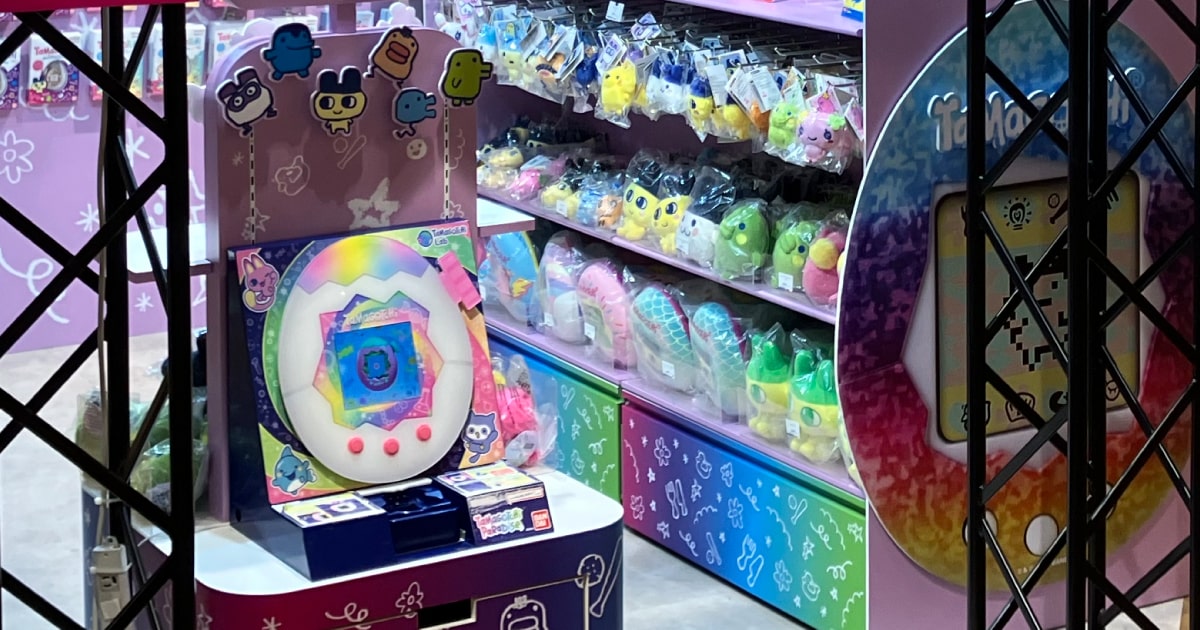
With the launch of Tamagotchi Paradise, entertainment giant Bandai set out to bring a new level of connected play to fans worldwide. The device supports nine languages and is available across Japan, North America, Europe, and Asia. To complement the new release, Bandai developed Lab Tama, a large in-store terminal that lets users link their Tamagotchi to the system for exclusive content and activities.
When players place their Tamagotchi Paradise device into the Lab Tama tray, the system connects instantly – unlocking region-specific downloads, limited-edition items, and unique in-store interactions. These terminals are installed in toy stores, department stores, and electronics retailers across Japan and beyond, acting as both a digital playground and a promotional platform.
In past deployments, updating in-store terminals required physical media and manual updates by staff, a process that proved both time-consuming and costly. For this global rollout, Bandai needed a secure, flexible way to distribute content remotely, update systems automatically, and monitor performance from a central location.
Bandai’s goal was to make Tamagotchi’s “connected play” truly worldwide. However, the company faced a major challenge: ensuring that each Lab Tama terminal could communicate securely and reliably across diverse retail environments.
Because the devices were being deployed in multiple countries, Bandai needed a connectivity solution that worked seamlessly across regions without relying on local Wi-Fi networks or complex configurations. They also needed to synchronize updates by region and campaign, ensuring that marketing content and gameplay experiences aligned perfectly with local events and product launches.
Operational visibility was another priority. Bandai wanted the ability to monitor connection status, view usage data, and analyze performance metrics in real time to plan maintenance, optimize content, and understand player behavior at each store location.
To meet these goals, Bandai integrated Soracom IoT SIMs into the Lab Tama terminal, enabling stable, secure communication regardless of installation location. Using Soracom’s global cellular coverage, the terminals now connect automatically without relying on local infrastructure.
Each terminal communicates regularly with the Soracom platform to check for new content. When updates are available, the device securely downloads promotional videos, software updates, or campaign-specific features directly from Soracom-hosted storage. This automated process ensures that content is always up to date and tailored to each region’s needs.
Soracom’s management console and APIs allow Bandai’s development team to centrally monitor connectivity, data usage, and device operation history. This remote visibility helps engineers diagnose issues quickly and ensures consistent performance across all global deployments.

For Bandai, Soracom offered more than just global connectivity. The combination of reliable network access, device management, and automated data delivery gave the company a flexible platform for future innovation.
By leveraging Soracom’s services instead of developing a new system from scratch, Bandai accelerated development timelines and reduced the complexity of deploying and maintaining hundreds of terminals across regions. The Soracom IoT SIM’s compatibility and scalability made it easy to expand the project globally without changing infrastructure.
The result was a fast, secure, and cost-efficient deployment that gave Bandai new tools for both customer engagement and data-driven business intelligence.
The new Lab Tama experience has transformed in-store engagement for Tamagotchi fans. Shoppers can now interact with their devices, unlock new items, and enjoy dynamic promotional content that refreshes automatically based on region and campaign.
At the same time, Bandai gains valuable real-time insights from aggregated usage data, including how often terminals are used, which content is most popular, and when maintenance may be required. This feedback loop informs everything from product development to marketing strategy, helping the company continuously refine the customer experience.
“By being able to distribute content regularly, Lab Tama has become a product fans can enjoy for a long time,” said Chisato Aoyagi, planning and Development Team, Toy Department, Bandai, Co.LTD. “Soracom makes it easy to deliver new experiences to stores around the world.”

Bandai continues to expand the global deployment of Lab Tama terminals, with support for language-specific content distribution and region-tailored campaigns. Future collaborations will extend beyond the toy industry, including a partnership with NEXCO East Japan, which will bring limited-edition Tamagotchi content to Lab Tama terminals installed in highway service areas starting in summer 2025.
As the Tamagotchi universe grows, Bandai aims to strengthen its brand through cross-industry collaborations and digital experiences that connect fans in new and meaningful ways. With Soracom powering its IoT infrastructure, the company is well positioned to deliver fresh content, collect valuable insights, and continue innovating the world of connected play.
VizioSense was created with a clear mission: to prove that AI and privacy can coexist. The company builds intelligent vision sensors that process video locally on-device, sending only anonymized data to the cloud.
From the start, VizioSense focused on helping customers understand real-world activity – the flow of people, vehicles, and goods – without the surveillance concerns common in camera-based systems. Their product lineup includes:
These self-learning sensors combine computer vision, AI, and embedded autonomy to provide real-time analytics while minimizing bandwidth and maintenance demands.
Deploying vision-based sensors outdoors introduces a host of connectivity challenges. Many installation sites lack access to fixed internet infrastructure, while Wi-Fi is often too unreliable ( and too insecure) for commercial deployments.
VizioSense needed a secure, always-on wireless connection that could transmit small packets of anonymized data in real time, across distributed urban and industrial environments. Each device had to operate autonomously and maintain uptime, even in remote or high-traffic areas.
With projects scaling across Europe and beyond, the company also needed a connectivity solution that could easily manage large device fleets without adding operational overhead.
VizioSense built its privacy-first sensors to process all video data locally, transmitting only anonymized counts or analytics. To keep that data flowing reliably, sensors connect via Soracom 4G cellular connectivity instead of Wi-Fi.
Soracom’s SIMs offer instant compatibility with VizioSense hardware and simplified global deployment, providing secure coverage in more than 160 countries. Through the Soracom API, the VizioSense team integrated connectivity management directly into their own systems, automatically monitoring data usage and alerting teams when thresholds were exceeded.
The Soracom User Console further streamlined operations by displaying live device status and connection history, allowing engineers to diagnose and resolve issues in minutes rather than hours.
VizioSense’s partnership with Soracom was built on shared principles of transparency and efficiency. Soracom’s flexible data plans and straightforward pricing allowed VizioSense to align costs with actual usage – an essential feature when managing thousands of lightweight, low-data IoT devices.
With Soracom handling connectivity across regions, VizioSense could focus on what they do best: refining their edge AI algorithms and expanding their solution portfolio.
VizioSense’s collaboration with Soracom is already powering complex smart-city initiatives.
In Greece, VizioCount sensors have been deployed for a large-scale mobility study at the Port of Piraeus, analyzing pedestrian and vehicle patterns to help city planners improve accessibility and safety.
Elsewhere, the VizioCrowd solution is helping municipalities manage public beaches more efficiently, using real-time crowd density data to optimize lifeguard staffing, enhance public safety, and improve sustainability.
Across these projects, Soracom’s reliable connectivity has enabled faster deployments, simplified device management, and ensured data integrity in distributed environments.

Looking ahead, VizioSense plans to expand its product portfolio with smaller, indoor sensors for retail, offices, and smart buildings, bridging the gap between public and private environments.
On a global scale, the company aims to make ethical, privacy-preserving sensing technology accessible to all regions, proving that intelligent analytics and data protection can go hand in hand.
Senzary is an industrial IoT solution provider helping enterprises unlock actionable data from physical infrastructure quickly, securely, and without disrupting existing systems. Its cloud-native platform, IoTLOGIQ, is designed to streamline operations like predictive maintenance, compliance monitoring, and air quality tracking using wireless gateways and modular integrations that scale across the enterprise.
“We’re not just another point solution,” said Eric Schummer, Senzary CEO. “We’re building what I call the ERP of IoT – an operating system that brings visibility and control across departments.”
By focusing on rapid deployment, seamless integration with legacy protocols, and a horizontal platform architecture, Senzary helps organizations go from pilot to production without vendor lock-in or internal resistance within weeks, rather than months.
Whether they be Fortune 500 manufacturers or complex infrastructure operators like airports, modern enterprises face two main challenges when launching a successful IoT project:
The Internal Challenge: IT Delays. The most common obstacles tend to be internal security processes, as even sensitive needs such as monitoring dust emissions for regulatory compliance or tracking vibrations to prevent equipment failure must pass rigorous scrutiny. Internal security procedures may force teams into long queues for security reviews and firewall approvals. “One of the biggest obstacles is the layers within large companies,” said Schummer. “Projects can lose all sense of urgency while waiting for IT clearance.”
The External Challenge: Coverage Inconsistencies. Of course, the world at large poses its own challenges. Companies with a national footprint will find that no single mobile carrier offers uniform coverage for their entire operational area, to say nothing of those operations that cross international borders. One area may favor Verizon, while another is exclusively covered by AT&T or T-Mobile. Managing multiple carrier relationships – and bills – can lead to all sorts of logistical fragmentation that can undermine the scalability of any cellular-connected deployment.

To address these challenges, Senzary partnered with Soracom, whose global IoT platform delivers multi-carrier connectivity, remote SIM management, and enterprise-grade networking features. Together, Senzary and Soracom enable a uniquely flexible deployment strategy.
Step One: Rapid Pilot, No IT Required
To bypass IT delays, Senzary deploys smart gateways equipped with Soracom SIMs. These devices operate fully outside the customer’s internal network, connecting instantly to the strongest local carrier – without the need for local contracts or tech intervention.
“Our first conversation with a Fortune 500 client isn’t about network diagrams,” said Schummer. “It’s about solving their immediate pain point. We tell them, ‘We can get you visibility on that critical asset next week, without a six-month IT review.’ Once they see it working, scaling the solution becomes a business decision, not an IT debate.”
Step Two: Seamless Failover for Business Continuity
After a pilot proves successful, that same secure cellular connection can be repurposed as a resilient backup link. If the customer’s primary network ever goes down, the gateway automatically fails over to the Soracom connection, ensuring uninterrupted access to mission-critical telemetry.
This entire solution is delivered as an end-to-end managed service, built on a foundation of security. All data passes through Soracom’s Virtual Private Gateway (VPG), securely encrypted and isolated from the public internet and ensuring enterprise-grade protection.
By pairing Soracom’s flexible, secure connectivity with Senzary’s turnkey platform, enterprises can now deploy IIoT solutions on their own terms – starting fast, proving value early, and expanding with confidence. This dual-role model allows customers to both innovate quickly and protect operations long term, all without sacrificing control or complicating procurement.
“When we’ve had issues, the Soracom technical team has been there,” said Schummer. “I don’t think of Soracom as a vendor. I think of you as part of my business.”
Senzary is now scaling deployments across cement plants, airports, municipal systems, and manufacturing facilities – each one starting with a single urgent need and evolving into a smart, connected operation.
“Predictive maintenance may be the first need, but what happens when the rest of the company wants in?” said Schummer. “That’s where our platform really shines.
BinSentry is a smart ag company revolutionizing feed management for animal agriculture. With its proprietary sensor technology, the company enables feed mills and vertical integrators to remotely monitor inventory levels in farm bins and large silos. Its flagship devices, including the explosion-proof Pro Sense HD, use near-infrared time-of-flight sensors and AI-powered image processing to produce accurate 3D volume readings – even in harsh, dusty environments. The result? Real-time, reliable inventory data that keeps animals fed, workers safe, and fleets running efficiently.
“We take about a half million total measurements just to get a single volume inside of a bin,” said Nathan Hoel, Co-Founder and CTO. “And that raw data gets processed using AI to deliver a precise reading back to the mill.”
To deliver accurate inventory data, BinSentry’s devices must transmit large volumes of sensor readings from rural and remote farm sites – locations often underserved by traditional cellular networks. These areas may only have partial or inconsistent coverage, making it difficult to maintain a stable connection for IoT devices – particularly when those devices must operate in potentially challenging weather conditions.
“In rural areas, it doesn’t matter what the coverage map says. You just need access to multiple carriers. If one signal drops, we can’t afford downtime,” said Hoel. “We need as much carrier overlap as possible.
The challenge is compounded by BinSentry’s device ownership model. Unlike consumer IoT, BinSentry owns and manages its devices end-to-end – from manufacturing and field installation to servicing and redeployment. Devices tested on the assembly line might then sit in inventory or with a technician for weeks or months before deployment. Though the devices are not in use at this time, traditional MVNOs will still charge full data rates.
“We’re managing all these connections, and we build devices that may sit idle for months before deployment,” said Hoel. “But with most carriers, we were paying full price whether we used them or not.”
Even after initial deployment, devices might need to be temporarily taken offline for servicing or refurbishment, before being reinstalled elsewhere. BinSentry needed a connectivity solution that could flex with their operational reality by allowing them to turn connectivity on and off remotely.
“With Soracom, it just works. We don’t have to think about where it’s going or what network it’s on. That peace of mind lets us scale confidently.”
BinSentry found the ideal partner in Soracom, whose global IoT platform delivered exactly what the company needed: multi-profile SIMs, automatic failover across carriers, and a billing model designed for the realities of industrial IoT.
Unlike traditional cellular providers that lock customers into always-on billing, Soracom allows devices to be activated, suspended, or deactivated on demand. This flexibility has proven crucial to BinSentry’s business model, which requires devices to be tested during manufacturing, paused during inventory or transit, and then reactivated only once installed in the field.
“We were almost paying double what we were actually using, and from an operational and margin standpoint, that was crazy” said Hoel. “When we went to Soracom, not only were they competitive on price, but we were able to turn off everything we weren’t using without having to program it into our own system.”
Additionally, Soracom’s real-time monitoring tools, cloud integrations, and SIM management portal allow the BinSentry team to manage connectivity across tens of thousands of devices without writing custom infrastructure or handling billing manually.
“It was surprising to contrast a group who just doesn’t seem to understand how IoT runs, even though they claim to be selling to IoT, and Soracom, who seems to have built everything up from the ground to work for an IoT company. It was just a night and day difference for us. The billing, the tools, everything was there for us.”
Soracom even helped the team source rugged industrial-grade SIMs that passed microscopic lab testing for durability in extreme temperature fluctuations – a key requirement for devices mounted on hot, sun-exposed feed bins in the summer or sub-zero silos in northern winters.
“They worked with us to source and test industrial SIMs with proper gold plating,” said Hoel. “That level of support was a game-changer.”

With Soracom, BinSentry has improved device uptime, mediated wasteful data costs, and streamlined global deployment. Their technical team now spends less time troubleshooting connectivity and more time innovating.
“With Soracom, it just works. We don’t have to think about where it’s going or what network it’s on. That peace of mind lets us scale confidently,” said Hoel.
As BinSentry expands its presence beyond North America and develops new sensing applications, it plans to continue building on its success with Soracom as a trusted connectivity partner.
“Soracom is a partner in our business. When there’s a problem, they’re on the call with us solving it. That’s what we need to grow.”
Founded by serial inventor Felix Zhao, Cassia Networks is a creator of connectivity solutions that is on a mission to reimagine what Bluetooth can do. The company that created the world’s first Bluetooth router, Cassia is pushing the boundaries of wireless communication by bringing this ubiquitous consumer protocol into enterprise applications. The company’s products have found their way into everything from factory floor automation to remote patient monitoring, utilizing Bluetooth technology to do away with the need for bulky infrastructure or tethered mobile devices.
“Bluetooth started as a short-range, one-to-one communication protocol for consumer devices,” explains Zhao. “Our vision was to fulfill its original promise: to unite wireless communication not just for consumers, but also for enterprise IoT.”
Bluetooth’s ubiquity makes it attractive for IoT, but traditional implementations have fallen short in more complex environments. Designed for short distances and one-to-one pairing, standard Bluetooth devices struggle to support enterprise needs like persistent connectivity, long-range communication, and large-scale sensor networks.
“In places like hospitals, warehouses, and manufacturing plants, having someone walk around with a phone or tablet to collect data from sensors just doesn’t scale,” says Zhao. “That kind of setup introduces costs, inefficiencies, and risks that enterprises can’t afford.”
Range can be a major constraint. While most consumer Bluetooth operates at 10-30 meters, enterprise applications can cover 10 times that or beyond. Moreover, the traditional pairing model creates unnecessary friction when managing devices at scale.
A Cassia Bluetooth gateway is a smart, long-range router that acts more like a Wi-Fi access point than a consumer Bluetooth device. These gateways communicate with dozens of endpoints simultaneously, in real-time, and without requiring human intervention.
“Just like a Wi-Fi router sits in the background and handles traffic, our Bluetooth routers are designed to live on the wall and quietly manage everything,” says Zhao. “The user doesn’t have to do anything.”
One of Cassia’s key innovations is its ability to dramatically increase range and connection density without modifying end devices. Through advanced antenna design, increased receiver sensitivity, and proprietary firmware, Cassia’s gateways can receive signals from standard Bluetooth sensors located up to 1 kilometer away (in optimal conditions) without increasing their transmission power or reducing battery life.
“It’s not just about range,” Zhao emphasizes. “We also eliminated the one-to-one pairing limitation. One gateway can manage a fleet of sensors, stream data in real time, and even host application logic directly on the gateway itself.”
This flexibility is particularly powerful for edge computing scenarios, where customers can run their own applications on the gateway – reducing latency and infrastructure complexity.

To fully decouple Bluetooth sensors from smartphones, PCs, or other mobile gateways, Cassia needed a reliable and secure way to connect its Bluetooth routers to the cloud. That’s where Soracom came in.
With Soracom, Cassia gateways can communicate over a multicarrier cellular network, avoiding the need to rely on local IT teams, Wi-Fi infrastructure, or on-site connectivity.
“Soracom allows us to deploy anywhere – whether it’s a hospital in a city or a remote agricultural facility,” says Zhao. “Customers don’t have to worry about configuring a network or opening firewall ports. Everything just works.”
Soracom’s secure, encrypted tunnels provide a reliable and scalable pathway from Cassia’s gateways to cloud services, enabling remote device management, firmware updates, and data aggregation at scale.
“It’s more than just connectivity,” adds Zhao. “It’s peace of mind for our customers.”
Cassia Networks is changing the conversation around Bluetooth. By transforming it into a long-range, multi-device, enterprise-ready communication protocol, Cassia has unlocked a new level of flexibility, affordability, and scalability for IoT deployments. Its gateways are replacing fragile mobile-device pairings with robust, cloud-connected infrastructure.
And with Soracom providing the secure, reliable cellular backbone, Cassia can deploy solutions faster, anywhere in the world, with minimal IT overhead.
“Bluetooth is no longer just for headphones,” says Zhao. “It’s the foundation for the next generation of enterprise IoT.”
PatchRx is a medical solutions provider that aims to tackle the serious issue of medication nonadherence across the United States. With nonadherence to a prescribed medication schedule estimated to account for about one-quarter of all hospitalizations in the US – and as many as 125,000 deaths each year – this is a hot-button issue that needs to be addressed.
When designing their solution, the PatchRx team recognized a few notable challenges that any remote care device will need to address for success. Chief among these was designing a solution that fits into perspective users’ everyday routines, as it significantly lowers the barrier of entry for would-be users.
Securing the reliability and integrity of any data generated and/or transmitted from this solution is also paramount, as medical data is among the most sought-after personal data by bad actors.
With these concerns in mind, PatchRx set out to devise a technological solution that was simple enough for anyone to pick up, sophisticated enough to securely route data where it needs to go, and – most importantly – helped patients stay on top of their daily medication usage.

From the start, the team at PatchRx recognized that nonadherence affects people from all walks of life, meaning that any solution to such a widespread challenge would need to be universally accessible to make an impact. That meant finding a technology that not only works with something all medication users possess, but one that can transmit data even from remote or rural locations.
Like many companies, PatchRx briefly attempted to function as an app for smartphones, but technical limitations and limited user engagement prevented their solution from having much of an impact.
“We found that patients really don’t want another app or widget on their phone,” Said Andrew Aertker, CEO and Co-founder of PatchRx. “People typically don’t like to change their usual routine.”
This is when the company began devising a device attached directly to the underside of pill bottle caps, which would both track medication usage and transmit that data to caregivers. Initial prototypes proved bulky, leading developers to evaluate different chipset and power source combinations to make the device as universally accessible as possible.
That also meant exploring different cellular connectivity options, as the majority of the population that would be served by the device lives in rural areas.
“One of the biggest hurdles we had to overcome in developing a truly universal product was the lack of reliable cellular connectivity in many rural areas,” said Aertker. “We wanted to make sure that any patient could take our technology home – regardless of their zip code.”
Several iterations of development cycles have led to the PatchRx Smart Pill Bottle Cap, named the PatchCap, a low-profile peel-and-stick device that adheres to the underside of any pill bottle cap and tracks when patients take their medication. The device is paired with a plug-in gateway that aggregates all of the collected data to generate a comprehensive overview of each patient’s medication history, identify and monitor trends in usage, and share this information with the appropriate caregivers.
The final design is not only small enough to work with virtually any pill bottle, it’s peel-and-stick design is intended to make the solution simple enough for any patient to use.
“Whether you’re 85 years old and you’ve been taking medication for 45 years, or you’re 25 years old and just taking a medication for the next two weeks, we’ve designed it to be less than 15 seconds of setup,” said Aertker.
As for its connectivity solution, PatchRx tested several individual carriers but found their connectivity lacking in terms of coverage area and reliability. That eventually led them to Soracom, where comprehensive nationwide coverage, consistent connectivity, and automatic failover mean devices can easily connect – and stay connected – wherever they are deployed.
“We need the flexibility to engage on various mobile networks at any point in time,” said Aertker. “We need to ensure that not only are we going to be transferring data effectively and securely, we need to be able to flip between networks and exercise bandwidth wherever we need it.”

PatchRx has found success with its smart pill bottle cap by focusing on user engagement. By designing its device to fit naturally into a user’s day, PatchRx has helped address nonadherence issues without burdening users with additional steps and processes.
By partnering with Soracom, PatchRx has also found a connectivity partner that provides strong, secure cellular coverage across its entire area of operation. With an unblemished uptime record that has kept PatchRx’s devices up and running consistently, Soracom has empowered this solution to create lasting changes in medication users’ lives.
“The best carrier in the world or the best [SIM] chip in the world is [one with] a team that you don’t need to talk to because it just works,” said Aertker. “That’s what you want at the end of the day, and that’s what we’ve gotten with Soracom. It’s been phenomenal.”
RxKeeper is a medication fulfillment device designed to help users adhere to prescribed medication schedules without interfering in their daily lives. The device is a medication container that can securely store prescriptions, remind patients to take their medication with an alarm, track medication usage, and alert medical personnel about medication adherence.
The device also boasts a self-contained input feature that allows users to make notes and share comments with their medical practitioners without needing a smartphone app or any additional equipment.
Nagesh Kadaba, the founder and CEO of RxKeeper’s parent company, Status Alert, was inspired to solve a challenge he witnessed first-hand while caring for his family.
“It all started with my 92-year-old mother and 90-year-old mother-in-law who were living with us,” said Kadaba. “Each was taking 10 or more medications per day, and given our own busy lives, we needed something to remind us to make sure they are taking their meds on time, if at all.”
They set out to create a simple and efficient device that could help people track their medication usage but recognized that the real challenge faced by these kinds of solutions is adoption.
“It’s the 90-10 rule,” said Kadaba. “While 10 percent of folks might actually need the sophisticated solution, the other 90 would benefit from a much simpler solution that already fits into their daily routines.”
Early in the design process, Kadaba and his team settled on tracking and monitoring medication usage by taking advantage of something every patient already had: the medication’s container. They envisioned a small box that could not only house prescriptions but also monitor any attempts to access them. Further iterations added a digital interface that could alert users when it was time to take their medicine, but the team wanted more for their device.

At its core, the device required a simple mechanism that could register events and other inputs from the box without taking up much space or processing power. To better suit the function of day-to-day use, the box also needed to be portable, which meant that the device needed to be battery-powered rather than being tethered to a cable or plug.
To share data with primary caregivers and medical professionals remotely, the team briefly considered local reporting tied to a smartphone app, but found that this added complexity and created another step in a process that has proven difficult for some to follow, and a technical barrier for patients who may not be confident using mobile applications or operating a smartphone.
Early designs opted for a WiFi connection, but the team quickly discovered that WiFi is not always available as it might seem, especially for people living in remote or rural areas. WiFi would also tether devices to gateways or specific areas of the house with stronger signal, which limited the efficacy of the solution. As such, cellular connectivity was also considered, though service would need to be widely available enough to help serve those remote customers.
Once cellular connectivity had been identified as the preferred method for data transfer, Kadaba began researching partners before eventually selecting Soracom. Soracom’s multi-carrier support and automatic failover were attractive enough, but what really caught Kadaba’s eye was the Soracom LTE-M button, an easily programmable smart button that offered both the simplicity he required and an endemic LTE-M connection that allowed the device to connect seamlessly to the broad Soracom network.
“I found the functionality I was looking for in the LTE-M Button,” said Kadaba. “The magic of this button is it is simple and it works in almost any situation you can imagine. By tracking patient usage, clinicians, medical providers, and even the patients themselves can all make better decisions.”
RxKeeper also deploys Soracom Funk, a service for dynamically offloading cloud service function calls, to help route the data from all of its deployed devices directly to its backend service on AWS. By offloading the data transmission process to the cloud, the RxKeeper team reduced device-side resource consumption and allowed for more flexibility in integrating their devices into existing medical solutions.
“Having the ability to send data out and not worry about it until it hits the AWS server was a huge thing as a business owner,” said Kadaba. “That helped solve a lot of the issues we face as an out-of-the-box solution.”

The RxKeeper fits effortlessly into a user’s daily life, serving as both a container to organize medications and a means of medication adherence through its clever use of IoT data and simple alerts. Kadaba again credits a great part of its efficacy to the use of the Soracom LTE-M button.
“When you go in the super rural areas, basements, or areas with geographical challenges, it becomes harder to get 4G signals,” said Kadaba. “In those situations, we sent out an LTE button version of the RxKeeper, and it works flawlessly because LTE-M has far more penetration into buildings and structures, which has helped us reach a broader patient group.”
In the future, the RxKeeper team hopes to continue evolving its capabilities to better serve the needs of patients throughout the country and beyond.
ColdChase creates customized IoT solutions designed to fit the needs of an evolving roster of customers. The company operates three unique brands that address the needs of cold chain operations (ColdChase), shipment and asset tracking (AssetChase), and a suite of products focused on improving the passenger experience at airports (PaXChase).
Over the years, the company has helped to resolve countless tracking and monitoring challenges across the supply chain – finding innovative ways to utilize temperature, pressure, and GPS sensors, among other specialized devices, to create unique solutions to individual company issues.
“Every client is different in what they require,” said Rosy Amlani, CPA, the CEO of ColdChase. “So every sensor we sell is customized for every client, which is why our team has to closely interact with the customer to really understand what they need.”

Because ColdChase has a pedigree of designing and manufacturing for other companies, it moved the manufacture of its custom devices in-house, where its engineering staff – representing specialties that range from electrical to simulation to firmware engineering – can craft solutions that perfectly address customer concerns on-site.
At the heart of these solutions is a roster of base devices that can be augmented and tweaked to better suit each application’s needs. These can range from Bluetooth low-energy devices for monitoring applications to cellular sensors ideal for long-distance tracking, with each being augmented to include different sensors and modules as needed. These devices can then be outfitted with GPS, pressure, temperature, light sensors, or other modifications.
“The fact that we have engineers on staff that were part of the company that did a lot of the product development allows us to craft perfectly tailored solutions for our customers,” said Amlani. “That unique understanding of how you put sensors together to create different effects helps make sure that we’re meeting all customer requirements.”
Naturally, when dealing with applications such as airports, cold chain transit, or asset tracking, these devices need to be versatile enough to meet a lot of regulatory, spacing, and power demands. As such, ColdChase sought a connectivity partner that could not only reliably connect their devices wherever they need to deploy but could offer them the versatility to design rugged and reliable devices that can withstand the potentially harsh conditions that abound in asset tracking and cold chain applications.
The ColdChase team evaluated at least a dozen service providers but struggled to find one that could meet the technical needs of their devices—specifically offering CatM1 and NB-IoT connectivity—and provide reliable coverage across the globe. Eventually, the team found Soracom, which not only met all of these needs but could also provide them with low-profile eSIMs for enhanced durability and lower-profile construction.
“We picked Soracom because it hit all those buttons,” said Amlani. “Not only do we get reliable service, we can get it all in eSIM form, which is very important for us. Since we do our own manufacturing, we prefer to put eSIMs on our boards.”
Because eSIMs are soldered directly onto a device’s System on Chip (SoC), their low profile allows manufacturers to design more compact devices. This construction also makes the SIMs more tamper-proof and resistant to vibration—factors important to applications that involve a lot of moving pieces.
In addition, embedding the eSIM into a device simplifies the connectivity process for the end user, removing a lot of the complexities of managing connections for fleets of mobile devices, many of which cross national borders in transit.
“We didn’t want customers trying to figure out what provider to go with depending on what country that we’re going to,” said Amlani. “So this way, the fact that Soracom has coverage in 150 countries or more, we were able to give that to our customers.”
ColdChase also highlights the benefits of Soracom’s User Console in managing deployed devices. The console can be used to monitor the connectivity status of all devices in a deployment.

ColdChase’s solutions have found their way into a number of different applications across the supply chain, providing reliable, actionable data that has helped shape the way business is done. One example shared by Amlani saw ColdChase’s sensors helping to avert a loss of more than $100k worth of meat from spoiling when extreme temperatures caused a commercial freezer to fail.
By partnering with Soracom, ColdChase’s customized solutions have enabled scores of customers to improve the efficiency of their operations and better manage their products. With reliable connectivity and the added security of the embedded eSIM, ColdChase is able to create powerful tools for all stages of the supply chain.
Amlani believes the company’s success comes from its customer-centric view, which provides solutions to issues that aren’t addressed in other technologies. “We focus on providing value to customers that realize how important having a safe, reliable, and functional piece of custom equipment is.”By partnering with a connectivity provider like Soracom, ColdChase can confidently count on reliable connectivity for their end customers.
hnology company offering a suite of compact Internet of Things (IoT) devices that monitor real-time electricity usage for residential, commercial, and industrial buildings.
Their solution is designed to enhance users’ energy efficiency, promote net-zero strategies, and cut operational costs – all integral aspects of the company’s overarching business strategy.
Through a collaboration with Thinxtra, the exclusive provider of Soracom’s connectivity services in Australia, Wattwatchers has introduced a dynamic and scalable energy monitoring system that reinforces sustainability initiatives and drives cost reductions in the face of the country’s ongoing Net Zero initiatives.
When it came time to connect its fleet of smart devices to the internet, Wattwatchers initially relied upon conventional SIM cards to access cellular connectivity over 4G. Yet between issues with international coverage, the challenges associated with wrangling local characters, and an ornate testing process, this method would quickly prove costly and complex.
This challenge is what ultimately led Wattwatchers to Soracom and Thinxtra, a Massive IoT solution that provides the company’s customers with flexible coverage, streamlined operational management, and transparent insights through comprehensive data analytics.

With access to a wide range of cellular networks throughout Australia – including Optus and Telstra, among others, all via a single SIM card – as well as automatic failover to ensure consistent uptime, Soracom’s IoT connectivity has enabled Wattwatchers’ devices to measure energy usage securely and reliably.
Their devices can be easily installed and activated, providing users with the data they need to make better organizational and foundational decisions as it pertains to energy consumption and reducing implementation time and ongoing management.
For Mark Dunn, CEO of Wattwatchers, the strategic long-term benefits of Soracom’s IoT solution cannot be undersold. The connectivity management platform provides Wattwatchers with fingertip control over their deployed devices, enabling rapid global scalability to meet the growing demand for simple yet comprehensive energy consumption monitoring aligned with sustainability strategies.
Given that electricity generation is currently the single largest source of Australia’s greenhouse gas emissions, managing it at the grid edge is crucial for the country’s Net Zero initiatives.
Digitalization and real-time data become pivotal in tracking, analyzing, reporting, and automating control of energy resources, emphasizing the critical role of solutions like Wattwatchers in achieving decarbonization, energy efficiency, electrification, and decentralized renewables optimization.
Soracom’s cellular solutions support Wattwatchers and its customers by ensuring secure and reliable connectivity and data transmission, outperforming alternatives like cable communications or Wi-Fi, particularly in commercial and industrial settings.
The collaboration enables real-time data-driven decision-making that is essential for the complex optimization of an organization’s energy usage, cost allocation, and resource management.

For companies facing mandated sub-metering requirements and external scrutiny, the combination of Wattwatchers’ devices and Soracom’s connectivity can help validate an organization’s sustainability initiatives, supporting progress towards net zero emissions targets.
The advantages of Soracom’s cellular solutions unlock unprecedented insights, making it the ideal choice for navigating the complexities of modern energy management.
DCS is an IoT Solutions provider that offers telematics, asset tracking, and monitoring services for the transportation, hospitality, agricultural, and telecommunications industries, among others. At the heart of their solution is MiFleet, a customizable GPS tracking and fleet management platform designed to help managers keep tabs on their vehicles and personnel in the field.
This data is drawn from a series of wired, solar, or battery-powered cameras, sensors, and other smart devices installed in mission-critical assets, then funneled into a cloud-based software platform that makes monitoring an expansive deployment easy and efficient. This data puts fleet managers at the front and center of their deployment, with the actionable intel, near real-time asset tracking, and video recordings necessary to make informed business decisions in a timely manner.
With an operational area that spans the continental US and beyond, DCS’s platform is designed to make managing mobile fleets accessible and simple. Yet that may not be as easy as it sounds.

It is an unfortunate truth of IoT that no Mobile Network Operator can be everywhere at once. For most businesses deploying solutions that require devices to stay connected across geographical – at times even international – borders, that means using multiple connectivity vendors.
The problem with using multiple vendors is that each one has its own way of doing things. This means users are left to manage multiple contracts with multiple rate plans, variable overage fees, and multiple business relationships. This is to say nothing of the technical difficulties that come with managing separate SIMs for each vendor.
Billing challenges only grow more complex when your business model involves working with resellers, as inconsistencies in billing make it harder to know what to charge resellers and their customers. DCS bundles wireless fees into the price of their monthly service contracts, and with most MVNOs charging different rates depending on which carrier the device connects to – and the nature of mobile vehicle fleets making it nearly impossible to anticipate which carrier a device will connect to at any given moment – creating a fair and consistent billing structure for its clients was a major priority for DCS.
Creating a suitable solution for this issue requires a multifaceted approach. For one, DCS needed a connectivity partner that could ensure consistent nationwide coverage at a consistent price. In Soracom, DCS found a provider that not only offers reliable multicarrier connectivity across North America but can also offer flat rate billing, one rate overage, and custom pricing that provides them with the flexibility to deliver designed rate plans to their vertical customers.
Because Soracom sets a single rate per MB used, regardless of which carrier a device may be connecting to at any given time, the billing experience is consistent and predictable. Combine that with the largest coverage area of any IoT provider, best-in-class customer service, and an architecture supporting an uptime record of 99 percent over the past three years, and you’ve got a recipe for an ideal connectivity solution.
Once fees accrued, DCS needed a way to simplify them for downstream billing for their end customers. Simetric made this simple. With a platform designed to simplify complex data streams into easily digestible forms, their solution enables the creation of a single, easy-to-understand, and consistent bill. The end result is an invoice that covers only the specific devices and data used by a customer in their own individualized pricing.
“Soracom and Simetric have created a singular approach to pricing, allowing DCS to effectively provide their resellers and solution providers with a bundled solution for a single price that is inclusive of platform, connectivity, and hardware,” said John Hubler of the DCS Board of Directors. ”Every device is now enabled with Simetric and Soracom as a single source solution for deployments across North America Soracom has enabled blended technologies within their platform.”

Telematics companies that bake connectivity into their product offerings face considerable challenges efficiently billing customers. No single carrier can ensure that devices stay connected wherever they go, and working with multiple vendors can create an impenetrable web of pricing structures, contracts, and relationships. Combining these two factors can make fair and consistent billing of customers a nightmare.
By deploying Soracom connectivity with Simetric’s data tools, DCS is able to connect its fleet of sensors and cameras securely and reliably bill its customers based on their own usage and pricing. Between multi-carrier coverage, consistent pricing, and excellent customer service, Soracom has proven an ideal connectivity partner; add Simetric coalescing that data into a simple individualized downstream billing system, and the pairing is a natural solution for any organization reliant upon a distributed business model,” said Hubler.