Since 2006, CO2Meter has grown to become one of the most trusted and reliable leaders in the gas detection industry. The company’s founders combined proven technical expertise and trusted sales and management experience in both the gas detection field for mining as well as photonics, and have only grown more “sense” since then.

In 2019, Travis Lenander, a successful business professional with Fortune 500 companies, purchased the business and became CEO. With the leadership change came a new focus on product diversification, sales penetration, brand recognition, and international development. Now, with two decades of extensive industry expertise, it is no surprise that the company continues to grow at a rapid pace.

Despite what its name may suggest, CO2Meter’s technologies track and monitor more than just carbon dioxide, with sensors that cover oxygen, carbon monoxide, ammonia, methane, nitrogen, argon, and other gases. They also offer fixed-gas safety systems, gas data loggers, and accessories that help make that data accessible and actionable.

It is no surprise, then, that CO2Meter serves a vast array of business types and organizations, with its customers including those found in restaurants and food, breweries and wineries, indoor agriculture, scientific and medical, industrial safety, and welding applications – to name a few.

CO2Meter, Hydroponics, gas meters

The Challenge – Integrating a Varied Monitoring Solution into an AWS Backend

With such a versatile solution covering countless industries and applications, CO2Meter required a robust and adaptive backend. That is what led the company to AWS, whose nearly universal accessibility and broad potential allowed the company an easy and secure means of connecting their devices to cloud applications and other devices. 

Yet even though AWS is the most prominent cloud platform on the market, not every device is designed to integrate with the service easily. Managing software and certificates for such a large fleet – particularly with most deployed devices being in the possession of end-users can be complicated – and that complexity only grows with each new customer. 

The complexity does not end at the backend either, as a global operation involving connected devices may also run into some difficulties when it comes to international pricing structures. As such, CO2Meter needed a connectivity provider that not only covered their operational area but helped simplify the integration process and cut through the red tape of international pricing, as well.

“With its ease of use, fantastic support, and competitive price structure, Soracom was an easy choice for us. It has significantly reduced the overhead in our data transmission thanks to the backend tools available, made onboarding of new devices completely seamless, and required no software changes other than updating the endpoint.”

"With its ease of use, fantastic support, and competitive price structure, Soracom was an easy choice for us. It has significantly reduced the overhead in our data transmission thanks to the backend tools available, made onboarding of new devices completely seamless, and required no software changes other than updating the endpoint."
Robert Miller, C02Meter Vice President of Engineering
Robert Miller
Vice President of Engineering
C02Meter

The Solution – A Connectivity Provider That Makes Scaling Easy

This search is what led them to Soracom, a provider of international IoT connectivity that was also built on an AWS infrastructure. Yet what truly sets Soracom apart from other MVNOs is its suite of backend tools that help secure and provision connected devices at a scale that works for a business as big as CO2Meter.

Key to this functionality is Soracom’s Beam and Krypton services – TLS encryption proxy and device provisioning services that provide both secure connectivity and device management with direct integration to AWS IoT Core. CO2Meter further deploys the data management tool Soracom Harvest to help monitor and track usage down to the specific SIM, a factor that has proven essential to the success of development and data management for their prototype devices.

Combine this with Soracom’s competitive pricing and single-rate, pay-as-you-go cost structure, and CO2Meter found a connectivity partner that has helped it scale its operation into what it is today.

“Coming from another IoT partner, the backend tools and integration with our AWS environment from Soracom is simply second to none,” said Robert Miller, CO2Meter’s Vice President of Engineering. “Where others offer SIM and Usage tools as well as routing, Soracom offers an entire platform meant to make the integration of any cellular-based project into AWS as easy as we could possibly imagine. All while still offering great rates and support with our preferred carriers, as well as global support.”

Brewery supplies, gas monitoring

The Importance of Smart Connectivity to a Remote Monitoring Solution

Soracom’s tools and services have helped CO2Meter expand to a global – even interstellar – operation. With Soracom’s data management controls and efficient setup, CO2Meter has seen data usage for its devices dip by around 30%, resulting in significant cost savings. Meanwhile, using the Soracom SIM and device authentication service (Krypton) to automate the device provisioning process, the setup time for each device has been reduced from about 5 minutes to less than one.

These additions have allowed CO2Meter to introduce new devices, expand its operations, and emerge as a global leader in sensor technologies. The company hopes to continue this spirit of innovation, saying that customers should expect more integration of their products and improved IoT features designed to expand the potential uses of their devices.

hnology company offering a suite of compact Internet of Things (IoT) devices that monitor real-time electricity usage for residential, commercial, and industrial buildings.

Their solution is designed to enhance users’ energy efficiency, promote net-zero strategies, and cut operational costs – all integral aspects of the company’s overarching business strategy.

Through a collaboration with Thinxtra, the exclusive provider of Soracom’s connectivity services in Australia, Wattwatchers has introduced a dynamic and scalable energy monitoring system that reinforces sustainability initiatives and drives cost reductions in the face of the country’s ongoing Net Zero initiatives.

The Challenge: Deploying IoT Solutions With Traditional 4G SIM Cards

When it came time to connect its fleet of smart devices to the internet, Wattwatchers initially relied upon conventional SIM cards to access cellular connectivity over 4G. Yet between issues with international coverage, the challenges associated with wrangling local characters, and an ornate testing process, this method would quickly prove costly and complex.

This challenge is what ultimately led Wattwatchers to Soracom and Thinxtra, a Massive IoT solution that provides the company’s customers with flexible coverage, streamlined operational management, and transparent insights through comprehensive data analytics.

Solar panels, Wattwatchers

The Solution: A Simple Way To Measure Energy Consumption

With access to a wide range of cellular networks throughout Australia – including Optus and Telstra, among others, all via a single SIM card – as well as automatic failover to ensure consistent uptime, Soracom’s IoT connectivity has enabled Wattwatchers’ devices to measure energy usage securely and reliably.

Their devices can be easily installed and activated, providing users with the data they need to make better organizational and foundational decisions as it pertains to energy consumption and reducing implementation time and ongoing management.

For Mark Dunn, CEO of Wattwatchers, the strategic long-term benefits of Soracom’s IoT solution cannot be undersold. The connectivity management platform provides Wattwatchers with fingertip control over their deployed devices, enabling rapid global scalability to meet the growing demand for simple yet comprehensive energy consumption monitoring aligned with sustainability strategies.

"Soracom's IoT solution offered the most strategic long-term benefit to our business. Its connectivity management platform gives Wattwatchers fingertip control of our device fleet, and allows us to rapidly scale our operations globally."
Mark-Dunn-CEO-of-Wattwatchers
Mark Dunn
CEO
Wattwatchers

Given that electricity generation is currently the single largest source of Australia’s greenhouse gas emissions, managing it at the grid edge is crucial for the country’s Net Zero initiatives.

Digitalization and real-time data become pivotal in tracking, analyzing, reporting, and automating control of energy resources, emphasizing the critical role of solutions like Wattwatchers in achieving decarbonization, energy efficiency, electrification, and decentralized renewables optimization.

The Benefits of Cellular IoT Coverage From Soracom

Soracom’s cellular solutions support Wattwatchers and its customers by ensuring secure and reliable connectivity and data transmission, outperforming alternatives like cable communications or Wi-Fi, particularly in commercial and industrial settings.

The collaboration enables real-time data-driven decision-making that is essential for the complex optimization of an organization’s energy usage, cost allocation, and resource management.

Wattwatchers, cityscape

For companies facing mandated sub-metering requirements and external scrutiny, the combination of Wattwatchers’ devices and Soracom’s connectivity can help validate an organization’s sustainability initiatives, supporting progress towards net zero emissions targets.

The advantages of Soracom’s cellular solutions unlock unprecedented insights, making it the ideal choice for navigating the complexities of modern energy management.

The Opportunity: Remote Monitoring for High-Risk Facilities

Operating offshore oil and chemical plants requires constant monitoring, but keeping human inspectors on-site poses significant cost, safety, and logistical challenges. Transporting crews, often by helicopter or boat, is expensive and vulnerable to weather delays, while the work itself can be hazardous.

Mitsubishi Heavy Industries (MHI) identified an opportunity to reduce these risks by developing an autonomous inspection solution capable of collecting detailed operational data without requiring continuous human presence.

“We chose Soracom because their wide service area covered all of the countries where we planned to deploy the system, confidential information could be securely communicated through a closed network, and we could rely on extensive support.”
Naoki Mizuno, Mitsubishi
Naoki Mizuno
Equipment Design Section
Mitsubishi Heavy Industries

The Solution: The EX ROVR ASCENT

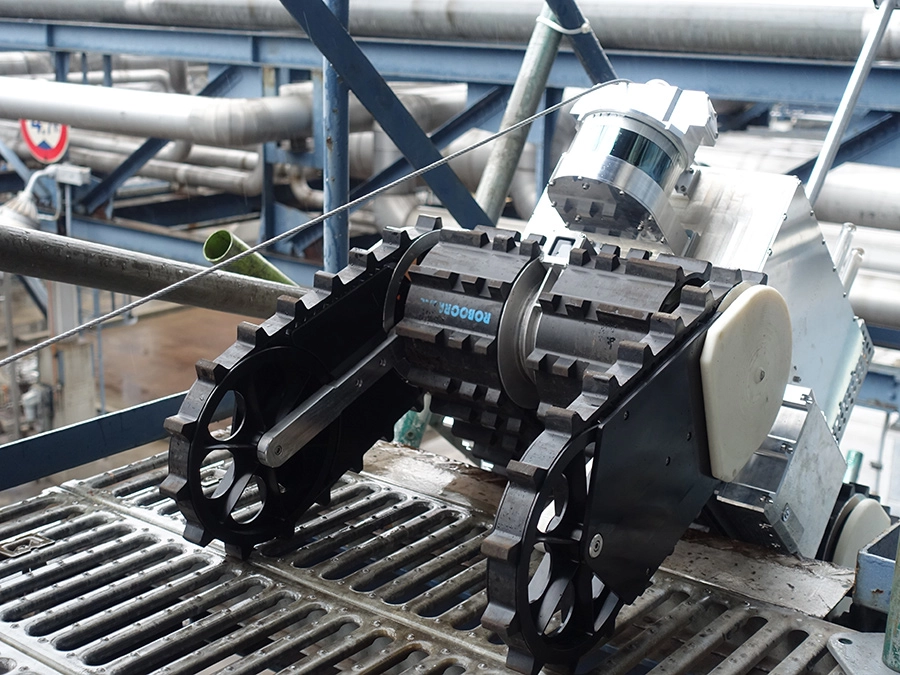
Originally designed in 2014 with Eneos Corporation for nuclear plant inspections, the EX ROVR ASCENT is a fully autonomous, explosion-proof inspection robot now also deployed in oil and chemical plants. Compact at 70 × 45 × 60 cm, it can navigate complex facilities, climb stairs, and operate a pneumatic arm equipped with microphones, multiple cameras, a thermal imaging unit, and a gas concentration sensor.

The robot transmits inspection data, including audio, visual, temperature, and gas readings, to the cloud, where operators can review it in real time. It can operate for two hours per battery charge, with 24/7 coverage possible using paired units.

Future versions are expected to autonomously determine when inspections are needed, further increasing operational efficiency.

Why Soracom: Secure, Integrated IoT Connectivity

The EX ROVR ASCENT required a communications system that could support both remote control and autonomous operation while securely transmitting sensitive industrial data. Rather than build a complex custom infrastructure from scratch, MHI leveraged AWS cloud services combined with Soracom’s IoT platform for end-to-end connectivity and security.

Soracom Air IoT SIMs provide reliable, global cellular coverage. Soracom Gate enables private, bi-directional LAN connections between deployed robots and remote control terminals. Soracom Beam and Soracom Funk handle secure routing and protocol conversion, transmitting telemetry data directly to AWS. The IoT SIMs themselves authenticate and authorize each device.

“We chose Soracom because their wide service area covered all of the countries where we planned to deploy the system, confidential information could be securely communicated through a closed network, and we could rely on extensive support,” said Naoki Mizuno, Equipment Design Section, MHI. “It is very reassuring to have a partner that so thoroughly understands the innermost workings of the EX ROVR ASCENT, and gives us appropriate advice.”

Soracom’s support helped MHI complete the project on schedule while reducing the system’s maintenance burden.

The Outcome: A Safer, Smarter Future for Offshore Operations

With Soracom managing all communication between the robot, remote terminals, and AWS, MHI has streamlined system architecture and positioned the EX ROVR ASCENT for scale.

The success of the project has sparked interest across MHI in applying Soracom-powered IoT solutions to other products. The company is now exploring ways to use deep learning and signal processing on collected data to detect, predict, and eventually respond to anomalies in real time.

“In addition to anomaly detection, we would also like to focus on how we can create more value from the data collected by sensors,” said Mizuno. “The world is shifting toward the cloud, which has the advantage of consolidating data in one place. This will make the use of data more valuable.”

The Opportunity: Building a Digital-First Sales Office

When expanding into Hamamatsu, the largest city in Shizuoka Prefecture and home to 200,000 propane-using households, residential energy pioneer NICIGAS saw a chance to completely rethink its operations.

Unlike city gas customers clustered in dense areas, propane users are spread out, making door-to-door meter reading costly and inefficient. Regional Head Manager Takeshi Suzuki recognized that traditional methods wouldn’t scale in Hamamatsu’s market.

“We wondered if we could change that conventional business model from ground zero, using the power of IoT and apps,” said Suzuki.

The new Hamamatsu Sales Office would be the prototype for a fully digitalized approach to customer management, billing, and service.

“With Space Hotaru, we will be able to make a big change from monthly data-based forecasting to hourly data-based real-time delivery.”
Takeshi Suzuki, Nicigas
Takeshi Suzuki
Regional Head
Nicigas

The Solution: IoT-Powered “Space Hotaru” and Three Major Efficiencies

At the heart of the transformation is Space Hotaru, a smart gas meter and Network Control Unit developed with Soracom that automatically collects usage data and detects abnormalities. By transmitting readings over cellular networks, Space Hotaru eliminates the need for monthly in-person visits, cutting costs and improving productivity.

The Hamamatsu office introduced three key “lessening” measures:

These changes reduced clerical workloads to just one-fourth of previous levels and enabled the Hamamatsu office to launch in only 18 months, far faster than the traditional two to four years.

Why Soracom: Scalable, Reliable Connectivity

The Space Hotaru project is a collaboration between Nicigas, Unabiz, Kyocera Communications, and Soracom. Using Soracom’s Air service for IoT SIM connectivity, Space Hotaru can transmit reliable, secure meter data across thousands of dispersed locations.

“NICIGAS represents a prime example of the benefits that a smart IoT connectivity platform brings to large-scale deployments,” said Ken Tamagawa, Soracom Co-founder and CEO.

Soracom’s architecture supports massive scaling while maintaining cost control – critical for a rollout that spans tens of thousands of homes.

Space Hotaru, Nicigas

The Outcome: Operational Efficiency and Industry Transformation

Going digital has redefined daily operations at Nicigas. Clerks now focus on customer engagement, meter data is collected hourly for more accurate forecasting, and delivery efficiency has improved dramatically, cutting rotation speed by up to 50%.

Customers benefit from transparent usage data in the My NICIGAS app and targeted digital offers, while Nicigas slashes printing and distribution costs.

Following Hamamatsu’s success, Nicigas has begun rolling out the model to other offices, with ambitions to share the system beyond the gas industry.

“The keyword for the future is co-creation, not competition,” said Suzuki. “We hope that Space Hotaru and our cashless and paperless systems will be utilized by companies all over Japan.”

About: Real-time insight for energy producers

Founded in 2014 in Calgary, TOKU Systems set out with an ambitious mission: bring real-time clarity to one of the world’s most complex and capital-intensive industries. With a $2 trillion global market, oil and gas represents both an opportunity and a challenge, one where small improvements in efficiency or reliability can translate into massive economic gains.

At the heart of TOKU’s approach is an advanced pressure-sensing device that can be installed in minutes to capture continuous, second-by-second data. These sensors, combined with an intuitive monitoring platform, give operators unprecedented visibility into the health of their wells, tanks, and pipelines.

By bridging the gap between 19th-century infrastructure and 21st-century demands, TOKU is transforming how energy producers manage critical assets. Their technology helps operators predict issues before they escalate, reduce field costs, and increase production capacity, all while maintaining safety and compliance standards.

Challenge: 20th century infrastructure; 21st century demands

Oil and gas producers remain central to the global energy supply, fulfilling 80% of daily demand through a vast web of pipelines and production sites. Yet much of this infrastructure dates back decades, and in many cases, monitoring technology simply hasn’t kept pace. An estimated 90% of oil wells lack automated monitoring, and the same is true for most of the industry’s millions of miles of pipelines.

This creates both risk and inefficiency. Leaks and failures in remote areas can go undetected for long stretches, while human-led inspections consume time and money without delivering continuous visibility. At the same time, market volatility, demographic shifts, and the rise of renewable energy have squeezed the industry’s labor force, which contracted by nearly 25% between 2014 and 2019.

Traditional SCADA systems offer some relief, but they are notoriously expensive and difficult to scale across such vast networks. The industry needed a monitoring solution that could deliver real-time data, be installed quickly, and provide actionable insight without adding new operational complexity.

Large oil, gas pipelines in oil refinery at daytime. Energy industry infrastructure shown. Production, transportation of oil gas visualized. Photo shows pipelines in factory. Sun sets at background.

Solution: Powerful, affordable asset monitoring

TOKU’s breakthrough was to design a sensor that was not only technically advanced but also easy to deploy. Their patented industrial pressure sensor can be installed and configured in as little as 10 minutes, a fraction of the time required for traditional monitoring systems. Once in place, the device captures second-by-second pressure readings and transmits them securely via cellular networks.

The sensor’s design is self-sustaining, featuring a 360-degree solar panel that ensures continuous operation without manual intervention. This allows operators to install sensors in even the most remote and difficult-to-access locations, confident that they will continue transmitting high-resolution data.

All information flows into Illumass, TOKU’s web-based data platform, which operators can access on any device. Illumass not only displays real-time pressure data but also triggers instant alerts for abnormal conditions like potential leaks. This reduces reliance on costly manual inspections, supports operators tasked with overseeing hundreds of wells, and enhances both safety and efficiency in field operations.

Why Soracom: Global capability and ease of use

As TOKU began expanding internationally, they needed a connectivity solution that could scale with them. In Indonesia, testing revealed a significant problem: local SIMs often took too long to connect or required credentials like usernames and passwords. While that approach works fine for mobile phones, it rendered IIoT devices effectively unusable.

Soracom solved this challenge with multicarrier connectivity, allowing TOKU sensors to connect seamlessly across multiple networks without manual intervention. This not only ensured reliable coverage but also simplified deployment logistics in diverse markets. For an industry spread across remote and rural areas, that capability was essential.

Thanks to Soracom’s reliability and ease of onboarding, TOKU quickly saw the benefits and began planning broader rollouts. With successful deployment in Indonesia, TOKU now expects to expand its Soracom-powered systems into major markets worldwide, including the United States.

TOKU Remote Pressure Monitor

Future Plans: Enhanced capability for enhanced operational insight

TOKU’s vision extends far beyond its current offering. The company is developing a “plug-and-play” version of its pressure sensor that supports additional sensing modules, giving operators even more ways to capture field data. This modular design will allow flexibility for monitoring a wider range of conditions while keeping deployment simple.

On the software side, TOKU is working to integrate third-party analytics tools directly into the Illumass portal. By combining their high-resolution data with advanced analytical models, they aim to deliver even deeper operational insights to producers, from predictive maintenance to optimized production strategies.

With every new development, TOKU remains focused on its original mission: helping the oil and gas industry operate more safely, more efficiently, and more sustainably. By putting real-time data into operators’ hands, TOKU ensures that even the most remote assets are visible, predictable, and better managed.

About: Nationwide Sigfox coverage in Central Europe

Founded as the national Sigfox operator for Austria, Liechtenstein, and Switzerland, HELIOT Group delivers reliable low-power, wide-area (LPWA) connectivity through a distributed network of over 800 base stations. Their infrastructure is designed to support the rapidly growing demand for IoT applications, where small sensors and devices need to communicate efficiently and at scale.

Sigfox connectivity offers a unique balance of extremely low energy consumption, long transmission range, and low cost. Devices can transmit small data packets across distances of up to 10km in cities and up to 50km in rural regions. This makes Sigfox an ideal choice for use cases like asset tracking, smart building monitoring, and environmental sensing, applications that don’t require high bandwidth but benefit from wide-area coverage and years-long device battery life.

Heliot’s mission is to make IoT accessible and sustainable. By providing a strong backbone for Sigfox-based solutions, they help innovators, enterprises, and municipalities bring projects to life, whether it’s monitoring air quality in urban areas, tracking assets across borders, or supporting smart agriculture in rural communities.

“The Soracom pay-as-you-go model fits our business case and operational needs perfectly.”
Anonymous Headshot
Gildas Seimbille
Network Operations and Pre-Sales Engineer
Heliot Group

Challenge: Ensuring reliability across borders

Sigfox already connects more than 10 million devices across 65 countries, proving its value as a global IoT standard. But for a regional operator like HELIOT, ensuring service quality at scale presents unique challenges.

One of the most significant issues is Europe’s fragmented telecom market. Many IoT projects require multi-national coverage, yet establishing individual agreements with separate carriers in each country adds unnecessary complexity and cost. For customers, this can translate into deployment delays, administrative hurdles, and uncertainty around reliability.

Heliot also recognized the risk of relying solely on a single type of connectivity. A network outage, even a short one, could disrupt mission-critical applications, lead to lost data, and in some cases raise safety or compliance concerns. The challenge was clear: design a network with world-class reliability while keeping service affordable and straightforward for customers.

Solution: Multi-operator failover for continuous service

Heliot engineered its Sigfox network to include multiple connectivity options at every base station. By supporting several wireless operators simultaneously, the network creates a built-in failover system that ensures service continuity. If one carrier experiences downtime, traffic can automatically switch to another, maintaining seamless coverage for end users.

This approach not only reduces the risk of service interruptions but also strengthens Heliot’s ability to meet demanding service-level expectations. Customers deploying IoT devices for asset tracking, security monitoring, or industrial control can rely on consistent, resilient connectivity without having to manage multiple operator agreements themselves.

To make this possible, Heliot needed a back-end cellular connectivity solution capable of delivering secure, reliable coverage across all three countries they serve. That solution also needed to integrate cost-effectively into their existing service model, which prioritizes efficiency and scalability.

Why Soracom: A partner for seamless IoT scale

Heliot’s extensive experience working with wireless providers made the advantages of Soracom immediately clear. Soracom’s global, multi-carrier coverage gave HELIOT a simple way to unify connectivity across Austria, Liechtenstein, and Switzerland, reducing administrative overhead while enhancing resilience.

Rapid deployment was another critical factor. Soracom’s console and APIs allow Heliot to provision devices instantly, monitor connections in real time, and manage hundreds of SIMs with full transparency and control. For a growing network already spanning more than 225 base stations, these capabilities are essential to delivering best-in-class service.

Perhaps most importantly, Soracom’s pay-as-you-go model aligns perfectly with HELIOT’s business case. Since cellular is used primarily as a failover resource in their architecture, costs are incurred only when needed, eliminating waste while preserving reliability. Together, these advantages make Soracom a trusted partner in building Europe’s most reliable Sigfox network.

Future Plans: Toward 85% coverage and beyond

Over the next two years, HELIOT Group plans to expand Sigfox availability to cover 85% of the population across Austria, Liechtenstein, and Switzerland. This expansion will extend the benefits of affordable, low-power IoT connectivity to more industries, communities, and citizens across the region.

At the same time, Heliot is looking outward. With global demand for Sigfox IoT solutions continuing to rise, the company is exploring opportunities to extend its model into new markets. By combining Sigfox’s proven low-power capabilities with Soracom’s global cellular integration, HELIOT aims to deliver scalable IoT connectivity solutions across borders.

Ultimately, Helio’s vision is to provide the foundation for a smarter, more connected world – helping innovators bring IoT projects to life with reliability, flexibility, and cost-efficiency at scale.

International volunteer-centered organization

Safecast was founded in the aftermath of the March 11, 2011 earthquake, tsunami, and subsequent Fukushima Daiichi Nuclear Power Plant meltdown. The organization began as a citizen-led effort to collect and openly share radiation data when trustworthy information was scarce. In the years since, it has grown into a global, volunteer-centered initiative dedicated to open environmental science.

What started as a grassroots project has become the world’s largest open dataset of environmental radiation readings, with coverage spanning multiple continents. Safecast has also expanded its focus to include air quality monitoring, giving communities worldwide greater access to environmental information.

By combining citizen science with open data principles, Safecast empowers individuals to contribute to (and benefit from) an unprecedented, freely available environmental dataset.

“The outstanding [Soracom] User Console replaces what used to be various complex services we outsourced separately with a single integrated platform where we can manage devices and SIMs.”
Anonymous Headshot
Pieter Franken
Co-Founder and Japan Director
Safecast

The Connectivity Challenge: A need for real-time, reliable data

The Fukushima disaster highlighted a critical gap in environmental monitoring: the lack of readily available, real-time radiation data. Communities needed accurate, localized information that could be collected and shared continuously, not just intermittently or through official channels.

Building a global sensor network posed significant challenges. Devices needed to be simple enough for volunteers to install themselves, while still capable of transmitting reliable data at all times. Since installations could be anywhere – from city homes to remote rural areas – connectivity had to be robust and accessible even in places without standard internet access.

To succeed, Safecast needed a connectivity solution that balanced ease of deployment, global reach, and centralized manageability, allowing them to focus on data collection and analysis rather than technical overhead.

Solution: A citizen science network powered by IoT sensors

Safecast developed a distributed sensing network using IoT devices equipped with radiation and air quality sensors. These devices transmit environmental readings in real time, 24 hours a day, 365 days a year, to a global database accessible to the public.

The network is built around volunteer participation. Citizen scientists install and operate devices in their own homes, neighborhoods, and communities, contributing to a growing body of environmental data. This model enables rapid expansion without requiring a large centralized infrastructure.

Thanks to IoT technology, Safecast can now deliver consistent, reliable environmental measurements at scale. Data is gathered and consolidated in one platform, supporting analysis and visualization that helps individuals, communities, and researchers alike.

Why Soracom: Simple, scalable, and globally available connectivity

For Safecast, one of the greatest technical hurdles was making devices simple enough for volunteers to deploy, while ensuring they could reliably connect from anywhere. As Safecast Co-Founder and Japan Director Pieter Franken explained, one major challenge to developing this device was maintaining its simplicity while enabling it to get online even in places with no obvious Internet access. We chose to use Soracom Air for its ability to communicate over the mobile grid.”

By using Soracom Air SIM cards, Safecast ensures that devices can connect securely and seamlessly in diverse environments without requiring complex setup. Volunteers can focus on contributing data, while Soracom provides the infrastructure for reliable communication.

As Franken noted, “The outstanding User Console replaces what used to be various complex services we outsourced separately with a single integrated platform where we can manage devices and SIMs.” This integration has streamlined operations, reduced costs, and made it possible for Safecast to scale their network globally.

Safecast devices

Future Plans: Expanding reach and impact through open science

Safecast remains committed to empowering communities with accurate, real-time environmental data. By continuing to grow its network of radiation and air quality sensors, the organization can broaden its coverage and provide even more valuable insights to people around the world.

Future efforts will likely focus on expanding the diversity of data collected and strengthening the tools available to volunteers and researchers. The emphasis on simplicity and openness ensures that anyone, anywhere, can participate in data collection.

With Soracom’s global connectivity and management capabilities, Safecast is well-positioned to keep scaling its operations, helping citizens, governments, and researchers access the environmental information they need to protect communities and the planet.

Smart energy savings for large buildings

Large buildings like airports and shopping centers consume roughly 40% of the world’s energy, often inefficiently. Heating and cooling systems are especially challenging: they are complex to configure, often unaware of actual indoor conditions, and can leave occupants uncomfortable while consuming more energy than necessary.

Enerbrain developed a cloud-driven solution combining IoT hardware, algorithms, and mobile apps to transform building management. The system makes existing HVAC infrastructure smarter, easier to control, and more comfortable for occupants, delivering up to 30% energy savings without requiring expert oversight.

By offering a simple installation process and compatibility with existing building management systems, Enerbrain helps property managers reduce both operating costs and environmental impact.

Together with Soracom Canal, Gate and Beam, we can securely integrate data from our cellular and Sigfox devices into AWS IoT and communicate back to them whenever required for tasks such as troubleshooting and upgrades.”
Anonymous Headshot
Enerbrain Team
Enerbrain

The Connectivity Challenge: Securely managing data growth in different markets

As Enerbrain’s Energy Cloud solution expanded across Europe, it quickly faced new connectivity and data management challenges. Devices in different markets generated growing volumes of environmental data, which had to be transmitted securely from sensors to cloud platforms.

Managing device lifecycles was critical. Each sensor required unique identifiers and consistent integration with customer systems, adding complexity to deployments in multiple countries. At the same time, differing national standards for environmental and building data created the need for a standardized pipeline to combine and analyze disparate data sources smoothly.

Enerbrain needed a solution that would ensure secure connectivity, simplify global device management, and scale easily with its rapid growth.

Solution: Secure IoT data management with Soracom

Enerbrain selected Soracom to connect and manage its IoT devices across multiple countries. Using Soracom Air for cellular connectivity and Soracom Air for Sigfox for low-power devices, the company could unify management of both types of devices under a single platform.

For data integration, Enerbrain relies on Soracom Beam to transmit sensor data directly into AWS IoT. Soracom Canal provides secure VPC peering with AWS, while Soracom Gate ensures private bidirectional communication for device administration and troubleshooting.

Enerbrain also uses Soracom Harvest to collect baseline device metrics, enabling quick visualization and simple API access for diagnostics. This combination of services allows the company to securely manage devices, standardize its data pipeline, and integrate seamlessly with AWS cloud services.

Why Soracom: A single partner for secure, data-driven growth

As a data-driven company, Enerbrain needed a partner that could deliver both connectivity and a suite of cloud-integrated services. Soracom provided exactly that, enabling secure communication, real-time device management, and efficient data visualization.

“Together with Soracom Canal, Gate and Beam, we can securely integrate data from our cellular and Sigfox devices into AWS IoT and communicate back to them whenever required for tasks such as troubleshooting and upgrades,” the team explains.

The pay-as-you-go model made it easy to scale operations efficiently, while Soracom’s platform simplified SIM and device management across multiple countries. With Harvest’s fast visualization capabilities, Enerbrain significantly improved its operational efficiency, reducing time spent on troubleshooting and device oversight.

Future Plans: Improved operational efficiency with cross-data mapping

As Enerbrain continues to expand into new regions, improving operational efficiency remains a top priority. Currently, device states are monitored through Soracom APIs, and the company plans to integrate Harvest APIs for deeper cross-data mapping between products, providers, and business systems.

The next step is closer integration with Soracom Funnel, which will further streamline data processing and simplify code requirements for large-scale deployments. This will allow Enerbrain to scale its data pipeline without adding operational complexity.

Since adopting Soracom, Enerbrain has grown from serving customers in Italy and France to operating across Europe, the Americas, India, the Emirates, and Japan, where it opened a subsidiary in 2018. With Soracom as a long-term partner, Enerbrain is confident in its ability to expand globally while continuing to deliver smarter, more sustainable building solutions.