
eSIM vs. iSIM: The Battle for the Smallest Square Inch

TL;DR
- eSIM solders a reprogrammable SIM chip to the board; iSIM embeds SIM functionality directly into the main processor. Both use eUICC for remote provisioning.
- eSIM suits industrial, ruggedized, and flexible hardware designs; iSIM is built for ultra-compact, high-volume, power-sensitive applications.
- Soracom supports both, so your SIM architecture choice doesn’t constrain your connectivity strategy.
The Paradox of Shrinking Devices
There’s a quiet tension running through modern IoT hardware design. The devices being deployed at scale – asset trackers, environmental sensors, medical wearables, industrial monitors – are getting physically smaller with every generation. At the same time, what we expect those devices to do is growing: always-on connectivity, multi-operator roaming, over-the-air updates, real-time telemetry, etc.
Because of this, the standard SIM card can create a bit of a bottleneck for designers – not because of it’s functionality, but because of how much space it demands. A component that exists purely to authenticate a device to a network creates challenges by consuming a dedicated slot, a tray mechanism, and a meaningful chunk of printed circuit board (PCB) real estate. This can create quite the hurdle when trying to design a device the size of a postage stamp.
Two distinct technologies have emerged from that pressure. The eSIM replaced the physical card with a chip soldered directly to the board. The iSIM, meanwhile, went further by embedding SIM functionality into the device’s main processor. Each represents a different answer to a different set of design constraints, and understanding which fits your project is the point of this guide.

The SIM’s Long Journey Toward Invisibility
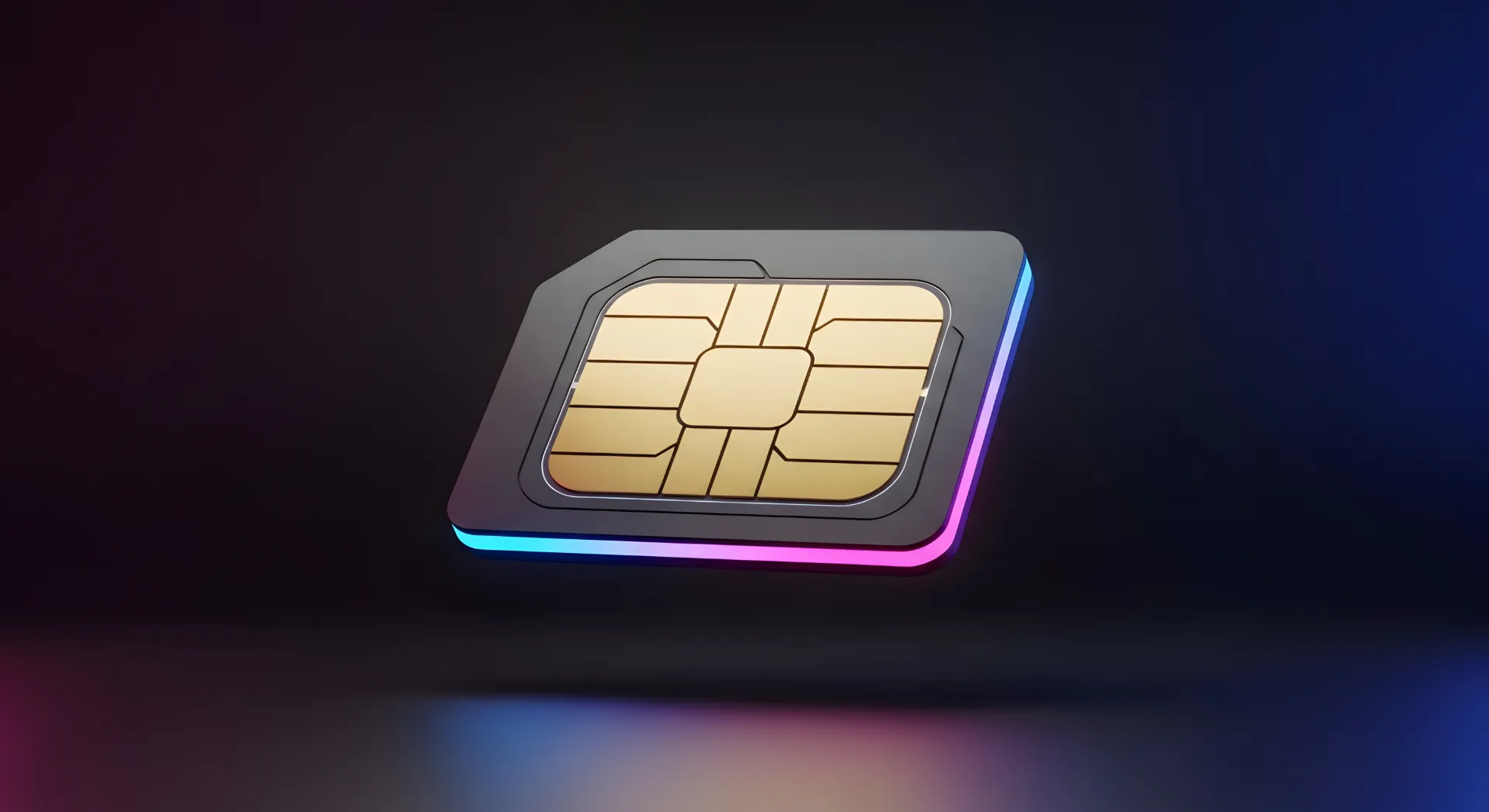
The original SIM card, introduced in the early 1990s, was the size of a credit card. Over the following decades, the form factor shrank through a predictable series of generations: mini-SIM, micro-SIM, nano-SIM, each iteration cutting away plastic while keeping the same chip at the center.
By the time nano-SIM became standard, the physical card was almost vestigial. The chip doing the actual work was tiny; the plastic around it existed largely to make it handleable. The logical next step was to eliminate the card entirely and solder the chip directly to the board. That’s the eSIM.
Soldering a chip to a board still leaves a discrete component with its own silicon, power rails, and PCB footprint. The iSIM addresses that differently: SIM functionality is integrated directly into the device’s main System-on-Chip (SoC). The SIM stops being a component and becomes a feature of the processor itself.
Both technologies rely on the GSMA eUICC (embedded Universal Integrated Circuit Card) standard, which enables remote provisioning: the ability to download, activate, and switch operator profiles over the air rather than swapping physical cards. The hardware architectures differ; the provisioning model is shared.
eSIM: Mature, Flexible, and Battle-Tested
An eSIM is a small chip, typically a few square millimeters, soldered directly to the device’s PCB during manufacturing. It operates independently from the main processor and communicates with the rest of the system via a standard interface.
That physical separation is an asset in many contexts. Because the eSIM is a discrete, standalone component, it can be independently certified and sourced. Industrial-grade eSIMs are available with operating temperature ratings from -40°C to +105°C, vibration and shock tolerance suitable for heavy machinery, and humidity resistance for outdoor deployments. These certifications represent years of qualification testing that the broader eSIM ecosystem has already completed.
The eSIM ecosystem is also the more mature one. Carrier support is broad, tooling for remote SIM provisioning (RSP) is well-established, and the supply chain is deep. For teams building hardware today and targeting a ship date in the next 12 to 18 months, eSIM is the lower-risk path.
Where eSIM genuinely shines:
- Industrial and ruggedized IoT — asset trackers, fleet telematics, utility meters, predictive maintenance sensors operating in harsh environments
- Prototyping and early-stage hardware development — where design flexibility matters more than ultimate miniaturization
- Multi-SoC designs — where the processor doesn’t natively support iSIM integration
- Retrofit scenarios — adding cellular connectivity to a hardware design not originally built around it
iSIM: Built for the Edge of What’s Physically Possible
iSIM takes a fundamentally different approach: rather than placing a dedicated SIM chip on the board, SIM functionality is integrated directly into the main application processor or modem SoC. There is no separate SIM component.
The hardware benefits are substantial. Eliminating a discrete SIM chip removes its standby power draw, which matters in tight battery budgets. It also frees PCB space that, in an ultra-compact device, can mean the difference between a viable design and one that simply doesn’t fit. Sourcing, testing, and reflowing one fewer component also reduces BOM complexity and unit cost at high volumes.
On security, iSIM integration into the SoC removes a physical attack surface. There is no SIM chip to extract and probe independently. Credentials live inside the processor’s trusted execution environment.
iSIM adoption is accelerating. Several major SoC vendors, including Qualcomm, Nordic Semiconductor, and MediaTek, now offer platforms with integrated SIM capability, and the GSMA has published iSIM specifications providing a standardized interoperability framework. The ecosystem is younger than eSIM’s, but it’s maturing quickly.
Where iSIM makes the strongest case:
- Ultra-compact devices — smart patches, implantable monitors, micro-asset trackers, hearing aids, and any form factor where every cubic millimeter is contested
- High-volume consumer electronics — where BOM cost reduction compounds significantly at scale
- Battery-powered devices with aggressive power budgets — where eliminating a discrete chip’s standby draw extends runtime measurably
- Ground-up designs on iSIM-capable SoCs — where SIM integration is planned from the start rather than retrofitted

Choosing Between Them: A Practical Framework
Neither eSIM nor iSIM is universally superior. The decision follows from the constraints your hardware design is operating under.
| Dimension | eSIM | iSIM |
|---|---|---|
| Form factor | Very small, discrete component | Smallest possible (integrated into SoC) |
| Ecosystem maturity | Broad, well-established | Growing rapidly |
| SoC dependency | Works with any SoC | Requires iSIM-capable SoC |
| Industrial certifications | Widely available | Emerging |
| Power consumption | Excellent | Marginally lower |
| BOM cost at scale | Low | Lower at high volume |
| Design complexity | Lower (drop-in component) | Higher (SoC-level integration) |
| Tamper resistance | Strong (isolated chip) | Strong (integrated into processor) |
If your primary constraints are ruggedness, ecosystem breadth, and design flexibility, eSIM is the call. If your primary constraints are physical size, battery life, and per-unit cost at scale, iSIM is the stronger fit. Many product roadmaps start with eSIM during prototyping and migrate to iSIM as the design matures and volumes justify the SoC investment.
The Layer Above the Hardware: Why Connectivity Management Matters
The hardware decision – eSIM or iSIM – determines how cellular credentials are stored on your device. It doesn’t determine how you manage connectivity across a fleet of thousands or hundreds of thousands of devices once they’re deployed.
That’s where the connectivity management platform becomes just as important as the SIM form factor. Whether a device carries an eSIM or an iSIM, it still needs to roam across carrier networks, route data securely to cloud infrastructure, and remain manageable as the fleet scales. Those requirements don’t change with the SIM architecture.
Soracom supports both eSIM and iSIM deployments, so the hardware decision doesn’t lock you into a connectivity strategy. Devices using either form factor connect through the same platform, with access to the same set of services:
- Soracom Air provides global multi-operator connectivity with a single SIM profile, eliminating the need to negotiate carrier agreements market by market
- Soracom Beam and Funnel handle data routing and protocol translation at the edge, reducing the processing burden on the device itself
- Soracom Harvest provides time-series data storage with no additional infrastructure to manage
- The Soracom console and API deliver centralized visibility and control across the entire fleet — activations, data usage, diagnostics — regardless of which SIM architecture is in the device
Your team can evaluate eSIM vs. iSIM purely on hardware merit, without worrying that the choice will create downstream friction in how you operate the fleet.
What’s Next: Connectivity as a Primitive
The trajectory here is consistent. The SIM started as a removable card. It became an embedded chip. It’s becoming a function of the SoC. The next point on that curve, already emerging in some implementations, is the SIM as pure software: a trusted execution environment running on the processor with no dedicated hardware at all.
Whether that soft-SIM model becomes mainstream or remains a niche approach, the underlying shift is the same: cellular connectivity is becoming a primitive, something built into hardware the way Wi-Fi or Bluetooth are today, rather than something you add as a separate component. eSIM and iSIM are each part of that shift, serving different segments, form factors, and cost structures. Both will coexist in the market for a long time.
For teams building connected products, staying current with both technologies and choosing a connectivity management layer that works across them is increasingly part of the job description.

Conclusion
eSIM and iSIM are distinct technologies built for different design environments. What they share is a common outcome: getting cellular connectivity out of the accessory slot and into the silicon, managed remotely, at scale.
eSIM is the pragmatic choice for most deployments today: mature ecosystem, broad carrier support, industrial-grade certifications, and lower integration complexity. iSIM is the right call when you’re designing at the edge of what’s physically possible and need every advantage in size, power, and cost.
Either way, what runs on top matters just as much as what’s embedded in the device. Soracom is built to work with both, so you can make the hardware decision on its merits and trust the connectivity infrastructure to handle the rest.
Interested in deploying eSIM or iSIM devices at scale? Explore Soracom’s IoT connectivity platform or talk to our team about your project.


MORE LIKE THIS



What is Soracom?
Discover why technology innovators choose Soracom for connecting their
devices to the cloud over cellular.
Soracom's Picks
Advices and interviews, to inform and inspire.

SMS in IoT: What is Changing, and What We are Doing About It
TL:DR Working in Telco, you hear the same story every…
The API-First Connectivity Model: Why Managing Your SIM Cards Should Feel as Easy as Managing Your AWS Instances
TL;DR Ask a technology leader how long it takes to…

Your Fleet Data Inside Your Team’s AI Tools: the Soracom Query Connector for Claude and ChatGPT
TL:DR I have spoken before about how Soracom Query can…


Cloud Native
IoT Connectivity Platform
Soracom built the worlds first cloud-native connectivity management platform, built on AWS. Learn more about going beyond connectivity.